


By Bennett Carpenter
As the Trump regime accelerates its autocratic project, how should pro-democracy forces update our strategy to confront its speed, scale, and volatility?
This past week has driven home the dread of living inside an accelerating patronal autocracy. As we all refreshed our phones to see whether the president would follow through on his threats to annihilate an entire civilization, millions of Americans were left with the sickening sense there was little we could do to stop it. With Congress literally checked out, the courts sidelined, and no visible brakes between one deranged man’s impulses and world-historic catastrophe, it was hard to shake the sense that we were trapped on a runaway train without an emergency stop.
But that same week, Hungary taught us all a lesson in how to brake authoritarian acceleration. After 16 years in power, Viktor Orbán was swept out in a landslide, as record turnout overcame a rigged political system and won a new government the two-thirds majority needed to begin unrigging it. That process will not be easy, given how deeply Orbán’s Fidesz party has entrenched autocracy into Hungarian political and civil society: rewriting the country’s constitution to entrench its dominance, stacking the courts and key oversight bodies with party loyalists in semi-permanent positions, rigging election maps and rules, bringing both public and private media under regime control, and steering state resources and public contracts into a patronage network built to survive electoral defeat.
“We have only to win once, but then properly.” That was the strategic lesson Orbán offered, not only for Trump and Project 2025, but for aspiring autocrats worldwide. But that is exactly why these election results are so inspiring. Hungary has long served as a proof of concept for the global authoritarian right. If democratic reversal is possible there, after far deeper autocratic consolidation, it should give us hope here too.
This is the second half of my update to last year’s three-part series on assessing, resisting, and reversing autocracy. In “Autocracy Update, Part I,” I revisited the core framework and reconsidered how far the United States had actually moved toward autocratic consolidation. I argued that Trump continues to operate on the standard patronal autocratic playbook, but now moving at warp speed and on a worldwide scale.
This installment turns to what that changed tempo and terrain mean for our strategy to reverse autocracy and restore democracy. I begin by revisiting the core strategic orientation I originally laid out, examining how well it has held up both theoretically and in practice. I then explore some risks and opportunities opened up by the changed terrain.
In closing, I argue that the regime’s increasing volatility means we must accelerate our strategic counter-offensive, treating 2026 as a critical year in which our entire hybrid strategy has to be run at full scale. The diffuse tasks of the midterm elections require us to find novel ways of aligning our efforts in the absence of a single unifying candidate—a role I argue can be played by the development of a shared governing program. The regime’s escalating attacks abroad, finally, mean we must more deeply engage the international arena as central to the fight for democracy at home.
Reassessing the Strategic Framework
The last part of my original series attempted to translate my diagnosis of autocratic inroads and democratic bulwarks into an overarching three-year framework to reverse autocracy and reconstruct democracy. (Elements of this were later incorporated, amended and expanded in Liberation Road’s collective 2025-2028 Strategic Orientation.)
What I argued
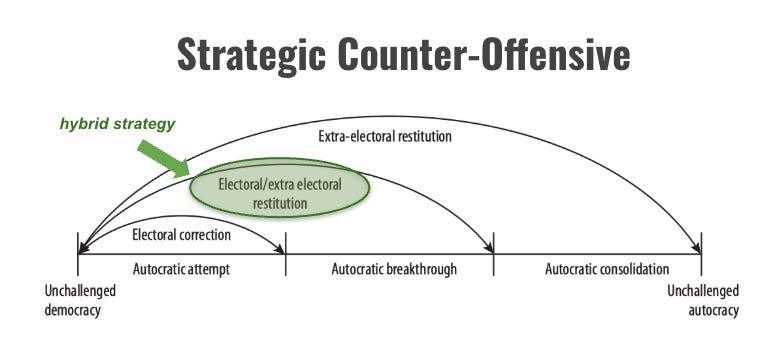
I argued that reversing autocracy would require a combination of mass electoral mobilization and sustained nonviolent social action that gradually moved from strategic defense toward a coordinated counter-offensive.
In the defensive phase, the priority was to protect people’s rights while holding together a broad front against divide-and-conquer attacks—especially in defense of immigrants, trans people, and others of the regime’s first targets. This meant linking political defense of institutional checks and democratic firewalls to forms of social self-defense rooted in communities and civil society. Mass protest was necessary but insufficient; it would need to be channeled into place-based organizing targeting key institutions—the “pillars of support” whose compliance or refusal ultimately determines whether an authoritarian regime can enforce its rule.
A successful counter-offensive, I argued, required a dual social and electoral strategy. On the social front, this meant rebuilding fighting democratic mass organizations, rooted in the multiracial and multigender working class, that could form an independent bastion of social power. On the political front, it meant breaking the Republican House majority in 2026, expanding Democratic state trifectas and weakening Republican ones, and primarying centrist Democrats to shift the needle within our own front to the left.
These efforts could then build toward a sustained push to win unified control of the federal government, and a more favorable state-level balance of power, by 2028. Under intensified autocratic pressure, electoral outcomes would have to be defended by mass nonviolent mobilization before, during, and after elections—underscoring the link between the strategy’s social and electoral components. If successful, our movements would then need to immediately push for a Third Reconstruction: a transformative governing agenda to expand democracy, rebuild the social welfare state, strengthen worker power, and advance racial, gender, ecological, and economic justice.
Reassessing the strategy: what has held
In the face of the regime’s accelerationism, the core elements of the strategy continue to hold. This is by design. Drawing on comparative research into successful democratic transition in countries facing very different levels of autocratic consolidation, the orientation I outlined was explicitly intended to remain valid across a wide range of scenarios—from a still mostly intact democracy to conditions of much deeper authoritarianism than we yet face.
If anything, Trump’s accelerationist approach has only increased the importance of the strategy’s defensive components. As the regime has hardened around an explicit white-nationalist core, defense of immigrants and other first targets matters even more. And as pressure intensifies on the autonomy of the branches, levels, and levers of government, as well as the institutions of civil society, the importance of defending those institutions increases as well.
Almost every time Trump has launched some new escalation, people have asked me whether this means we need to reconsider the strategy’s counter-offensive and electoral components. Under intensifying autocracy, do elections even matter anymore? In a word, yes. Across very different levels of autocratic consolidation, the most consistent predicator of democratic transition is concerted electoral and extra-electoral mobilization before, during, and after elections.
In fact, under intensifying authoritarian conditions, elections matter more, not less—precisely because electoral organizing must then be fused with broad extra-electoral mobilization in order to successfully topple a regime. What changes is the relative importance between the two prongs of this hybrid strategy. The deeper the degree of autocratic consolidation, the more important mass protest, noncooperation, and nonviolent civil disobedience become to ensure a democratic transition. Likewise, the deeper the damage to political and civic institutions, the more there is to rebuild afterward, increasing the importance of the strategy’s “reconstruction” component.
So if Trump has accelerated his attacks on democracy, the implication is not to abandon the strategy but to lean further into the parts that grow more decisive under more deeply autocratic conditions: social and political defense; extra-electoral mobilization before, during and after elections; and serious preparation for the reconstruction agenda that must follow any successful democratic transition.
Assessing our movements: how well have we run the play?
But if the overall strategy holds, how well have pro-democracy forces done at carrying it out?
One year in, it’s still too early to fully evaluate our movements’ existing defensive efforts and our emerging counter-offensive. Still, early indicators provide enough data points to identify both strengths and weaknesses. At their best, our movements have translated mass mobilization into durable organization, institutional noncooperation, and social self-defense, while beginning to convert electoral openings into tangible gains. At our weakest, an over-emphasis on mass mobilization has confused scale with strategy, while too much of our electoral work still treats 2026 like a conventional midterm—or worse, a rehash of the 2024 elections.
Strategic defense: strengths and weaknesses
Where our strategic defense has been most impactful, it has connected mass mobilization to durable organization rooted in workplaces, neighborhoods, schools, and civil society. Minnesota offers one strong example. There, mass outrage was translated into organized pressure against key pillars of support that made ICE operations possible—from hotels housing agents to rental-car companies—while coordinated work, school, and shopping stoppages disrupted business as usual. These efforts helped reinforce noncooperation by city and state officials, which in turn strengthened social resistance. In these and other successful examples of strategic defense, mass mobilization functioned as one tactic within a broader strategy.
Where our defense has been less impactful, it has over-focused on mass mobilization as a tactic divorced from any broader strategic calculus. This seems based on a misapplication of the so-called “3.5% rule” formulated by Erica Chenoweth, whose research found that no autocratic government has withstood a challenge from a nonviolent movement that successfully mobilized at least that percentage of its population. Others have challenged Chenoweth’s empirical findings, or questioned their applicability to the US, and she herself has qualified them. But the deeper problem has less to do with the research itself than with a category error in its application. Drawn to that seemingly straightforward numerical goal, our movements have often pushed for bigger numbers (of protests, days of action, and participants) without asking what such mass mobilization is actually intended to accomplish.
For researchers like Chenoweth, protest size can serve as a useful indicator of whether a movement is gaining strength. But when organizers begin pursuing the metric as an end in itself, they risk confusing a measure of strength for the underlying work that generates it. In and of themselves, numbers in the streets are not a strategy. They are at best a tactical expression, and one possible indicator, of whether a movement is successfully widening legitimacy, accelerating defections, and building disruptive capacity.
Counter-offensive: early indicators
The electoral side of our strategic counter-offensive has not yet faced its most decisive tests. But early indications from the 2025 elections show real promise. In Virginia, Democrats expanded their House majority and flipped the governorship, then used their restored trifecta to raise the minimum wage, mandate paid sick leave, and and restrict cooperation with ICE, while advancing amendments to enshrine reproductive, LGBTQ and voting rights in their state constitution. In New York, Zohran Mamdani’s victory points to a parallel dynamic inside our own front: governing power already translated into real wins like universal pre-K childcare, major infrastructure upgrades, plans for 12,000 new units of affordable housing, and the creation of the city’s Office of LGBTQIA+ Affairs.
At the same time, these early examples also show the limits of our movements’ social power and our reconstruction strategy. In Virginia, Governor Spanberger has watered down new public-sector bargaining laws and refused to repeal the deeper anti-labor architecture of right-to-work. Her prevaricating attempts to be both “pro-worker and pro-business” point to an insufficient grasp of the relation between economic inequality and electoral autocracy—and more importantly, to the under-development of an independent base of social power capable of pushing past these limits. As a committed socialist, Mamdani does not share Spanberger’s subjective limitations; but objectively he may be unable to push past elite resistance in the absence of counter-power rooted in durable social formations: neighborhood assemblies, tenant organizations, unions, and other vehicles capable of carrying organized pressure beyond the election itself.
Meanwhile, many of our own forces have drawn the wrong lesson from these early election wins. Establishment Democrats interpret Spanberger’s victory as confirmation that 2026 should be focused on an “affordability agenda” narrowly focused on rising costs, while treating immigrant rights, racial justice, bodily autonomy, war, democracy and the environment as secondary concerns at best, or electoral liabilities at worst. More alarmingly, too many on the left have misread Mamdani’s victory in the same way, pointing to his focus on “buses, rent and childcare” on the doors—and ignoring how Mamdani’s bold stance on Palestine, trans rights and other issues beyond “affordability” energized the over 100,000 volunteers who powered that very doorknocking operation.
As I have written elsewhere, the point is not that we don’t need a popular economic agenda, but that we should not mistake people’s immediate economic grievances (or, worse, their responses to reductive polling questions) for the full terrain of political struggle and the need for a broader class politics. This economistic error risks reflecting voters’ immediate economic anxieties back to them, rather than offering a governing vision capable of naming antagonists, clarifying stakes, and projecting a path through the interrelated crises that we face. More dangerously, it produces a quiet drift away from racial, gender, immigrant, and ecological justice, recoding these as “non-winning” issues rather than constitutive components of the actual political struggle we are in.
Looking ahead: the 2026 strategic terrain
The terrain heading deeper into 2026 is at once more dangerous and more favorable than many of us would have predicted even a few months ago. The very crises eroding the regime’s support are both expanding the electoral battlefield and raising the stakes of how it may respond.
Strategic Opportunities
Even under conventional midterm dynamics, baseline models always favored Democratic chances to retake the House. But deteriorating support for the regime has begun to push conditions closer to wave territory. Recent polling suggests an electoral environment running seven points or more in Democrats’ favor, which if it holds would put us close to the +8 midterm swings of 2006 and 2018—the largest midterm “waves” of recent decades. In addition to delivering Democrats a sizable House majority, that would give them a credible path to retake the Senate, until recently widely seen as out of reach. At the state level, it would likely net Democratic trifectas in Wisconsin and Michigan, and perhaps Pennsylvania. In the terms of conventional horse race politics, this would already be considered a “very good night” for Democrats.
However, the regime’s overreach—its fusion of executive lawlessness, white-nationalist escalation, economic volatility, and reckless war-making—requires us to consider the possibility of something even larger than a conventional “wave” election. If these compounding crises continue to deepen, we might be looking at something closer to Reagan’s landslide win in 1980, when he defeated Carter by a 9.7 point margin. At the outer limit of the possible, we should explore something even more dramatic, like Roosevelt’s 1932 election, when a +17.8 margin opened the road to wholesale political realignment.
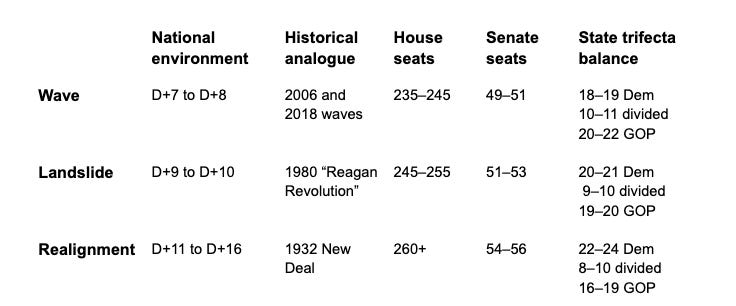
What pushed those elections into realignment territory was the fusion of long-brewing legitimacy erosion with compounding crises that tipped the system into a full governing breakdown. The long recession following the 1929 stock market crash had already generated simmering discontent. But in 1931–32, a perfect storm of factors transformed the prolonged downtown into a full-scale economic breakdown, triggering a massive political realignment. By 1980, years of stagflation had similarly eroded confidence in the post-war order’s ability to deliver stability and rising living standards. But the oil shock of 1979 and the subsequent Iranian hostage crisis supercharged that simmering malaise into a more acute governing crisis, helping drive Reagan’s landslide victory.
I do not mean to suggest exact analogies; the point is that this period requires us to look beyond conventional midterm models toward other crisis moments of comparable magnitude. Mounting public revulsion over the Epstein files, ICE’s body-snatching dragnet, and the broader sense of executive lawlessness, corruption, and drift have already created a slow-burning legitimacy crisis for the regime. It is not hard to envision developments that could push that underlying erosion into a more acute governing breakdown. The war with Iran is one such possibility, with uncanny parallels to 1980. If it triggers a deep recession, oil shocks, or a wider conflict placing many more American lives at risk, the electoral map could shift well beyond the familiar contours of a “normal” wave election.
But here a key difference also comes into view. Both the 1932 and 1980 elections translated legitimacy crises into durable realignment because the victorious coalition arrived with a governing project equal to the breakdown of the old order. Roosevelt entered office with the broad outlines of what would become the New Deal, while Reagan’s victory consolidated a neoliberal counter-project that had been decades in the making. Our side today has no equivalent level of coherence. We possess fragments of a governing horizon, but not yet anything like the strategic and programmatic clarity required to reorganize political common sense at a comparable scale. That gap points directly to the underdevelopment of, and urgent need for, a Third Reconstruction program.
Strategic Risks
Yet the same dynamics that open opportunities also make the Trump regime more dangerous. The more conditions deteriorate for the regime, the stronger its incentives to counter-escalate. If economic and political crises deepen, we should anticipate increased temptations toward executive overreach, the invocation of emergency powers, and intensified state violence at home and abroad. And as the November elections near, the regime will move to block, narrow, or override electoral outcomes in proportion to the scale of its likely defeat.
Any such effort is unlikely to take the form of a single decisive action. It will come as a thousand smaller cuts. While much anxiety has focused on the “SAVE Act,” this and many other headline measures will not survive the legislative or judicial process. The greater risk comes from a barrage of overlapping, less visible, legally dubious actions. These could include:
Before the election: state-level voter-roll purges, restrictive ID laws and other structural voter suppression measures in MAGA-controlled or capitulating states, carried out bureaucratically and quietly.
During the election: the chilling effects on voter turnout of threatened, rumored or actual ICE presence.
After the election: delayed counts, selective non-certification, attempted seizure of ballots, and/or bad-faith legal challenges or investigations used to stall, fragment, or delegitimize outcomes.
Such maneuvers are unlikely to appear everywhere in the same form. More likely, they will be scattered unevenly across key states and localities. But that very patchwork quality makes them harder to predict, while allowing the impact of isolated disruptions to be amplified. The regime’s bet here is cumulative: no single tactic needs to “work” on its own if the overall effect manages to suppress turnout at the margins, sow mistrust and confusion, and justify election denialism. We thus need to prepare, less for one dramatic coup attempt, than for a patchwork terrain of cumulative disruption.
Updating the strategy: reorienting for 2026
What are the implications of this analysis for our movement strategy?
While the overall orientation continues to hold, we must grapple with new challenges and opportunities. In closing, I want to tease out several possible strategic shifts—not as a final word, but a starting point for further discussion.
Run the full strategy now: 2026 is a make-or-break year
The speed-run of the autocratic playbook means we no longer have the luxury of treating the midterm elections as a conventional “set-up” cycle for 2028. 2026 is not a drill or a dress rehearsal, but a critical window in which the entire strategic counter-offensive has to be run at full tilt.
Given the possibility of larger-than-expected electoral openings, we should be expanding the battlefield now: supporting candidates in races that might only become viable under extraordinary conditions and investing in infrastructure beyond the usual tier-one targets. We also need to speak to voters at the level of the actual stakes. Pocketbook concerns are real, but this election cannot be reduced to the price of gas or the cost of healthcare. We need to connect those concerns to the larger crisis now facing the country—showing how rising costs are bound up with executive lawlessness, white-nationalist escalation, and reckless war.
At the same time, we need to plan for the near-inevitability that the Trump regime will attempt to narrow, block, or override the election results. Rather than treating election protection as an afterthought for November, we need to front-load election defense—making roll checks, (re-)registration, and voter education core organizing tasks now. We must also prepare to counter the dampening effects on voter turnout of real or threatened ICE presence, using mass education, public messaging, and visible solidarity to lower the perceived personal risk of voting for naturalized voters, voters of color, and other targeted constituencies.
Finally, every major action between now and the election needs to lay the groundwork for post-election action. Across the country, we need to ready people for mass mobilization and, in the event of an overt election steal, for sustained nonviolent civil disobedience. But the most critical task is to develop place-based networks for rapid response to localized threats to election integrity as and where they emerge. ICE-watch networks have become one of the clearest models of locally-rooted formations where ordinary people learn to move information quickly, verify threats, coordinate response, and build trust through practice. The skills and tactical creativity being forged through these efforts are precisely the ones we will need to bring into the coming fights around and beyond the election in November.
Build a governing horizon equal to the scale of the crisis
The midterm elections will not automatically provide a bold vision able to turn simmering discontent into sweeping political victories. If we want a governing program equal to this moment, we will have to build it.
US politics is unusually reliant on presidential campaigns to provide political coherence. The two-party system forces uneasy bedfellows into big-tent coalitions, while primaries turn candidates into free agents running on their own platforms, leaving parties without strong programmatic or ideological unity. In practice, that means whatever political coherence the parties possess usually comes from the top of the ticket. Something similar has been true of social movements. Whether we think in terms of Becky Bond’s “big organizing” or the Momentum model, our most successful examples of scaled social action have usually depended on a single unifying factor—either a charismatic candidate or a specific issue fight—to set a common direction and align activity across a wide field.
In 2026, that unifying force is absent. Instead of one candidate or a single issue fight, we face a fragmented terrain of interconnected battles. Yet that very challenge offers left forces a unique opportunity. Rather than relying on a candidate campaign to provide ideological and programmatic coherence, we can cultivate it deliberately—by developing a shared program rooted in social movements.
A number of forces on the US left have called for something like this in recent years. In the early 2000s, Jack O’Dell proposed a “Democracy Charter” to guide a new phase of democratic struggle, and Bill Fletcher Jr. has recently revived that call. There is a growing appetite across our movements to develop such a common national program.
There are historical precedents that we can draw on. The African National Congress’s Freedom Charter, forged through a mass, participatory process, translated the needs and longings of a diverse coalition into a clear and concise set of objectives that could serve as both a governing blueprint and a tool for mobilization. In the US, the Black Panther Party’s Ten-Point Program played a similar role, linking immediate issues to a positive program and giving dispersed struggles a common language.
A shared program is what can give this moment direction, turning fragmented struggles into a coherent project capable of defeating autocracy and beginning the work of democratic reconstruction. Whether it is possible for a set of movement forces to cohere around such an ambitious project in the context of 2026 remains an open question. But the urgency of the moment suggests that we should try.
Internationalize the struggle for democracy
Trump’s attempted patronal rewiring of the international order requires us to expand the scope of our movement strategy. It is incumbent on us to build a mass movement capable of stopping Trump’s reckless assault on Iran, ending U.S. support for the destruction of Palestine, opposing regime-change threats against Venezuela and Cuba, rejecting coercive escalation toward Mexico, and blocking other coercive actions across the world.
We should use the cost-of-living crisis to widen the social base for antiwar politics—showing how rising prices, shortages, and instability are direct consequences of war and imperialism. We also need to make clear that the fight against US imperialism and the fight against US autocracy are inseparable, as the same forces driving violence abroad are reorganizing power, repression, and democratic breakdown at home.
Our movements also need to invest in stronger relationships with democratic and left-progressive forces in Mexico, Latin America, Israel-Palestine, Iran, and around the globe. One of the weaknesses of our current moment is the relative weakness of the global solidarity networks that defined earlier generations of movement struggle—from the global justice movement of the 1990s, to the Tricontental networks of the 1960s, to the older socialist and communist internationals. Part of the strategic task now is to begin rebuilding equivalents for our new terrain.
Finally, our strategy needs a positive international horizon, not only a defensive one. As Max Elbaum recently argued, it is not enough to oppose reckless wars and US imperialism abroad. We need to articulate a fundamentally different role for the United States on the world stage: one that breaks with both corporate globalization and nationalism, replaces zero-sum competition with shared development, and rebuilds the material basis for democracy at home and abroad.
Conclusion
One year in, the regime that Trump and MAGA seek to build still reads most clearly as a patronal autocracy, even as they have moved faster and further than comparative models anticipated. Yet that very acceleration has also exposed the regime’s underlying weaknesses. What looked at first like overwhelming momentum has created openings that may not have existed under a slower, more methodical authoritarian consolidation.
The question now is whether we can translate those opportunities into a coordinated democratic counter-offensive equal to the speed and scale of the crises we are facing. The tasks before us are not easy, and success is not guaranteed. But we also have more going for us than the mood of the moment sometimes allows us to see. The results from Hungary are just the latest reminder that authoritarianism is not inevitable. Let’s move forward with courage and boldness to fight for the world that we need.
Bennett Carpenter is a queer Southern organizer, trainer, and movement strategist. They are a member of the National Executive Committee of Liberation Road.