


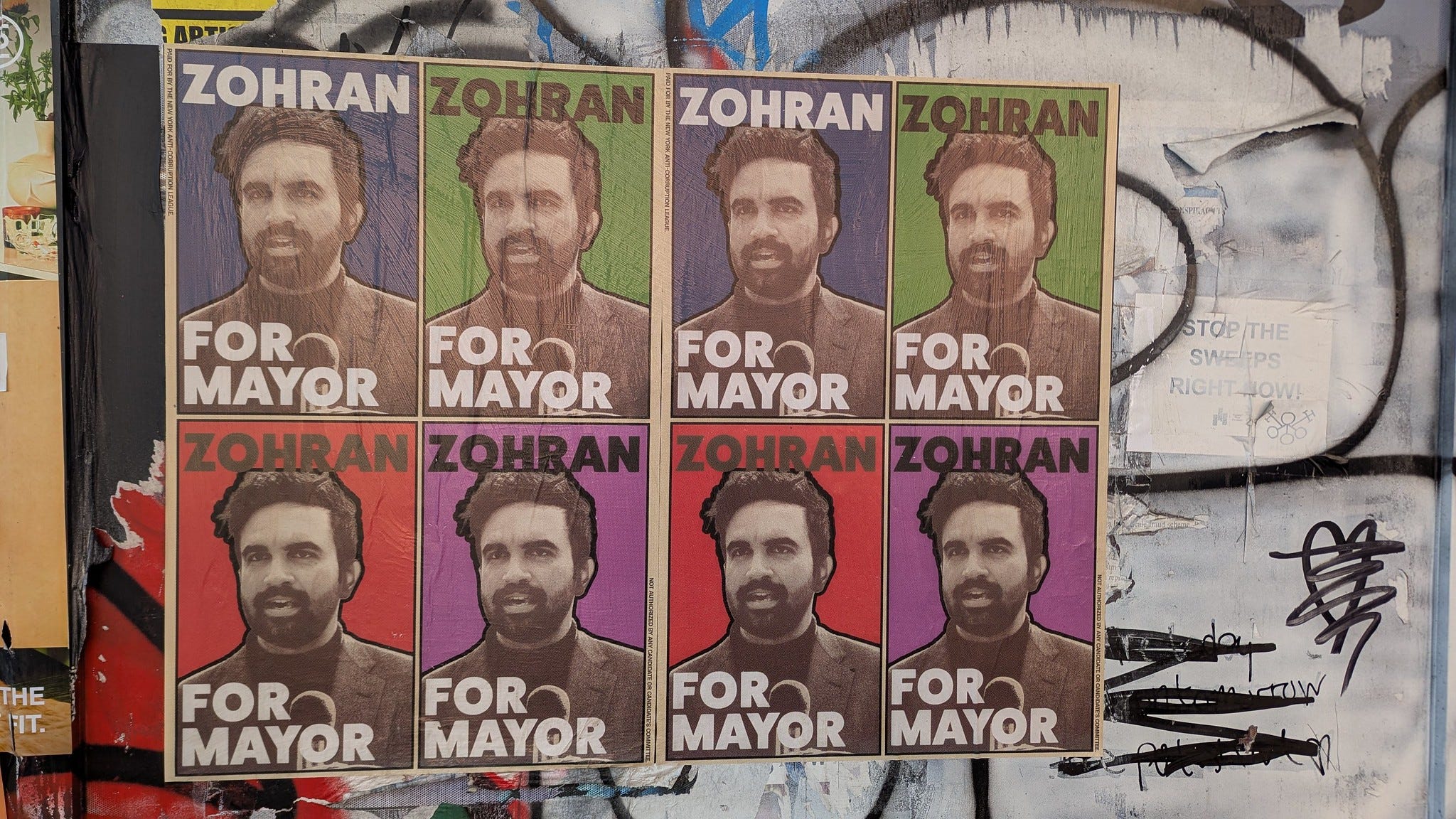
Last Tuesday’s elections offered a real-world test of how to defeat an increasingly authoritarian right in a volatile political moment. The takes are already flying—some useful, others deeply wrong. Getting this right matters: the lessons we take from Tuesday will shape our strategy heading into 2026 and 2028, and beyond.
So with that in mind, here are seven lessons from the election — and one thought about where we go from here.
1. Zohran’s victory is a tribute to the mass politics machine that NY DSA has built.
This is not to discount Mamdani’s skill as a candidate—or the weaknesses of his opponents—but the real story of his electrifying win is the political vehicle behind him. Since creating its electoral commission in 2016, NYC DSA has recruited and run many candidates. Some have won, others didn’t, but within and across election cycles NYC DSA has systematically used electoral organizing to grow and develop an active membership base, on a scale that is now staggering: 11,000 dues-paying members, and over 104,000 volunteers who doorknocked or phonebanked on this campaign—that’s one in ten people who voted for Mamdani! At the national level, DSA is riven by competing factions, but New York shows what is possible when DSAers with a mass politics orientation are in the driver’s seat. In a period with very few scalable organizing models—and even fewer that have built durable long-term infrastructure—NYC DSA is an example we should all study seriously.
2. It was a great night for pro-democracy forces around the country.
Beyond New York, pro-democracy candidates overperformed across the map. The structure of this cycle—an off-year election facing a deeply unpopular president—already tilted conditions toward Democrats. But results exceeded even optimistic expectations virtually everywhere that pro-democracy forces faced off against MAGA. Before the election, political analyst Ryan Brune published a set of 18 benchmarks with which to gauge the strength of Democratic over- or under-performance—hitting less than six would be a bad night, ten meant decent. Ultimately, pro-democracy forces hit or exceeded all 18, making this a wildly successful night for democracy—and one that sets us up well for our ongoing battle against New Confederate autocracy.
3. There is a clear line from “No Kings” record-breaking turnout to Nov. 4th.
One dynamic that hasn’t received enough attention is the relationship between the October 18th “No Kings” mobilizations and the electoral results on November 4th. With an estimated 7 million people participating, October 18th was by some counts the largest single-day protest in U.S. history. It is not a coincidence that a mass mobilization of that scale was followed by record-breaking electoral turnout. Scholarly research has established a strong correlation between successful democratic electoral victories and high levels of extra-electoral mobilization immediately before, during, and after elections. That’s one reason Liberation Road’s 2025-2028 strategy has called for us to “use elections as flashpoints around which we plan and coordinate both widespread electoral mobilization and widespread nonviolent social action—protests, economic boycotts, strikes and work stoppages, social noncooperation.” The strong turnout for both October 18th and November 4th shows the mutually strengthening relationship between mass electoral politics and mass protest. That’s a key lesson we should take into 2026 and—crucially—2028.
4. These victories were powered by a broad front that included pro-democracy partisans, MAGA defectors, and political skeptics.
One reason for Tuesday’s strong performance was high turnout from core Democratic constituencies, who in recent cycles have voted much more reliably in off-year elections than the MAGA base. This strong core of high-propensity, highly partisan voters—people who reliably vote in every election, and who reliably vote for every pro-democracy candidate up and down the ballot—provided the durable, disciplined backbone of the pro-democracy vote.
But two other shifts were crucial in turning what might otherwise have been modest gains into double-digit wins. First, a meaningful share of high-propensity Republican voters appear to have crossed party lines. Early estimates suggest that the Democratic gubernatorial candidates in New Jersey and Virginia each won about 7% of 2024 Trump voters—small on paper, but in competitive partisan environments, statistically decisive. Second, lower-propensity voters—people who rarely vote in off-year elections, if at all—showed up in unusually high numbers. This was most obvious in New York, but turnout was up around the country, including both New Jersey and Virginia, where numbers were at or near 21st-century highs for off-year gubernatorial races.
In a certain sense, this is back to basics. Campaign operatives are trained to calculate their win number by combining three categories of voters: their base (people who are definitely voting for our candidate), persuasion voters (they’re definitely voting, but not sure for whom) and mobilization voters (they may not vote at all, but if they do it’ll probably be for our candidate). Tuesday’s blowouts were the result of strong performance across all three. That’s what transformed what most polls had expected would be single-digit races for Sherrill and Spanberger into the +13 and +15 margins we saw.
5. We need to build the strongest possible left and the broadest possible front in order to block authoritarianism.
So pro-democracy candidates did well almost everywhere by 1) rallying the most politically engaged layers of the pro-democracy front, including both progressives and moderates 2) mobilizing millions of lower-engagement voters who don’t always participate in electoral politics, and 3) winning over a statistically significant portion of former Trump voters. Taken together, these patterns underscore how Tuesday’s victories were the product of a broad pro-democracy front—one held together, not by ideological unity, but by a shared determination to block an authoritarian right from its frightening ascent.
The challenge for the left is to continue to strengthen our position against the center without mistaking that for a mandate to walk away from—rather than lead within—the broad front needed to defeat the MAGA right. This is where we must be careful not to draw the wrong conclusions. Some on the left will now be tempted to suggest Tuesday’s election results “prove” that decisive majorities of the electorate are ready to embrace left politics, and perhaps even to break with the Democratic Party. Some centrists will claim these results prove the opposite: that only establishment moderates like Spanberger can win. But the reality is that we decisively defeated MAGA candidates precisely because leftists and moderates rallied behind a joint Democratic candidate everywhere that we faced off against MAGA, while consciously working to mobilize new voters and win over Trump voters. Moving forward, we will continue to need to balance building the strongest possible left and the broadest possible front.
6. Mamdani’s campaign modeled what left leadership inside the united front can look like.
Mamdani’s race offers a clear example of how the left can strengthen its own ideological and organizational position while still operating inside—and helping to reshape—the broader pro-democracy front. His campaign unapologetically advanced a class-conscious, anti-war, pro-housing agenda that rallied the self-conscious left. Yet after winning the primary, Mamdani also consciously appealed to moderate Democrats, positioning himself as both a bold alternative to a broken system and the rightful heir of the best of the Democratic Party legacy. This made it possible to bring more of the Democratic base vote into his coalition. At the same time, the campaign made a visible effort to peel off a segment of 2024 Trump voters, particularly younger Black and Brown men who have been heavily targeted by right-wing populist messaging. And crucially, it invested deeply in mobilizing people who do not typically vote in off-year municipal elections—and in some cases had never voted before at all. His campaign illustrated what it looks like to practice an inside/outside strategy that is neither assimilation to centrism nor retreat to the margins, but rather confident left leadership within a broad front capable of both winning elections and shifting horizons.
7. The divide within the pro-democracy coalition is now “woke populism” vs “broke populism”
In the debate over what Tuesday’s victories mean, a familiar misunderstanding has resurfaced: that Tuesday’s winning campaigns succeeded because they focused on “economic issues” and steered clear of “identity politics.” Some on the left now imagine this as the defining difference between left candidates like Mamdani and centrists like Spanberger. But this misreads what actually happened. Centrist Democrats have also gotten the memo that material conditions matter; Spanberger, like nearly every successful pro-democracy candidate this cycle, led with bread-and-butter, kitchen-table appeals. (Of course, her economic platform was pablum compared to Mamdani’s, but this is a difference of radicality, not of relentless economic focus.)
Instead, the real divide inside the Democratic coalition today is whether that economic appeal is paired with an unapologetic stance on racial justice, immigrant justice, gender liberation, and anti-imperialism—or whether these principles are sacrificed in pursuit of a mythical “economically minded but culturally conservative” working-class voter, implicitly coded as straight, male, rural, and white. This is the split between what we might call “woke” populism—a multiracial, class-conscious populism rooted in solidarity and shared liberation—and a “broke” populism that reduces politics to the price of milk while quietly conceding the terrain of race, gender, culture, and global solidarity to the authoritarian right.
Alas, it is not only centrist moderates who seem tempted by broke populism; there are worrying murmurs in that direction among sections of the (class reductionist) left. Choosing this path would not only be a moral failure. It would be a strategic catastrophe, demobilizing many of the very core constituencies—Black, Brown, queer, women, and young voters—who make the pro-democracy front possible in the first place. The vast majority of these voters are themselves, of course, working class. But we can’t speak to them using only a narrow economistic agenda that ignores racial justice, international solidarity, abortion access, trans rights, and immigrant justice—indeed, all these issues that were major drivers of the wave of turnout that powered pro-democracy victories this past Tuesday (see links for receipts). We can walk and chew gum at the same time, using a popular economic agenda to win over even broader sectors of the working class while also being clear and unapologetic about our racial, gender, anti-imperialist, and social justice agenda. Here again, Mamdani shows how to lead with this kind of “social justice populism.”
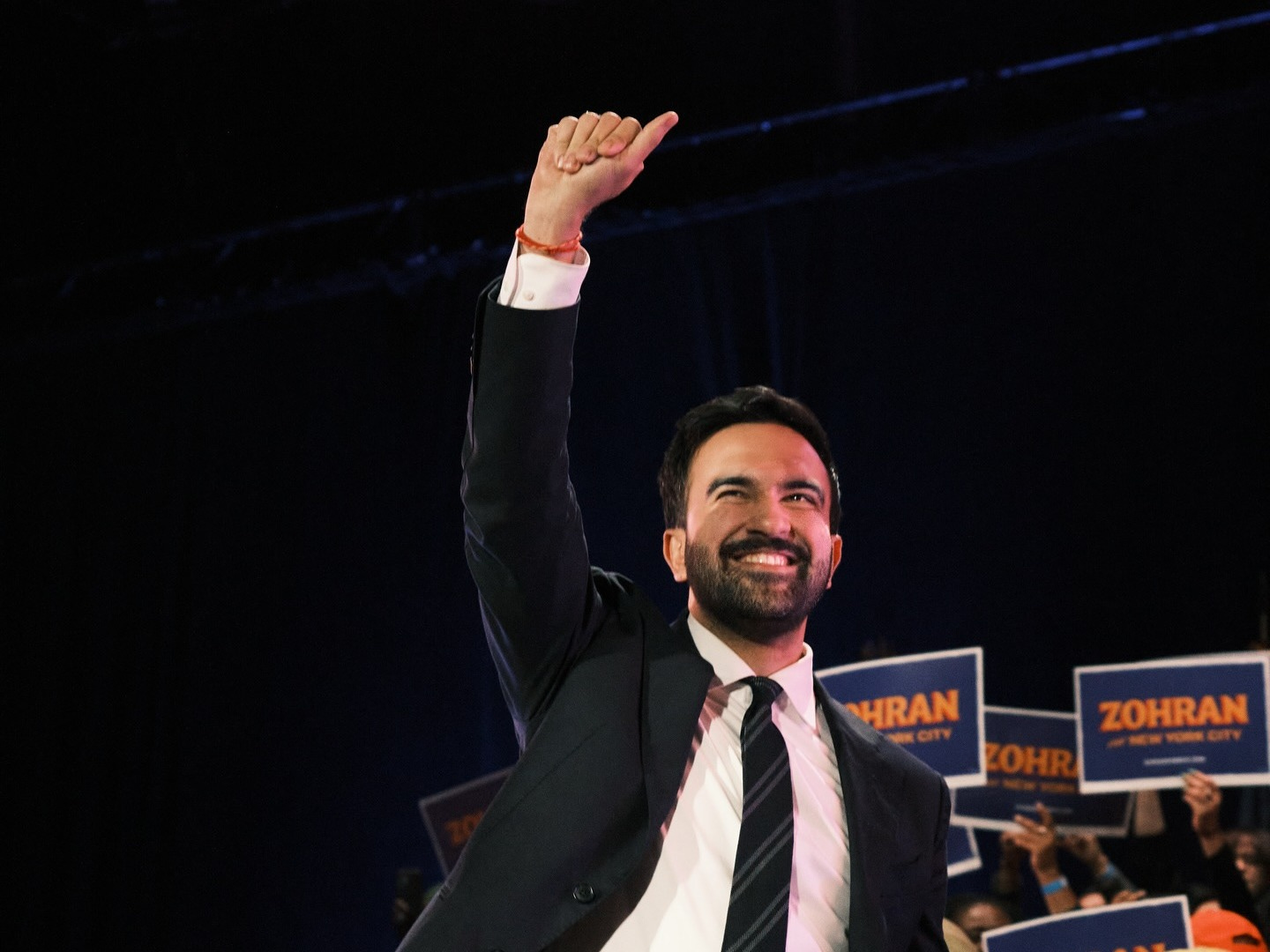
Ask not what Mamdani can do for you, ask how to build the power he (and we) will need to govern
A common question circulating now is: “Okay, we elected Mamdani—how do we hold him accountable?” But this question starts from the wrong premise. The main threat facing left-progressive elected officials is rarely individual betrayal or ideological drift. Far more often, the obstacle is material constraint: too little organized power behind them, too many hostile institutions around them, and well-funded enemies ready to isolate and neutralize them the moment they step out of line.
If left champions falter, it is usually because we have not yet built the power to make their demands governable — not because they lacked conviction. Which means the task now is not vigilance against our leaders, but organization with and around them. So the question is not how to police elected allies from the outside. The question is how to organize the mass constituency, the political capacity, and the disruptive leverage required to expand what is possible once they are in office.
When our electeds do make mistakes—and they will—our principle should be to “protect and correct.” Protect them publicly from attempts to discredit, isolate, and weaken them; they are already facing down coordinated attacks from the right and center, they do not need the left to pile on. Then correct them privately, through ongoing relationships, clear channels of communication, and spaces for shared strategizing—assuming these exist, and if they do not, we must build them.
After starting to practice this approach in co-governance work with elected allies, some of us added a third step: “protect, inspect, and correct.” Too often, what initially looked like an ideological retreat or an unforced error turned out — once we talked with our electeds on the inside — to be a structural constraint we had not yet organized the power to overcome. So before assuming a betrayal, investigate the situation: talk with our elected allies, movement partners, and other forces to understand the context and constraints.
If we want Mamdani—and others like him—to stay bold, stay grounded, and stay left, the question is not how to hold one person’s feet to the fire. The question is how to build the mass, durable, militant social force needed to actualize our shared political agenda. In other words: the work is ours, not just his.
Excellent analysis, Bennett! I am circulating widely within DSA.
This analysis brilliantly captures how Mamdani’s victory was built, through a mass politics machine that operates inside a broad front. I want to extend this by highlighting the material geography that makes a politics centered on racial and gender justice not just principled, but strategically essential for building that front.
Bennett argues we cannot abandon a commitment to racial and gender justice to chase a narrowly defined, economistic appeal. This is correct because the working class we are building is itself structured through racialized and gendered circuits of production and reproduction.
The affordability crisis Mamdani confronted in New York is materially linked to the exploitation of majority-Black and Latino workers in logistics hubs like Savannah, Georgia. The goods that stock our shelves arrive via a supply chain that is also a chain of social cost-shifting onto communities of color. The same capitalist class power that financializes housing in NYC drives the port expansion that burdens working-class communities in Savannah.
Therefore, a politics that retreats from racial and gender justice would be strategically self-defeating. It would sever the essential, material solidarity between the tenant in Queens and the longshore worker in Savannah. They are not just abstract allies; they are points of leverage within the same capitalist circuit.
Bennett’s call for a politics that unites economic and social justice is, in practice, a call to organize across this real, existing geography. To win the "Right to the City" in one place, we must contest the capitalist system that reproduces inequality across space. This means building a movement and organizational forms that see the fight for a home in New York and the fight for a healthy environment in Savannah as fronts in the same struggle against capitalist class power. Mamdani’s machine shows we can win a key position. The task now is to learn how to challenge the entire circuit.