


By Bennett Carpenter
One year ago, I published a three-part series attempting to make sense of the authoritarian threat posed by Trump and the MAGA right, and to sketch an orientation for how pro-democracy forces might respond. The series moved from conceptual framework to diagnosis to strategy: first defining the regime Trump aspired to construct, then assessing how far the United States had actually moved toward it, and finally outlining a path to restore and reconstruct democracy.
Those articles circulated more widely than I’d anticipated, in part because of the particular moment when they appeared. The speed at which Trump 2.0 was running the autocratic playbook, combined with the slower pace of developing analysis, created a time-lag in which our movements lacked a shared vocabulary for understanding what was happening. My series played a small but, I hope, not insignificant role in helping to plug that gap.
Since then, many more analyses of U.S. authoritarianism have emerged—from updated democracy indexes by V-Dem and other research institutes, to the Century Foundation’s new US “Democracy Meter,” to, astoundingly, an intelligence-style assessment by former US national security officials. Much of this scholarly and institutional work draws on richer data sets and deeper expertise than I could hope to match, even as it often remains shaped by the blind spots of conventional (dare I say, “bourgeois”) political science.
Meanwhile almost all of us in movement work have been forced to become amateur experts on authoritarianism. This has owed as much—or more—to practice than to theory, and lots of the key lessons have circulated informally. In terms of academic influences, the research of political scientist Erica Chenoweth seems to have had the most impact on movement strategy. Overall I think its effect has been salutary, although it has at times contributed to an unfortunate fixation on “3.5%” as some sort of magic antidote to authoritarianism. Still, I have been encouraged by the increasingly sophisticated—and shared—frameworks that have grown up across our movements as we skill up around how to both assess authoritarianism and combat it.
With so much theory (and practice!) developed since, I hesitated about whether it made sense to return to my earlier series. But ultimately I decided that revisiting the analysis was worthwhile. Authoritarian projects do not unfold on a fixed script, and strategy requires revisiting earlier assessments in light of new developments. I wanted to see to what extent my analysis has held, where it hasn’t, and what that might mean for our work ahead.
This two-part update returns to the original series in sequence. In this first installment, I’ll reexamine the conceptual framework and diagnostic claims of the original series. I first return to the concept of patronal autocracy to ask to what extent it has adequately captured the logic of the regime Trump has sought to impose. I then revisit my diagnosis of authoritarian advance: to what extent was I correct in my assessment of democratic regression and resilience, and where has the terrain shifted?
In the second installment, I’ll reexamine the strategic conclusions drawn from that diagnosis, asking what remains sound and what now needs to shift as we move toward the 2026 and 2028 election cycles.
Conceptual Framework: Patronal Autocracy
The first installment sought to clarify the regime type that Trump and MAGA aspired to build, adapting a comparative framework that distinguishes regime types along two axes: the degree of authoritarian control versus democratic pluralism, and the degree of patronal domination versus impersonal, rule-bound governance.
What I argued
I argued that the regime-type Trump was aiming for is best understood as a patronal autocracy. In autocratic regimes, elections, nominal civil liberties, and a legal political opposition persist, but democratic change is effectively blocked by the autocrat’s control over the state apparatuses and domination of civil society. In patronal regimes, authority is not based on laws or institutions but rather flows from a dominant “patron” through an informal network of loyal clients. A patronal autocracy combines these two logics, marrying centralized (but still nominally democratic) state power to a system of personalized rule oriented toward the accumulation of wealth by the chief patron and his network. Unlike ideologically driven “conservative autocracies,” where a ruling party uses the state to advance a coherent political project, patronal autocracies deploy both ideology and state power instrumentally—not to advance a coherent project of public governance, but rather to serve the private interests of the patronage network.
What the framework got right
Overall, I think the core of the conceptual framework has held up well. Despite Trump’s periodic talk of “canceling” elections, it is now generally understood that the regime MAGA aims to build will preserve the formal trappings of democracy while systematically hollowing out its substance. “Autocracy” is just one name for this kind of hybrid regime midway between democracy and dictatorship (others call it “competitive authoritarianism,” “illiberal democracy,” etc.) but it has proven a popular one—a sign not only that the phenomenon itself has become more visible, but that the underlying analysis was broadly correct.
“Patronalism,” in contrast, has not caught on in the same way. Yet the dynamics it seeks to describe are everywhere evident. We see it in Trump’s expectation of absolute personal fealty, in his use of state power to reward allies and punish perceived enemies, and in the blurring of lines between public authority and private interests. It is visible, too, in the regime’s foreign policy, where relationships with other states are increasingly treated in personalized and transactional terms rather than through stable institutional or strategic frameworks.
Yet our movements have been less adept at grasping the regime’s patronal features than its autocratic ones. Part of the difficulty, I think, lies in how the left has historically understood the relationship between the state and capital. We are accustomed—correctly—to seeing the state as serving elite economic interests. But this can blind us to what is genuinely different about Trump’s patronalism compared to (crony) capitalist business as usual.
To see what is genuinely new here, we need to think about capitalism as a mode of production, not simply “rule by the rich.” For as Ellen Meiksins Wood has argued, one of the key features that distinguishes capitalism from other forms of class rule is precisely the relative separation of political and economic spheres. In earlier class societies, rulers extracted economic surplus directly; political and economic command were fused. Under capitalism, in contrast, surplus value is extracted through market dependence and wage labor, while the state takes on the more mediated role of securing the conditions under which those economic relations reproduce themselves.
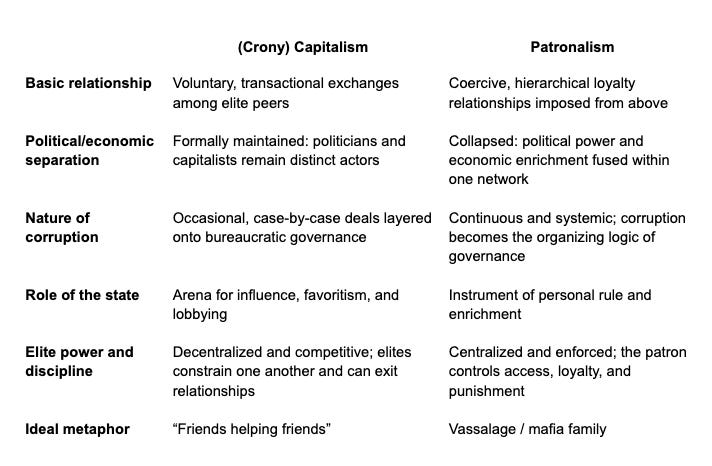
Patronalism fundamentally erodes the relative autonomy between the political and economic that has been a constitutive feature of the capitalist system. In this sense, what we are seeing is not simply crony capitalist “business as usual,” but a partial reversion toward a more personalized, patrimonial form of rule operating within—and deforming—the institutional shell of a modern capitalist state. The table below tries to highlight some elements of this distinction.
What the framework missed
So much for what “patronal autocracy” got right. What did it get wrong?
One limitation I’d already grappled with in writing the series is the blind spots of the political scientists Bálint Magyar and Bálint Madlovics, from whom I adapted the framework. Treating capitalist democracy as an unqualified good, they fail to consider the ways coercion and domination persist in nominally free market societies. As a result they overstate the divide between liberal-capitalist “freedom” and patronal domination, missing their deeper affinity. In a sense this is the inverse weakness of the socialist left, which can overstate the continuity between the two, failing to register the qualitative shift from indirect market coercion to direct patronal control.
What we really need is a framework that can grasp both continuity and rupture—seeing how patronal domination grows out of coercive dynamics already present within capitalist liberal democracy, while still registering the real transformation that patronalism marks. The Marxist tradition offers some starting points here, from Karl Marx’s analysis of bonapartism to Antonio Gramsci’s concept of caesarism, which I hope to return to in another article.
Another thing I underestimated is the degree of ideological coherence that the Trump 2.0 project has developed in practice. Again following Magyar and Madlovics, I distinguished patronal autocracy from ideologically-driven “conservative autocracies,” arguing that the former deployed primarily ideology instrumentally. I still think there’s some truth to that; Trump can’t hold a consistent idea together from one end of a sentence to the other, and that very protean quality makes him a kind of cipher onto which rival factions can project their own agendas.
But among the competing tendencies within Trump’s coalition, the regime has in fact consolidated around a coherent and ever-more explicit white nationalist ideology. This is nowhere more evident than in the regime’s widening dragnet of body-snatchers and the increasingly open fusion of immigration enforcement with a broader politics of ethno-national purification. In the run-up to the 2025 election, there were indications that Trumpism might evolve toward a more expansive, flexible form of ethno-nationalism. Instead, it has cohered around its most racialized, radicalized, and exclusionary core.
This ideological hardening is one expression of a more general dynamic of increasing radicalization in which the Trump regime seems to have settled on an “accelerationist” strategy, pushing the autocratic playbook harder and faster rather than consolidating more cautiously. In my opinion that makes it more immediately dangerous, but less likely to consolidate long-term hegemony. But that brings us to the next section of the series—assessing the pace of autocratic advance and democratic resistance.
Checking the gauge: the autocrometer one year on
The second part of my series took patronal autocracy as a hypothetical endpoint and asked a diagnostic question: how close had the United States actually come to that state, and where did democratic bulwarks still hold?
What I argued
I argued that autocratic advance was uneven across institutions and levels of government. At the federal level, the executive branch had moved closest to autocratic capture. However, the other two branches, while under pressure, retained significant structural autonomy. While Republican lawmakers displayed strong patronal servility, control of Congress remained dependent on at least partially free and fair elections that the regime could not fully undermine, leaving open a path to electoral reversal. Meanwhile the judiciary was trending toward long-term autocratic consolidation but in the immediate term continued to function as a real if uneven constraint on executive overreach.
At the state level, the United States’ highly federated system sharply limited the regime’s ability to impose a uniform patronal autocracy nationwide. As a result authoritarian consolidation was bifurcating. States under Republican trifecta rule had already crossed over into semi-consolidated authoritarian rule, but blue states still functioned as democratic firewalls, preserving electoral integrity and civil liberties. Civil society presented a similarly mixed picture. The United States retained a vast, pluralistic civic landscape, but many major institutions had become increasingly top-down, elite-driven, and vulnerable to patronal pressure, significantly weakening their capacity to function as an independent democratic counterweight.
What the autocrometer got right
Here too I think the analysis has held up well. Rather than a uniform national slide, the past year has seen uneven advance at the federal level, a growing divide between red and blue states, and a sharp bifurcation between elite capitulation and grassroots resistance.
Executive consolidation
At the federal level, the executive branch and administrative apparatuses have indeed proven the leading edge of autocratic consolidation. From the politicization of the nonpartisan civil service, to the unilateral shuttering of agencies and aid programs, to the weaponization of the Justice Department as a tool to attack opponents, it is hard to overstate the extent of the autocratic transformation of the federal government over the past year.
The patronal dimension of this shift is perhaps less obvious, but in some ways even more revealing. Across departments and agencies, decisions that once moved through institutional chains now increasingly turn on interpersonal competition among members of the president’s patronal network. Madja Ruge and Jeremy Shapiro have analyzed how this has played out around US foreign policy. The latter was long shaped through a technocratic process known as the interagency model, in which the National Security Council (NCS) coordinated proposals from the Department of State, the Pentagon, and the intelligence agencies, compelling them to hash out differences before presenting the president with a set of vetted options. But the regime has now gutted the NSC and replaced it with a process of direct, personalized competition for the president’s ear and attention, which Ruge and Shapiro term a “factional process.” The result is a more volatile, less vetted, and hyper-personalized decision-making model that reflects the administration’s distrust of bureaucratic autonomy and aligns with my analysis of patronal rule.
Judicial constraints
My prediction that the judiciary would serve as a check on autocracy has also largely held up. Over 530 cases have been filed against the administration in 2025 alone, far exceeding any past administration. (For comparison, Biden faced 133 across his entire four-year term.) Significantly, judges have largely abandoned the long-standing “presumption of regularity” extended to government officials in court cases, meaning they no longer start from the assumption that the administration is acting in good faith. This has contributed to the administration losing over 70% of cases at the district court level, an astonishing loss rate for a sitting president.'
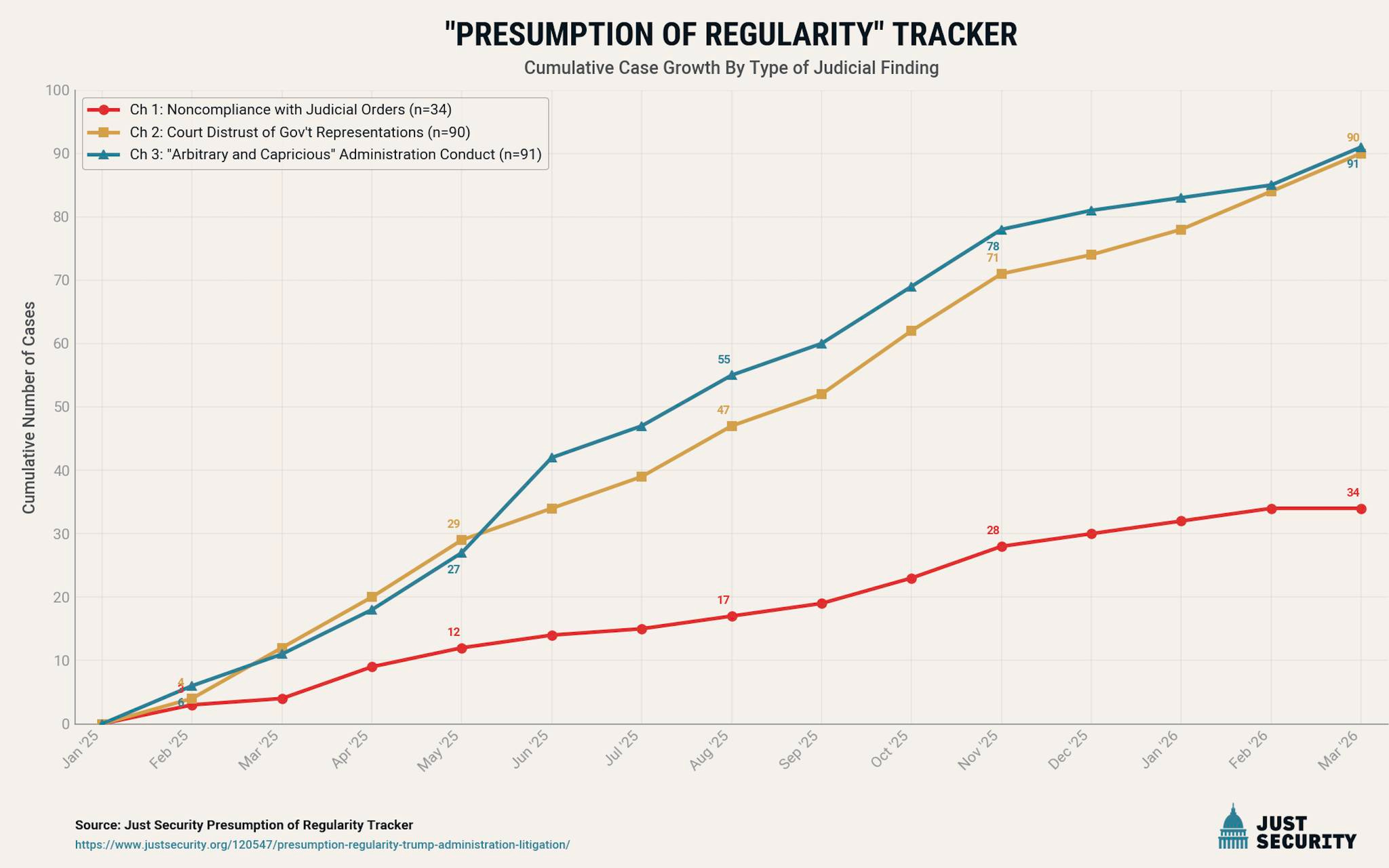
It is true that those loss rates decrease upon appeal: circuit courts have ruled against Trump only about half the time, while the Supreme Court has actually ruled for the administration in over 80% of “emergency” rulings, making unprecedented use of the shadow docket to issue striking decisions without explanation. This had led to justified alarm about the compromised nature of the court’s 6-3 far-right supermajority and its long-term implications for our democracy.
But that appellate record should be read with caution, since, as Harvard law professor Jack Goldsmith notes, the administration selectively appeals only a small fraction of the cases it believes it can win—just a few dozen out of many hundreds. That makes it all the more striking that the Court has still ruled against Trump in major cases, including his attempts to federalize the National Guard and to impose tariffs at will. Without diminishing the long-term dangers of right-wing judicial capture, I agree with Goldsmith’s conclusion that, in the short term, “The federal judicial system has done a remarkable job in the face of unprecedented challenges and hostility in standing up to the Trump administration.”
Congress captive, but competitive
In contrast, Congress has been even more servile than I anticipated. From tariffs to executive oversight, war powers to the power of the purse, Congressional Republicans have repeatedly prioritized patronal loyalty over institutional autonomy, accelerating the concentration of power in the executive. Congressional Democrats spent most of last year adrift and spineless, then rediscovered their backbone in last fall’s fight over the expiration of Affordable Care Act subsidies, only to promptly lose it again. They have shown stiffer resolve around the ongoing DHS shutdown, though it still seems less like they’re leading the party than being dragged along by its base. In any case as a minority party they have largely lacked the power to function as a meaningful institutional counterweight. In the immediate term, Congress has thus for all intents and purposes vacated its position as an independent branch of government.
However, my argument that the legislative branch would resist autocratic capture did not rest on the immediate actions of the current Congress, but rather on the fact that Congressional control remains dependent on at least partially free and fair elections that the regime cannot fully corrupt. This is certainly not for lack of trying, whether we think of the dystopian SAVE act or Trump’s recent executive order restricting mail-in voting. But both of those examples actually point to the limits of the regime’s power; there is no Senate supermajority to pass the former, while the latter is blatantly unconstitutional and will almost certainly be struck down by the courts. The Trumpified federal government still poses real risks to election integrity, which I will discuss in section three. But because the US federal system leaves most core election powers to the states, election integrity depends above all on the balance of power at the state level.
A tale of two state trifectas
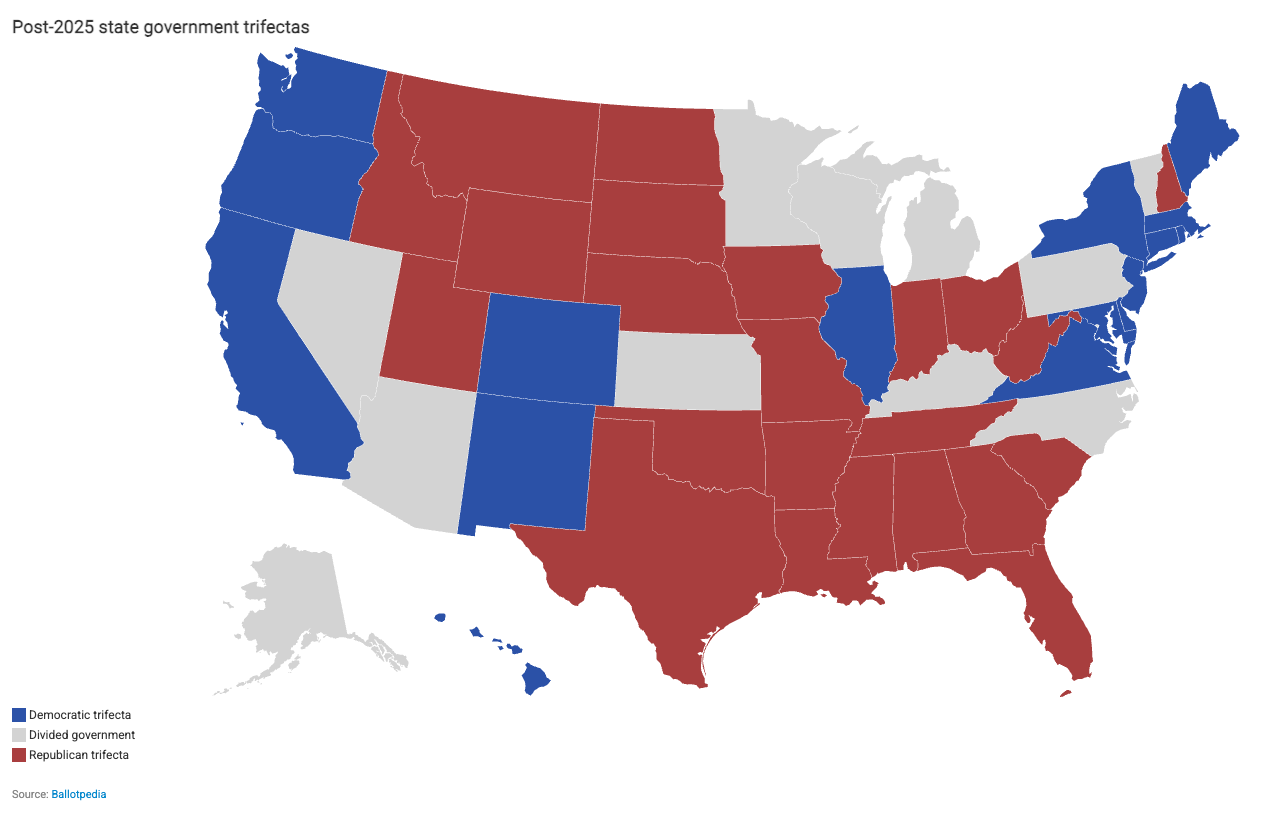
As predicted, the degree of autocratization has varied dramatically across the 50 states, as states with GOP trifectas consolidate authoritarianism while blue trifectas continue to function as meaningful democratic firewalls.
In red states, autocratic consolidation has deepened most visibly through a new wave of restrictive voting laws, proof-of-citizenship requirements, and election-interference measures designed to harden partisan control ahead of 2026. Red states have also expanded cooperation between local and state law enforcement and ICE and intensified attacks on bodily autonomy, targeting both abortion access and gender-affirming care while increasingly trying to assert coercive authority across state lines. Taken together, these measures point to the continued consolidation of red states as laboratories of authoritarianism.
In contrast, blue states have functioned as a democratic counter-power. A bloc of 23 Democratic attorneys general have emerged as one of the most significant fighting forces in the first year of Trump, filing more than 70 lawsuits and building a formidable multi-state firewall against federal autocracy. State and local officials have also repeatedly defended sanctuary policies, refusing incorporation into the federal deportation apparatus, while expanding shield protections for both abortion access and gender-affirming care. These are major exercises of state power that have become among the biggest barriers to nationwide authoritarian consolidation.
Civil society: capitulation above, resistance below
My original series grappled with a paradox: on paper, the US possessed an older, larger, richer civil societal infrastructure than almost any other country. In practice, however, many of these institutions had been hierarchized and hollowed out, making it harder to predict whether civil society would stand up to Trump or fold under pressure.
The answer, in the end, has been a bifurcation almost as sharp as that between red states and blue states. But here the fault line runs less left versus right than top versus bottom.
At the top, elite institutions, executive directors, and CEOs have repeatedly bent the knee to autocracy. Universities have rolled back DEI programs, disciplined protesters, and made unprecedented concessions in order to restore frozen federal funding streams. Major foundations have likewise begun to chill under pressure, with funders themselves describing a pullback from racial justice and pro-democracy work they now perceive as politically risky. Perhaps most alarmingly, legacy media has continued to consolidate into fewer billionaire hands, accelerating the hollowing out of long-standing institutions of independent journalism just when democratic society most needs them.
Yet the picture looks very different from below, where we have seen an astonishing surge of grassroots resistance. The leading edge has been the rapid scaling of immigrant defense infrastructure, as volunteer hotlines, neighborhood verification networks, and court-watch teams have proliferated in response to ICE escalation. Whatever the criticisms or limitations of “No Kings,” meanwhile, its record-breaking turnout has translated into a dense network of largely organic and geographically distributed local groups—one that is especially significant in rural communities, small towns, and red states. In labor, both strike activity and union membership actually increased in 2025, while formations like the Federal Unionists Network have helped pull major unions into a more confrontational stance. Across these cases, the common thread has been the ability of bottom-up grassroots efforts to adapt faster than elite institutions, with large NGOs and organizational leadership more often tailing than driving the resistance.
What the autocrometer missed: warp speed and worldwide scope
Last year, I argued that two variables could distort the autocrometer’s reading: speed and scale. Trump seemed to be compressing into months what had taken figures like Putin or Orbán years, thereby unsettling the assumptions of a model based on slower, more methodical trajectories. Those other cases had also involved countries far smaller than the United States, raising the possibility that an autocratic coup attempt from the commanding heights of a global superpower would carry risks of a different order altogether.
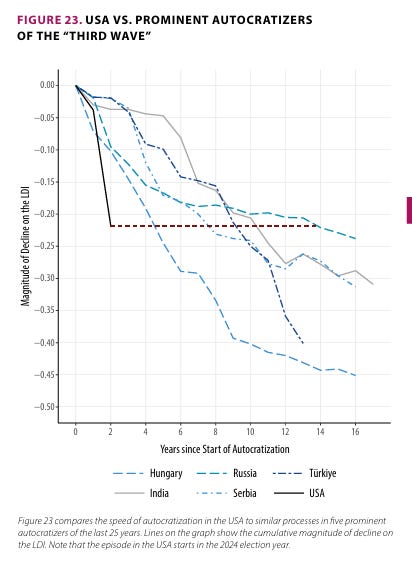
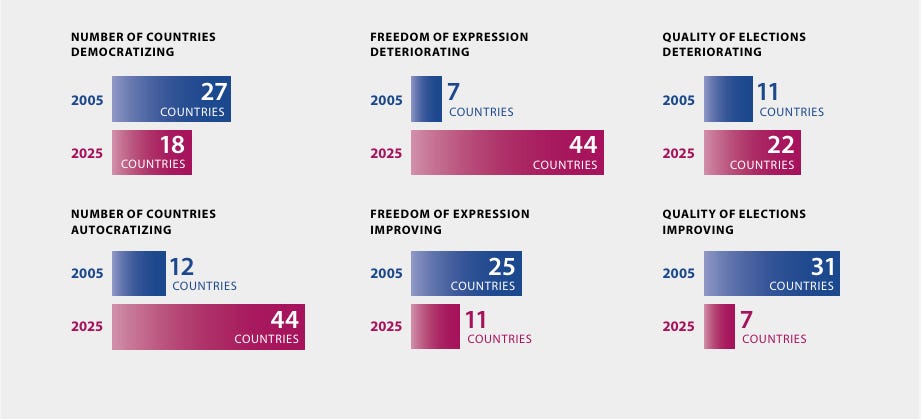
Since then Trump has indeed sped-run through the autocratic playbook. As the authors of the latest V-Dem report note, democratic decline under Trump 2.0 has proceeded far more rapidly than in any other of the so-called “third wave” of autocratizing countries. They estimate that Trump has compressed into a single year transformations that took four years in Hungary, eight in Serbia, and a decade or more in Turkey, India, and Russia.
This does not necessarily mean that Trump has been more effective. Indeed, I would argue the opposite. Speed can strengthen an autocratic bid in the short term, but beyond a certain threshold it begins to erode the very mechanisms on which durable consolidation depends. Authoritarian projects still require competent loyalists and a functioning administrative apparatus; when purges move too quickly and patronalization becomes too abrupt, the regime risks hollowing out the very pillars it needs to govern. At the same time, the faster it moves, the more it risks defections and inflames opposition. The result is a more dangerous immediate situation, but potentially a shorter window in which the regime can convert shock into stable hegemony.
Yet the most truly unprecedented element of this autocratic coup attempt has been its global ambitions. It was already clear, when I wrote the original series, that Trump sought to rewrite the rules of international trade, upend longstanding alliances, and intensify coercive pressure against the nations of the Global South. But the abduction of Venezuela’s sitting president and coercive threats towards Cuba, Mexico, and Greenland have shattered even the nominal norms that long mediated U.S. hemispheric power. The war on Iran marks an even darker threshold, as increasingly apocalyptic rhetoric suggests a willingness to degrade rival states as coherent territorial and institutional actors.
In hindsight, what I failed to appreciate is that the model that helped make sense of the Trump regime’s domestic project does not give us a framework for its international aims. The comparative model I adopted describes the attempted autocratic transformation of nation states embedded within a broader international order whose basic contours it assumes remain intact. Yet we now face a patronal autocratic project attempting to reshape the rules of that very order, from the commanding heights of a superpower that retains disproportionate influence over it. In other words, the Trump regime seems to be attempting to extend the logic of patronal autocracy to the level of the capitalist world-system as a whole.
What may be emerging, and what requires much further analysis, is not simply the addition of one more autocratizing nation to a growing list. The patronal autocratization of the United States risks transforming that quantitative trend into a qualitative shift in the structure of the international order itself. At the core of that possible shift is the growing fusion of executive power, oligarchic wealth, and personal loyalty inside the autocratizing states of the capitalist core and semi-periphery, while peripheral states are increasingly pressured into dependent relationships with one or another of these competing patronal blocs. This points toward an attempt to restructure the wider interstate order of nominally sovereign nation-states that has shaped international relations since at least the postwar era.
To be clear, that system was never truly one of equal sovereignty. Some states have always been “more sovereign” than others, and Western imperialism long rested on precisely that double standard. What feels new is less that hierarchy itself than the increasingly patronal form it now takes, as relatively rule-bound relations give way to more personalized structures of dependency across an unevenly weakening interstate order. The closest analog may therefore be less 19th-century imperialism than even older tributary or suzerain systems, in which formally distinct polities retained nominal autonomy while operating inside layered hierarchies of deference, tribute, and personal dependency.
Whether this amounts to the beginnings of a new mode of authoritarian accumulation or merely a more chaotic pattern of fragmentation and failed hegemonic rewiring remains uncertain. The point is that, unlike its domestic agenda, the Trump regime’s international project has no real precedent in the comparative frameworks from which the original analysis drew. Once the terrain shifts from the national to the international order, those case studies in autocracy become far less reliable as strategic guides. That raises an urgent question: what will it take, not only to reverse Trump’s authoritarian project at home, but on the world stage?
Conclusion
One year in, the core of the original diagnosis has largely held. The regime that Trump and MAGA have sought to build still reads most clearly as a patronal autocratic project. Aided by an obedient network of MAGA loyalists, and abetted by elite capitulation and a quiescent Congress, autocratic advance has moved fastest at the highest levels of federal and institutional power. But democratic resilience has persisted through the lower courts, blue-state firewalls, and the more distributed capacities of grassroots civil society.
The regime’s hyper-accelerationism has intensified its contradictions, increasing the immediate danger while reducing its chances of stabilizing domestic hegemony. In response, it has increasingly sought to displace those contradictions abroad, widening the conflict into a struggle over the shape of the international order.
As I will argue, these dynamics do not fundamentally alter our movement strategy. But they both compress the timeline and widen the terrain on which we must fight. The second installment turns to what it means to accelerate our counter-offensive, to build forms of leadership capable of learning and coordinating at the speed of events, and to link up struggles against authoritarianism, war, and domination at home and abroad.
Bennett Carpenter is a queer Southern organizer, trainer, and movement strategist. They are a member of the National Executive Committee of Liberation Road.
Excellent follow-up! Really appreciate the rigor of comparing last year’s arguments to what we’ve seen play out.
Thanks, Bennett!