


Tonight, as election results roll in, most attention will be focused on whether Democrats manage to flip the House and Senate. But in state capitals across the country, another “flip” may unfold with much less fanfare. For the first time in nearly two decades, Democrats could emerge with control over more state governments than Republicans.
That matters because Trump’s blitzkrieg assault on democracy has been enabled by a decades-long project to consolidate far-right political power at the state level. Retaking the House and Senate are critical to halt Trump’s autocratic “speed run.” But to fully defeat and reverse authoritarianism, we will have to dismantle the foundations laid by this “slow-motion coup.”
The right’s strategy has been to win power at the state level and then rewrite the rules to hold it. By securing state government trifectas—control of the governorship and both legislative chambers—Republicans have gained the power to gerrymander districts, restrict voting rights, and weaken checks on their authority. They have used that power to insulate themselves from electoral accountability, turning competitive states into strongholds of minority rule.
The New Confederacy readied the ground for autocracy at the state level. It is at the state level that we must root it out.
The Origins of the New Confederacy’s State-Based Project
Michael Podhorzer has just published a phenomenal analysis of this decades-long project, which he terms “The Confederate Realignment.” As he writes: “The MAGA coalition has managed to rebuild, across roughly half the country, the types of one-party regimes that defined the Jim Crow South.”
This autocratic offensive has its origins in the New Right of the 1960s and 1970s, which built an enduring infrastructure of think tanks, donor networks, legal organizations, and legislative vehicles that slowly captured political institutions and reshaped the courts. But three developments supercharged it heading into the 2010s: the consolidation of the Roberts Court’s right-wing majority, the rise of the Tea Party movement, and “REDMAP,” a coordinated Republican campaign to capture state government trifectas ahead of the 2010 redistricting cycle.
These rigged maps helped Republicans retain a 33-seat majority in the US House in 2012 even as Democratic candidates won over a million more votes nationally. At the state level, they entrenched Republican legislative majorities, helping the party preserve its power and position itself to draw another round of rigged maps after the 2020 census.
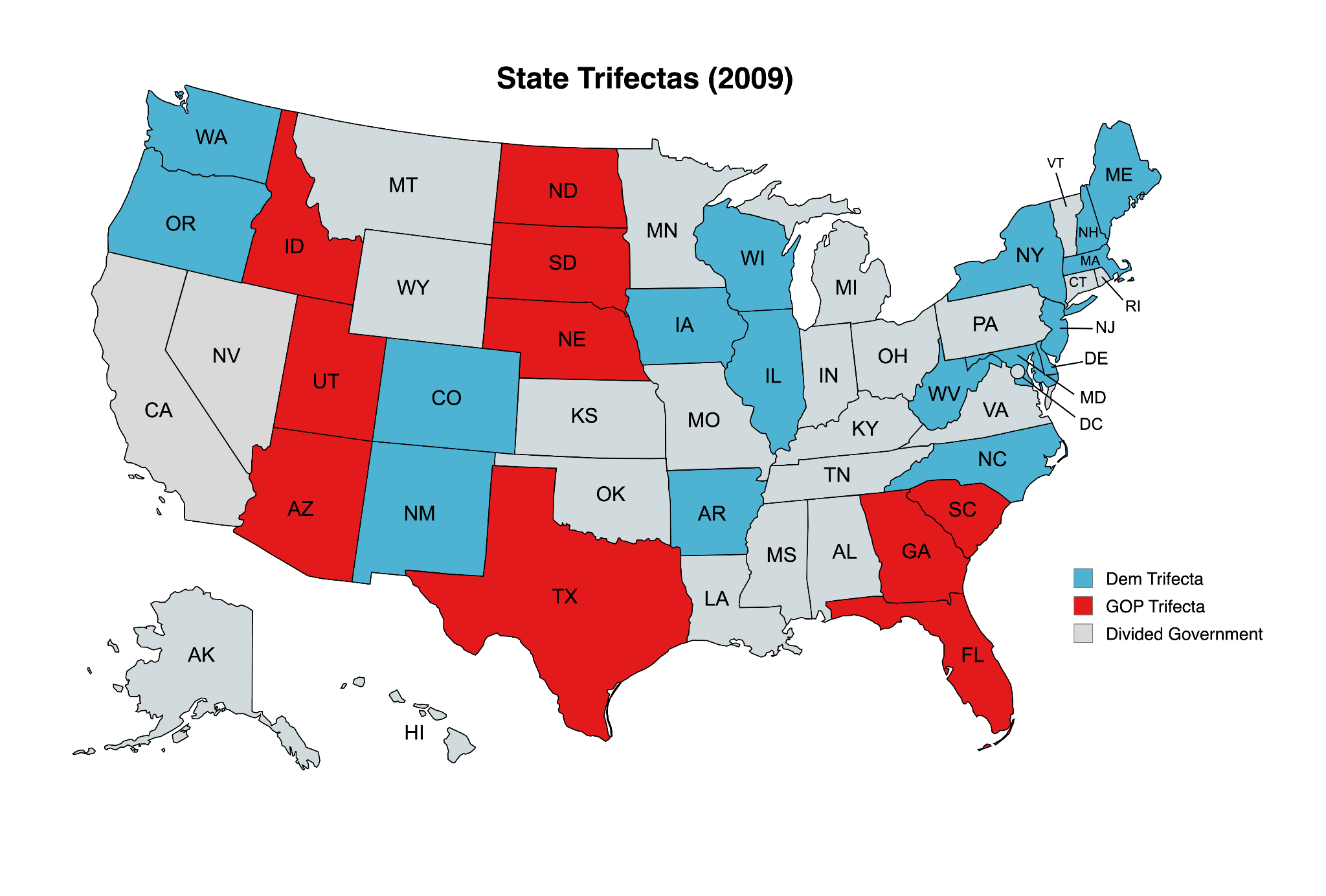
The scale of the breakthrough is visible in the trifecta maps. In 2009, Republicans controlled 10 state trifectas:
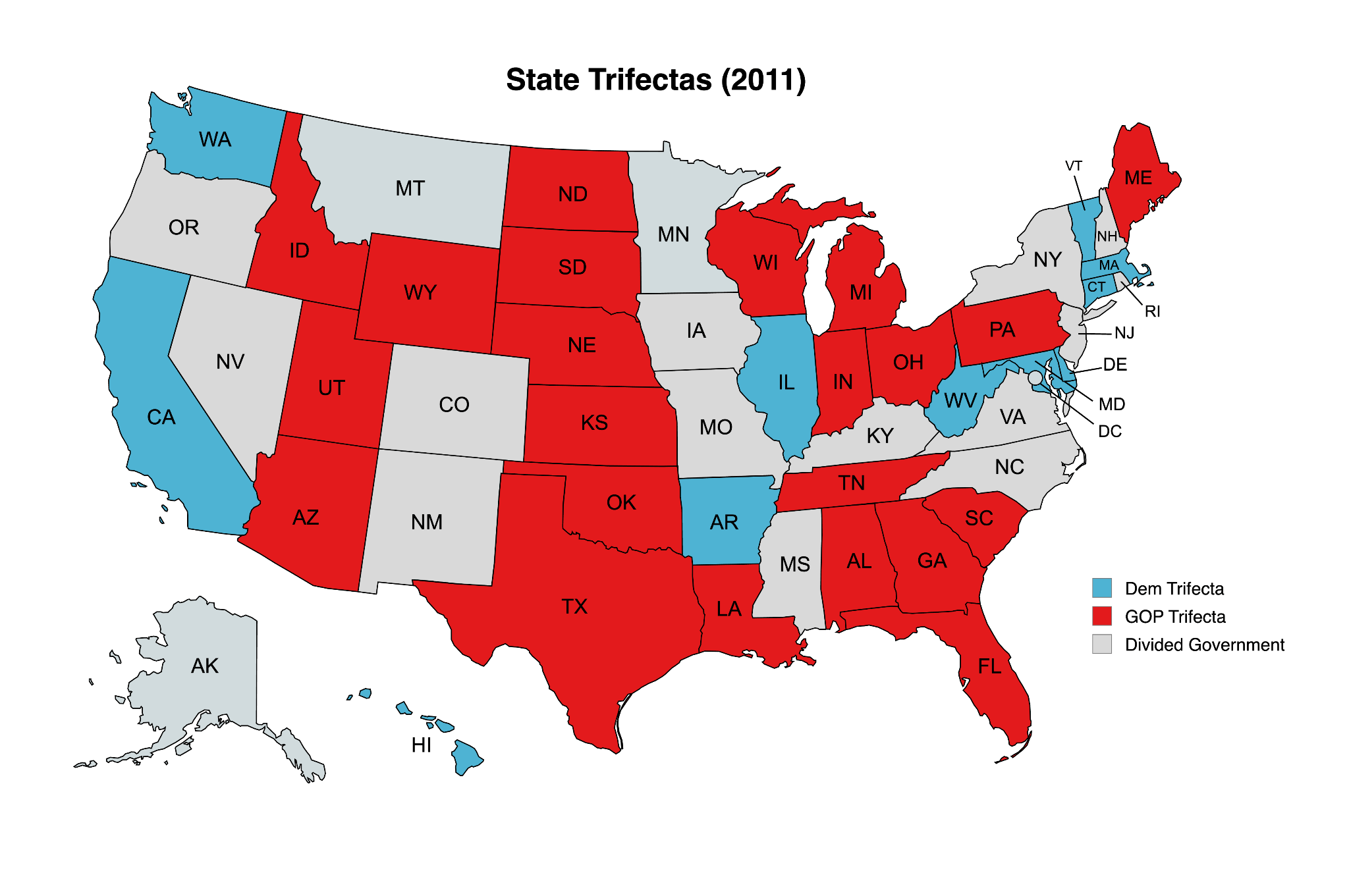
By 2011, Republicans had more than doubled their trifectas, to 22:
Meanwhile, the Roberts Court steadily dismantled safeguards against this consolidation of power. Citizens United (2010) expanded the power of wealthy interests in elections, while Shelby County (2013), Rucho (2019), and Brnovich (2021) dismantled protections against voter suppression and rigged maps. This year’s Callais ruling is just the latest nail in the coffin. As Republican lawmakers rigged the rules to preserve their power, the radical Roberts Court steadily narrowed voters’ ability to challenge them.
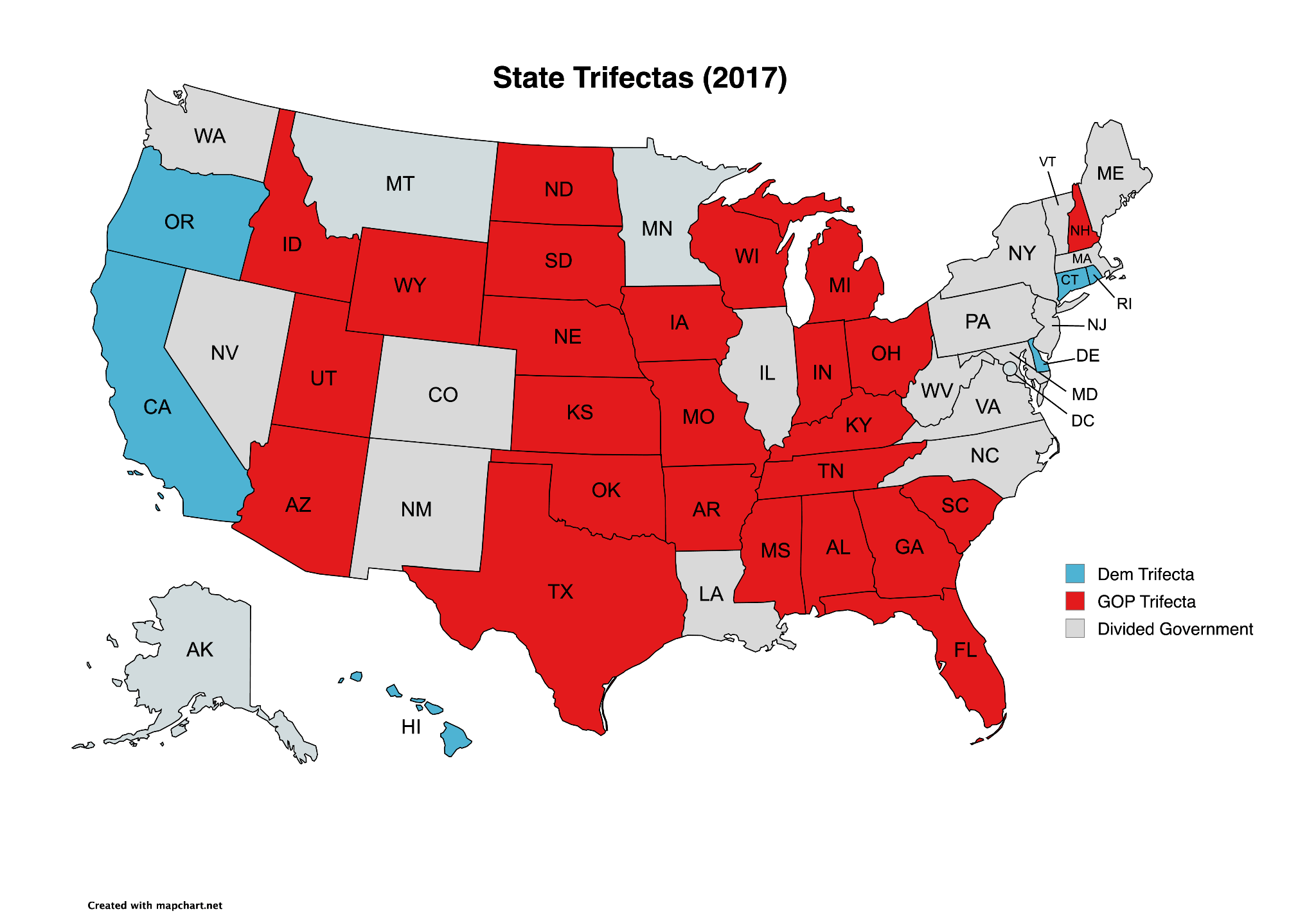
By the beginning of 2017, following Trump’s first election, the imbalance was stark: Republicans held unilateral control of 25 state governments, while Democratic trifectas had shrunk to just six:
Turning the Tide in the States
Since that absolute low point following Trump’s first election, pro-democracy forces have gradually clawed back power at the state level. During Trump’s first term, Democrats gained nine trifectas. In 2022 they gained four more. Despite losing a few, Democrats now hold 16 trifectas, up from six at the beginning of 2017.
Meanwhile pro-democracy forces have broken Republican trifectas in Kansas, Wisconsin, Kentucky, and Arizona. While MAGA forces partially offset these losses with gains in Montana, New Hampshire, and Louisiana, Republican trifecta control has shrunk from 25 states at the beginning of 2017 to 23 today.
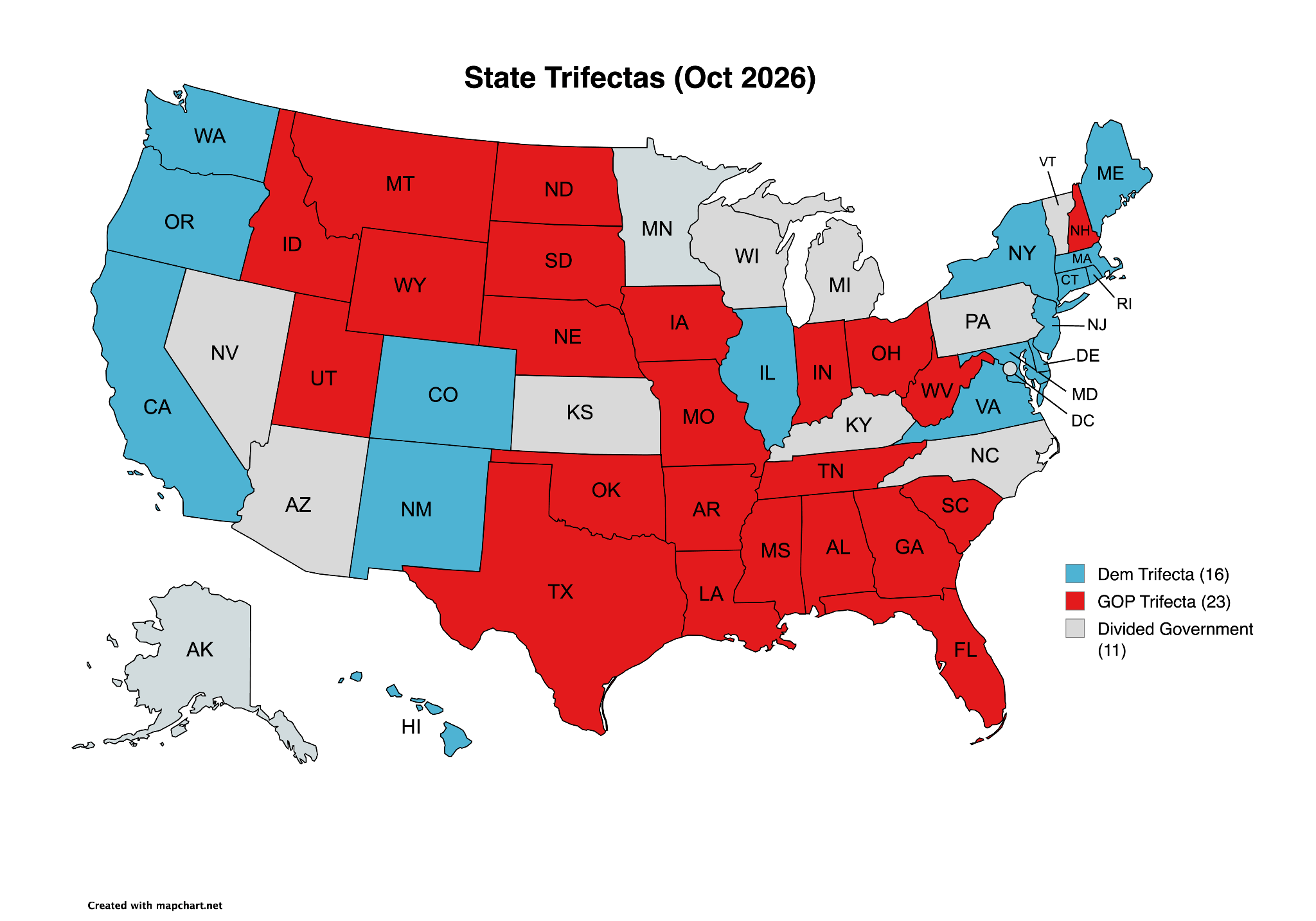
Still, Republicans have maintained their overall advantage throughout the political period opened by the 2010 elections. But tonight could mark a turning point. By winning new Democratic trifectas and breaking Republican ones, we could reverse the GOP’s advantage.
State Navigate, a non-partisan state election forecaster, currently projects that Democrats will win governing trifectas in five new states: Arizona, Pennsylvania, Michigan, Minnesota, and Wisconsin. It also projects that pro-democracy forces will break Republican trifectas in Iowa, Georgia, Ohio, and New Hampshire. Its only potential Republican pickup is Kansas, where the governor’s race remains neck and neck.
If those projections bear out, Democrats would emerge with 21 trifectas to Republicans’ 20—or 19 if Democrats hold the Kansas governorship. For the first time since 2010, Democrats would control more state governments outright than Republicans. The New Confederacy would remain powerful, but its strongholds would be shrinking, while our opportunities to exercise governing power would be expanding.
In fact, such a result would reach or exceed the state-level targets Liberation Road set for 2028, two years early. In the Strategic Orientation we adopted in June 2025, we wrote:
“By or before 2028, we should aim to help secure Democratic trifectas in 5 or more additional states (potentially Virginia, Michigan, Minnesota, Nevada, Arizona, Wisconsin, or Pennsylvania) while defending and strengthening majorities in current “blue” states. We should seek to break Republican trifectas in three or more states (potentially Georgia, Iowa, Texas, or New Hampshire) while weakening Republican majorities in other “red” states. We should aim to secure at least as many Democratic state trifectas as Republican state trifectas by 2028.”
Reaching those goals two years early would signal a significant shift in the terrain of struggle. As I argued last week, new or strengthened Democratic trifectas can become our “forward operating bases”: places to block MAGA’s agenda, advance our own, and build the organization and governing experience we will need to draw on to mount a full federal counteroffensive in 2028.
So as results come in tonight and over the coming days, keep your eyes on the states.
Bennett Carpenter is a queer Southern organizer, trainer, and movement strategist. They are a member of the National Executive Committee of Liberation Road.
Podhorzer's piece is deep and well worth our study. Thanks for noting it.