


By Bennett Carpenter
We are less than three weeks away from a critical midterm election—the first since Donald Trump returned to power. In the last two years, Trump has raced through the authoritarian playbook. The speed and scope of this autocratic offensive has been truly staggering. Yet as I wrote this spring, the acceleration of MAGA’s fascist project has intensified its contradictions, opening the possibility for a democratic resurgence just as sweeping.
While midterm elections generally favor the party out of power, all indicators point toward a large anti-MAGA backlash well beyond a typical midterm correction. This spring, I outlined three potential scenarios: a “blue wave” like 2018; a “landslide” like Reagan’s 1980 rout; or, at the outer limits of the possible, a “realignment” analogous to Franklin Delano Roosevelt’s 1932 election.
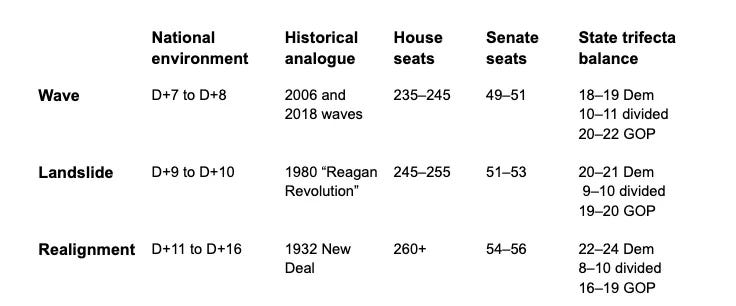
Currently, polling averages paint a picture somewhere between my “wave” and “landslide” scenarios. Democrats are ahead by roughly 8.8 points on the generic Congressional ballot. Polls increasingly project they will retake both chambers of Congress. Election analyst Nate Silver forecasts 52 Senate seats—in line with my “landslide” range—while predicting a more modest 238 seats in the House, closer to a conventional wave. (MAGA’s egregious new racial gerrymanders may account for some of that gap.)
Polls, notoriously, can be biased—in either direction. If they overstate Democratic support, we could see a smaller wave, with a narrower House majority and Republicans retaining the Senate. But if they understate it, we could be looking at a truly massive landslide. Republican spending suggests they fear the worst: GOP groups are pulling millions from states like North Carolina to defend Kansas, Iowa, Nebraska, and South Carolina, and pouring money into dozens of previously “safe” House races. Democratic wins in some of these states and districts could open the way to a once-unthinkable 54- or 55-seat Senate majority and perhaps 250 House seats.
Of course, under partial but intensifying autocracy, it is not enough to win elections—we also have to defend them. We know for sure that Trump and MAGA will attempt to undermine the vote, because they already have—through gerrymandering, voter purges, disinformation, and federal attacks on voting. In the weeks and months ahead, risks to election integrity will unfold in three phases: potential interference with the casting of ballots between now and November 3; potential obstruction of accurate counting and certification in the weeks after the election; and potential attempts to prevent duly elected members from taking their seats as the new Congress takes office in January. Pro-democracy forces will need to be prepared to withstand these and other potential challenges.
It will take a very broad, multi-tendency front to defend our flawed and imperfect democracy against the fascist threat. The more decisively the left demonstrates our ability to contribute to that fight, the more people we can rally to our vision, the more influence we will gain, and the greater our ability to push for a Third Reconstruction.
Therefore, we on the left have a responsibility to meet this moment with everything we’ve got. Coming off a strong primary cycle, we now need to bring that energy into the fight against our main enemy: the MAGA New Confederacy. In some races, that means rallying behind progressive champions like Randy Villegas, William Lawrence and Abdul El-Sayed. In others, it means extending tactical support to centrist candidates—sometimes the very ones we were just fighting in the primaries.
Two Key Tasks: GOTV and Election Defense
We have two key tasks before us in the weeks and months ahead. Between now and election day, we need to mobilize voters in numbers too big to rig. Then, if the election results are undermined, we must take to the streets to stop the cheat.
1. Numbers Too Big to Rig
While many are already looking ahead to election protection, it’s worth remembering that the best election defense is a good election offense. Close elections are especially vulnerable to subversion; the bigger the margins, the harder the results are to manipulate, deny, or overturn. That means our core job from now to election day is to do everything we can to get out the vote.
The October 17 “No Kings” mobilizations aims to make this Saturday the largest single day of early voting in US history. That is a great goal. If your state has early voting, consider voting tomorrow. There are No Kings events planned all around the country; you can find the nearest one here.
People should also plug into canvassing, phone banking, and other GOTV work wherever they can have the greatest impact. For many of us, that’s close to home. The Congressional battlefield extends well beyond the familiar “purple” states; there are at least 20 states with competitive House or Senate races, with some of the tightest in deep-red Texas and deep-blue California. Backlash against MAGA could broaden the battlefield even further, as we are seeing with tightening polls in states like Kansas, Nebraska, and South Carolina. A strong enough wave could even turn the post-Callais gerrymanders into “dummymanders”—allowing us to expand the map and protect Black and Brown political power in the South.
Moreover, the electoral battlefield is not just Congressional. Because our federal system gives enormous authority to the states, state-level races have a critical impact on the balance of power at both the state and national level. The latest round of Republican gerrymanders is just one illustration of the critical importance of state trifectas—control of the governorship and both legislative chambers. Forecasts suggest there are at least five states where we could break Republican trifectas, and six where we could win new Democratic ones.
If you live in an area with important state or federal races, plug into local GOTV efforts and make sure your friends and family have a plan to vote. If your area does not have competitive races on the ballot, you can support efforts to get out the vote elsewhere. National organizations like Showing Up for Racial Justice (SURJ) offer opportunities to phone bank remotely, and Seed the Vote is coordinating travel to critical swing districts, working with partner organizations on the ground. You might focus on nearby battlegrounds or places where you have personal ties, or prioritize left-progressive candidates and fights against racial gerrymandering. (Justin Pearson in Tennessee combines both priorities—one of the reasons I think it is among the most critical races of this cycle.)
2. Take to the Street to Stop the Cheat
After the election, the focus shifts to ensuring that votes are fairly counted and honored. Election defense work has three overlapping stages: ballot curing in the days immediately after voting; local and state mobilizations during counting and certification; and nationwide mobilizations if attempts are made to block the seating of the new Congress.
Immediately after the election, people can help with ballot curing wherever state rules allow, helping voters resolve problems that might otherwise prevent valid ballots from being counted. This work is local and time-sensitive: curing deadlines vary by state and can come just days after the election.
Through November—and, in some states, December—we should be ready to organize and join big “Hands Off Our Vote” mobilizations in the event of attempts to stop the vote count or obstruct certification. This is most likely in places where close results could determine control of Congress, and/or where MAGA officials have the ability to obstruct counting or certification.
Once state results are certified, attention shifts to Congress. If Trump or Republican congressional leaders try to delay the swearing-in of duly elected members or obstruct the transfer of congressional control, we should be ready for nationwide mobilizations in December and early January, demanding that elected members take their seats and the new Congress be allowed to exercise its authority.
Build Organization Beyond November
Wherever possible, we should pursue these two key tasks in ways that strengthen place-based, member-driven organization. Traditional candidate campaigns fold up after Election Day, and in most places Democratic Party structures do little to organize people beyond turning them out to vote. Pursuing election work through grassroots movement organizations can help us win the immediate fight while building a base, developing leaders, and strengthening our power beyond November.
Which organizations to focus on depend on your context. If you’re already involved with a local group or a member of a union, start there. Find out what plans they have for GOTV and election protection. If they don’t yet have a plan, help connect your organization to existing local and state efforts. For union members, your local Central Labor Council (CLC) can be a good place to start.
Liberation Road has long called for building independent political organizations (IPOs) that combine electoral organizing with year-round base-building and leadership development, without formally functioning as a traditional political party. State-level IPOs like the Carolina Federation, New Virginia Majority, and the Ohio Organizing Collaborative put this approach into practice. All three belong to State Power Caucus, which brings together similar organizations. People’s Action and Movement Voter Project also support groups combining electoral work and community organizing, and their directories can help you find organizations near you.
While many left-progressive groups are converging around this IPO strategy, we still lack a single shared political vehicle at the national level. Two very different organizations that aspire to that role are the Democratic Socialists of America and the Working Families Party. Depending where you live, one or the other might be a good place to plug in—but look at what they’re doing locally. DSA chapters with a mass-politics orientation offer a fantastic political home; but amid factional infighting, other chapters remain sectarian and isolated. WFP’s work likewise varies from state to state depending on which individuals and organizations are leading it. (And with its direct membership model still developing, joining one of those partner groups may be the best way to get involved.)
Depending on where you live, local chapters of other national groups like Indivisible and Sunrise might be the best place to plug in. Black Voters Matter is coordinating tours across the South to support local Black groups that combine electoral and community organizing. And for white allies, SURJ is doing some of the most impactful electoral organizing out there.
As this diversity suggests, left-progressive political infrastructure remains fragmented and uneven. A critical task beyond November is to bring these organizations into closer alignment around a shared strategy—building a whole greater than the sum of its parts.
From Resistance to Refusal, on the Road to Reconstruction
A decisive victory in November will open a new phase in the protracted struggle against the MAGA New Confederacy. For the past two years, pro-democracy forces were on the strategic defensive. Locked out of power at the federal level, we have largely been in resistance mode. Wresting back control of Congress will allow us to move from resistance to refusal. We will have more power to block the further advance of Trump’s fascist project, even as we don’t yet have the ability to implement our own agenda—a strategic stalemate. We must then use that strengthened position to ready the ground for a strategic counteroffensive in 2028.
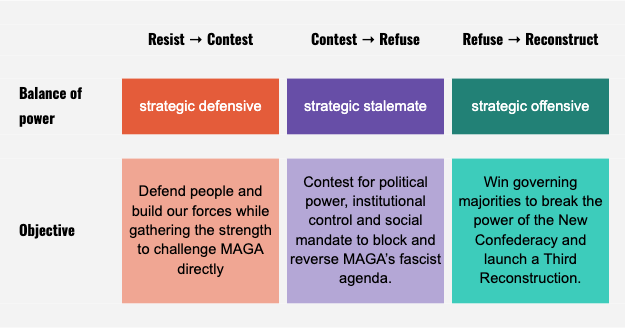
Having Democratic House and Senate majorities would greatly strengthen our ability to halt the Trump regime’s corruption and lawless violence. The House can impeach officials responsible for abuses, the Senate can block judicial appointments, and both chambers must reclaim the power of the purse—compelling the administration to spend funds as Congress directs, and using budget negotiations to refuse further money for wars and deportations. Given the fecklessness of Democratic House and Senate leadership, it will take sustained mass pressure to make them use these powers—and we should push for leadership challenges if they refuse.
States that break Republican trifectas can pursue a similar strategy, blocking MAGA’s agenda even where we cannot yet enact our own. In states like Florida and Georgia, winning the governorship would give us veto power over reactionary legislation, and greater leverage over budget negotiations, in addition to the direct powers of the executive branch. Our movements must press governors to use those powers to block attacks on abortion and LGBTQ+ rights, strengthen voting access, protect workers, and fight for Medicaid expansion and an end to state cooperation with ICE.
States that emerge from the election with new or strengthened Democratic trifectas will become our forward operating bases. Here, we can move beyond blocking MAGA’s agenda to advancing our own: expanding healthcare, housing, and workers’ rights; protecting immigrants and bodily autonomy; and enacting bold structural reforms to our system of government.
Minnesota provides one example of what that can look like. After winning a state trifecta in 2022, Democrats moved quickly to enact a sweeping agenda: paid family and medical leave; free breakfast and lunch for all public school students; tuition-free public college; expanded immigrant, reproductive, and trans rights; and a plan for 100% carbon-free electricity by 2040. Though that bold agenda passed in a single legislative session, it was the product of years of organizing by labor and social movements to build a shared program, and the power to win it.
Our movements urgently need to ready the ground for something similar at the federal level, so we can push for and take advantage of a strategic counter-offensive in 2028. Assuming we win House and Senate majorities and the presidency, we will have a narrow window in which to act.
Winning electoral ground this November strengthens our starting position: newly elected senators will still hold their seats in 2028, while House victories give us incumbents to defend. But electoral gains alone will not prepare us to govern. We need to forge a shared agenda bold enough to rally millions—and an organized movement strong enough to win it.
Our agenda must match the scale of the crises we face. We must be ready to deliver universal healthcare, childcare, and eldercare; build social housing; strengthen workers rights; implement a just transition to renewable energy; and guarantee reproductive and gender freedom. And we must transform the institutions that obstruct those gains: expanding and democratizing the Supreme Court, securing statehood for DC and self-determination for Puerto Rico, passing the John Lewis Voting Rights Act, and replacing rigged electoral maps with free and fair ones.
We must start organizing for that transformation now. Our movements must bring our members together to discuss demands, connect immediate fights to structural change, and forge a common governing agenda. By 2028, we need millions of people who have helped shape this agenda, are organized to fight for it, and will demand that those we elect deliver it.
Together, we can turn an electoral opening against autocracy into a mandate to expand, transform, and fundamentally reconstruct our democracy. Only then can we truly break the power of the MAGA New Confederacy and launch a Third Reconstruction.
Bennett Carpenter is a queer Southern organizer, trainer, and movement strategist. They are a member of the National Executive Committee of Liberation Road.