


TABLE OF CONTENTS
APPLYING THIS STRATEGY TO DIVERSE TERRAINS
Tactical Objectives: Resist, Contest, Refuse, and Reconstruct
Secondary Contradictions: Struggles with Establishment Forces
Tertiary Contradictions: Struggles within the People’s Movements
PREFACE
Purpose and focus of this document
This Strategic Orientation is designed as a companion to Liberation Road’s 2022- 2025 Main Political Report (MPR), which identified key political developments of the recent period. If the MPR offers a detailed map of the political terrain we’re operating on, this document serves as a compass. It attempts to provide a directional guide for how advanced forces should navigate this terrain toward shared strategic objectives: to block the consolidation of fascist autocracy, broaden the pro-democracy united front, and build the independent left-progressive power necessary to advance a project of deep political and social transformation, which we term a Third Reconstruction.
This document is a compass in the sense that it provides a set of tools, as well as instructions about how to use those tools to determine what to do. Geographically, sectorally, and organizationally, left and progressive forces are rooted in different locations within the terrain that we analyze. While we seek to advance shared objectives, the specific paths to move us toward those goals depend on many factors. Because of this complexity and heterogeneity, this Strategic Orientation does not and cannot provide a set of detailed, rigid instructions that apply across all geographic terrains and movement sectors. Instead, it seeks to provide a flexible framework to help left forces apply overarching strategic objectives to their concrete conditions in order to figure out the specific tactical interventions they should pursue. In other words, this document does not give specific marching orders (“turn left here, go straight ahead there”) but rather an overall strategic orientation (“here are the ways to determine where you are in relation to where you must go, and to identify what to do from there”).
Who this document is for
This document outlines a strategy that needs to be pursued by a conscious, coherent, and consolidated bloc of left and progressive forces rooted in powerful mass movement organizations. And yet one of our key strategic diagnoses is that this very bloc—while it exists in embryonic and uneven form—is still too fragmented, too incoherent, and too weak to carry out the tasks that this period demands. In a sense, this document is at once an orientation, an invitation, and a provocation: a call for the emergence of a more unified and capable left-progressive bloc that can rise to meet the magnitude of this moment. To phrase it sharply, this strategy is written for a collective mass left that has not yet cohered.
This strategy is therefore intended for those actively trying to build that left-progressive collective political subject. It is for the mass leaders, organizers, and strategists working to translate scattered resistance into coordinated motion within and across movement sectors; working at the local, state, and national level; engaging in defensive fights and strategic counter-offensives. We offer it as one contribution to a larger project: developing the collective will and political discipline necessary to forge a genuine mass left.
For cadre members of Liberation Road specifically, this document is intended to guide our collective work over the next three-year period—helping us assess the terrain, determine where and how to intervene, and coordinate our contributions to the broader aims of our movements. Sections I through IV of this document have a dual function: to help orient both our cadre narrowly, and left and progressive forces more broadly. In contrast, section V outlines tasks for Liberation Road cadre specifically— aimed at helping our cadre apply these overarching objectives to specific red work and red mass work interventions they can pursue through geographic districts and national work teams and commissions.

I. EXECUTIVE SUMMARY OF THE 2025-2028 STRATEGIC ORIENTATION
This document presents Liberation Road's three-year (2025-2028) Strategic Orientation. Its purpose is to translate our 2025 Main Political Report's general analysis of conditions into a specific plan of action. Our Main Political Report assessed that we are in a period of interregnum, where the hegemony of the US-led neoliberal order has collapsed, but no new order has emerged. In this vacuum, the New Confederacy is vying to consolidate hegemony around an authoritarian, white supremacist, and patriarchal political project. Having long prepared a “slow-motion coup” against our imperfect democracy, the New Confederacy is now taking advantage of its trifecta control of the federal government to mount a rapid war of maneuver to install a new autocratic regime. This is a battle between reconstruction and reaction—between those seeking to complete the centuries-long struggle to build an antiracist democracy, and those seeking to restore a patriarchal, white nationalist autocracy. Our task is not only to defeat this reactionary project, but to win a Third Reconstruction worthy of our ancestors and our future.
The New Confederacy aims to use its control of the federal government to consolidate autocracy, an intermediary regime type between democracy and dictatorship. To do so, it will attempt to subjugate all branches, levers, and levels of government, and to subvert the independence of civil society (including organized labor, independent political organizations, NGOs, universities, and the media). There are three stages of autocratic transformation: attempt, breakthrough, and consolidation. At the time of writing, we are at the stage of an autocratic attempt, with partial autocratic breakthroughs in certain areas. While the severity and scale of the assault is extreme, the strength and diversity of US civil society and the decentralization of powers within the US political system create many points for refusal, resistance, and contestation.
With concerted effort, we can beat back the New Confederacy’s authoritarian project; defend the people’s political, civil, social, and economic rights; and lay the groundwork for a Third Reconstruction. To do so, we must explicitly make the fight against racism and national oppression central to our strategic orientation and united front. In this period, there are three urgent, interrelated, simultaneous strategic objectives that all advanced forces must pursue:
Our first strategic objective is to block the New Confederacy from consolidating autocracy. Institutions and organizations are the pillars of power that either prop up the ability of a regime to rule, or deprive it of support. Politically, we must defend the independence of all branches, levers, and levels of government. Socially, we must defend the autonomy of civil society institutions including organized labor, social movements, media, academia, and faith groups. Ultimately, we need to use both political and social defensive battles to lay the groundwork for a strategic counter-offensive to reverse autocracy and reconstruct democracy. Ousting the New Confederate regime will require a combination of mass electoral mobilization and mass nonviolent social action before, during, and after elections. Our forces should plan a three-year counter-offensive that uses elections as flashpoints to build political and social power, with the ultimate aim of unseating the New Confederate autocratic regime in 2028. Simultaneously, we must prepare the foundations to push for and implement a Third Reconstruction program to reconstitute our government and society as a consistent anti-racist, pro-justice democracy.
Our second strategic objective is to broaden the pro-democracy front to defend the people’s political, civil, social, and economic rights. Because the success of our efforts will be based, in part, on the size and representativeness of our front, we must forge tactical alliances with diverse class and social forces. These forces hold a variety of left, centrist, and center-right political positions, but can be united in opposition to the New Confederacy’s attacks on the people’s existing political, civil, social, and economic rights. We must hold the front together in defense of immigrants, trans people, pro-Palestinian protestors, and others who are fascism’s “first targets.” At the international level, we must defend the right of all nations to self-determination, and the rights of all peoples within and across nations. To foment broad resistance across all sectors of society, we should encourage a diversity of nonviolent tactics, but maintain unity around nonviolence as a core component of our defensive strategy (while recognizing the right to self-defense). To be successful at scale, our front must be distributed, localized, and pluralist; but wherever possible, we should connect protests and mass mobilization to long-term, place- and structure-based organizing.
Our third strategic objective is to build the power of progressive forces to lead a strategic counter-offensive toward a Third Reconstruction. We must build the independent power of the left-progressive sections of our front, rooted in mass membership organizations of the multiracial working class, the oppressed nationalities, and women and LGBTQ+ people. Politically, we must build the power of independent political organizations (IPOs) to fight for a deep-seated democratic transformation of the state. Socially, we must build the power of progressive sectors of organized labor and the social movements to fight for a deep-seated democratic transformation of our economy and civil society. Left-led labor and social movement organizations and IPOs should increase tactical and strategic alignment, building toward a shared “political vehicle,” rooted in an organized mass membership, with a focus at the state level. Where mass organizations are not yet sufficiently consolidated to form or join a collective political vehicle, left forces should organize internally and coordinate externally to help increase alignment. At the national level, we should connect mass organizations to the Working Families Party as the seeds of a nationwide political instrument with a flexible, federated structure. These efforts should build toward coordinated efforts to run a slate of progressive political candidates—including a credible presidential candidate—and the development of a popular political program that lays the foundations for a Third Reconstruction.
Within this shared strategic orientation, our tactical objectives vary with the terrain: resistance in “red” states and New Confederate strongholds, contestation in “purple” states and contested territory, and refusal and reconstruction in “blue” states and Pro-Democracy bastions. While the left’s strategic defensive and counter-offensive objectives remain the same, our tactical means of advancing these objectives will vary based on the balance of power in any particular political or social terrain, as will our secondary struggles with establishment moderates and corporate Democrats and the tertiary contradictions within our movements.
In red states, localities and institutions captured by the New Confederacy, our work is primarily defensive. Here, we must resist the New Confederacy by undermining its legitimacy, protecting the most vulnerable, and disrupting its efforts to consolidate autocratic power. Organizing in these conditions requires resilience, creativity, and courage—from mutual aid and community defense to institutional noncooperation and strategic defiance. These terrains demand strong movement infrastructure even when electoral openings are limited, and they often require cooperation with moderate forces despite ideological differences. While pragmatism and reformism can be right errors here, a countervailing risk is revolutionary pessimism: retreating into isolation or symbolic militancy disconnected from mass action. In these places, our three-year strategic counter-offensive should be to use resistance struggles to build the power to pick winnable fights that directly contest against the New Confederacy, especially as national-level cracks in MAGA power emerge.
In purple states and institutions and contexts where power is up for grabs, we are in a high-stakes fight to tip the balance, not just electorally, but in the hearts and minds of the masses and within the institutions of civil society. Here, the central objective is to broaden and solidify a durable pro-democracy majority while fighting for greater leadership within it—choosing fights that grow our forces, split the opposition, and test-drive demands that can win real support. The contradictions here are fluid and often mixed—both between progressives and corporate Democrats, and within our own movements. The left must stay rooted, disciplined, and responsive, building political vehicles and social formations that can shift the terrain decisively toward reconstruction. In these places, our three-year strategic objective should be focused on directly defeating the New Confederacy in head-to-head fights—electorally and otherwise—in order to actually win governing power and lay the foundations for a Third Reconstruction.
In states, localities, and institutions where pro-democracy forces hold power, our task is to refuse complicity with the New Confederacy and begin to prefigure a Third Reconstruction. These are our movement’s forward operating bases—zones where we can organize to refuse fascist compliance, and fight to expand democratic rights. Struggles with the Democratic establishment and moderate forces are often sharp and antagonistic, but must not jeopardize the broader effort to defeat the New Confederacy; these contexts carry the risk of heightened ultra-leftism, given the distance between the most immediate struggles against corporate Democrats and the primary, national struggle against the New Confederacy. Contradictions within our movements often surface as strategic disorientation, political “purism,” or factionalism and sectarianism within the left itself—requiring deliberate efforts to stay grounded in mass politics. In these places, our three-year strategic counter-offensive objective should be to bridge from refusal to reconstruction—modeling new forms of governance that deepen popular participation and shift power downward and outward.
As we build toward a strategic counter-offensive, our motto must be “one step forward, everywhere we fight.” In New Confederate strongholds, we should seek to build the power to move from resistance to contestation. In contested terrain, we should use electoral and extra-electoral contestation to win the power to actively refuse the New Confederacy. In pro-democracy strongholds, our task is to go beyond refusal to reconstruction—modeling new forms of governance that deepen popular participation and shift power downward and outward.
Within the broad efforts outlined above, Liberation Road’s central task is to help cohere the advanced leaders of mass organizations in the left-progressive bloc—prioritizing the strategic alliance of the oppressed nationalities and the multiracial working class, particularly oppressed gender people—to defend people's rights, defeat New Confederate autocracy, and set the stage for a Third Reconstruction.
We define “the advanced” as those rooted in movements of the multiracial working class and the oppressed nationalities and genders who share both clarity on the threat of fascist autocracy and commitment to a transformative, justice-centered democratic program. Our central task requires facilitating coordination, shared strategic direction, and programmatic unity-in-action among these forces within and across movement sectors at all levels: local, state, and national.
To carry out our central task, all Liberation Road cadre will engage in a structured deployment process following Congress, through which our geographic districts and national work teams and commissions will determine concrete interventions aligned with our strategic orientation. Cadre will contribute through two interrelated avenues: red mass work (organizing collective interventions within and across mass organizations) and red work (helping develop the left’s strategic program, organizational infrastructure, and ideological clarity).
II. THE NEW CONFEDERATE OBJECTIVE: FASCIST AUTOCRACY
The New Confederacy remains the main enemy of this political period. A decade ago Liberation Road identified what we called the “New Confederacy” as “the main enemy in this period” and “the dominant force shaping the US political terrain in this moment.” We argued that it was “composed of the most reactionary factions of capital allied with racist/nativist, right-wing populists,” and described the Republican Party as “the political expression of this alliance.” Just as the post-Civil War Redemption movement sought to reverse Reconstruction, and the post–Civil Rights backlash gave rise to mass incarceration and neoliberal austerity, today’s New Confederacy is the organized reaction to the social gains of recent decades—from Black liberation to LGBTQ+ rights to climate justice. Simultaneously, the New Confederacy manipulates the economic and status anxiety wrought, in part, by neoliberalism to shore up a revanchist united front—scapegoating immigrants and trans people to shore up white racial and patriarchal coalitions.
Today, the New Confederacy aims to overthrow multiracial (neo)liberal democracy and replace it with a new authoritarian regime. This is not a conservative project, but a right-wing revolutionary one that seeks to replace our flawed and imperfect democracy with a new fascist regime. Where neoliberalism covertly undermined the gains made by Black and Brown, women’s, workers’, and other social movements, the right now seeks to overtly repress and suppress them, smashing the remaining vestiges of a multiracial pluralist society and rolling back all the gains made by the oppressed nationalities, oppressed gender, and workers’ movements over the past hundred years.
The New Confederacy aims to establish an autocracy. If the New Confederacy is able to consolidate an authoritarian regime, it will likely be a “hybrid” regime type that centralizes power in the executive branch of the state, but maintains some formal features of democracy, including semi-competitive elections, nominal (if weak) civil liberties, a legal political opposition, and the absence of widespread, overt state terror. Some call this “competitive authoritarianism” or “illiberal democracy.”1 A simpler term is “autocracy,” understood as a stable regime type distinct from both democracy and dictatorship:
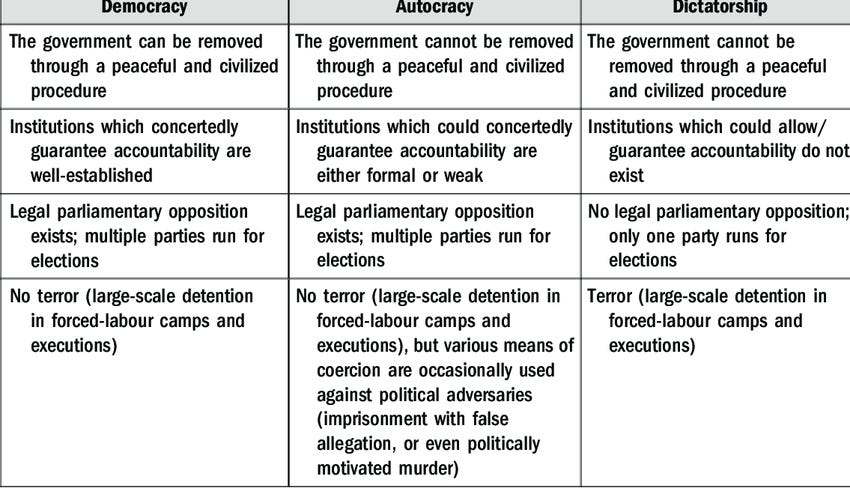
A MAGA-led autocratic regime will be patronal. All regime types (democracies, autocracies, and dictatorships) can be more or less rules-based or patronal. In a rules-based system, authority is based on agreed-upon norms, expressed through formal institutions, and enforced by rules and regulations. In a patronal system, authority is based on the personal power of a leader or “patron,” who runs the government as an extension of his household, with his will expressed through informal patronage networks, and enforced by threats and promises. While we often associate patronalism with authoritarianism, many authoritarian regimes are rules-based and bureaucratic. However, the regime that is currently consolidating around Donald Trump is patronal.
A patronal autocracy is also called a mafia state. This is not because the state’s activities are necessarily criminal, but because the patterns of power are structurally similar to the mafia: it is a regime run by and in the interests of an “adopted political family,” a patronal network dominated by a chief patron who exercises unconstrained informal power over political, economic, and social spheres. The chief patron uses personal loyalty and discretional rewards and punishments to maintain control. The de jure ruling party does not de facto govern, but rather rubber-stamps decisions made by the patron's “court,” an informal body of close decision-makers. The bureaucracy is filled with patronal servants who act on the chief patron's orders. The judiciary is neutralized, providing impunity for the adopted political family, and corruption is centralized and monopolized by the regime. Victor Orban’s Hungary is an example of a fully consolidated patronal autocracy.
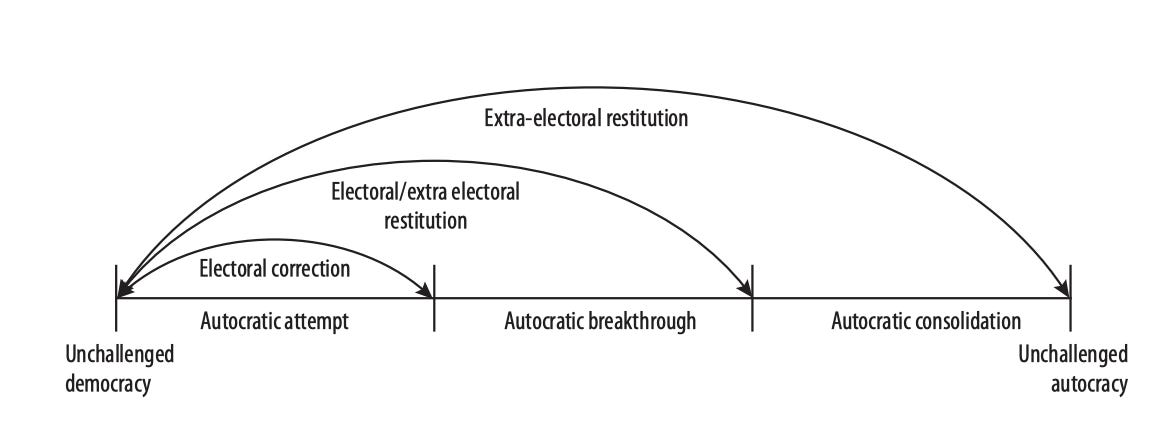
There are three stages of autocratic transformation: attempt, breakthrough, and consolidation. The transformation of democracy into patronal autocracy typically goes through three stages:
Autocratic attempt - Aspiring autocrats use their democratic mandate to 1) strengthen the power of the executive, 2) narrow the powers of other branches, levers, and levels of government, and/or 3) replace government officials with personal loyalists.
Autocratic breakthrough - Autocrats systemically transform a democracy to an autocracy via a “constitutional coup,” connecting the branches of government to a single vertical of vassalage and gaining patronal control over the entire state.
Autocratic consolidation - Autocrats use the power of the state to subjugate the autonomies of civil society (media, academia, NGOs, labor, etc.) undermining effective opposition and the public deliberation process.
There are two key democratic defense mechanisms against autocracy: the separation of political powers and the autonomy of civil society.
The first defense mechanism, the separation of powers, has both horizontal and vertical dimensions. Horizontally, it includes the separation of legislative, judicial, and executive powers—the branches of government. It also includes the degree of operational autonomy exercised by the civil service and administrative apparatus—the levers of government. Vertically, it includes the separation of power between national, regional, and local government—the levels of government. The stronger the institutional boundaries between branches, levers, and levels of government, the more difficult it will be for the New Confederacy to achieve a monopoly on political power.
The second defense mechanism, the autonomy of civil society, concerns the size, strength, diversity, and resiliency of civil society organizations. We can define “civil society” as all the different groups, organizations, and associations that exist within the geographic territory governed by a state, but that are formally and functionally independent of the sphere of government. The more independent civic organizations there are, the more people who are actively involved in those organizations, and the more they refuse to comply with the regime, the more difficult it becomes for the New Confederacy to consolidate social control.
At the time of writing, we are at the stage of an autocratic attempt, with partial autocratic breakthroughs in certain areas. Nationally, the New Confederacy has achieved an autocratic breakthrough over the federal administrative apparatus, but has not yet managed to fully subjugate the judicial and legislative branches, nor to eradicate the possibility of electoral opposition victory. The picture is more complex at the state level:
In many of the 23 states where the New Confederacy holds governing trifectas, they have achieved autocratic breakthroughs, functionally restricting or eliminating the possibility for pro-democracy forces to win majorities in free and fair elections at the state level. In some of these states, such as Florida, the New Confederacy has further advanced toward autocratic consolidation.
Of the 27 remaining states, 15 have Democratic government trifectas, while 12 are under divided government. In most cases, the systems of liberal democratic governance remain fully or largely intact in these states.
Although the right-wing’s autocratic capture of many state governments has contributed to the erosion of electoral fairness at both the state and federal electoral level, the current balance of state-level power is overall favorable to protecting the (relative) fairness of the 2026 and 2028 federal elections.
III. THREE STRATEGIC OBJECTIVES: BLOCK, BROADEN, BUILD
With concerted effort, we can beat back the New Confederacy’s authoritarian takeover, defend the people’s political, civil, social, and economic rights, and lay the groundwork for a Third Reconstruction. Doing so will require that we connect defensive struggles to a three-year strategic counter-offensive focused on unseating MAGA forces across and through the 2026 and 2028 elections, using a combination of mass electoral mobilization and mass nonviolent social action. Simultaneously, we must ready the ground to push for and implement a transformative program immediately following the ouster of autocratic forces, in order to defend, expand, and transform democracy toward a Third Reconstruction. To achieve these objectives, there are three urgent, interrelated, simultaneous strategic objectives that all advanced forces must pursue:
Block the New Confederacy from consolidating fascist autocracy.
Broaden the anti-fascist front around the defense of political, civil, social, and economic rights.
Build the power of progressive forces to lead a strategic counter-offensive toward a Third Reconstruction.
A. Block the New Confederacy from consolidating fascist autocracy
To block the New Confederacy from consolidating fascist autocracy, advanced forces must mount a strategic defense and, ultimately, counter-offensive on the terrain of both political and civil societal power. We should focus our strategic defense on depriving the regime of the ability to consolidate autocracy by neutralizing, undermining, or withdrawing the support of key political and civic institutions—the “pillars of power” upon which all regimes ultimately depend in order to govern. As we wrest political and civil institutions away from control by or compliance with the New Confederate regime, we must mount a strategic counter-offensive to increase the power of our Multiracial Pro-Democracy United Front within the state and civil society.
Institutions and organizations are the pillars of power that either prop up the ability of a regime to rule, or deprive it of support. As Gene Sharp wrote: “By themselves, rulers cannot collect taxes, enforce repressive laws and regulations, keep trains running on time, prepare national budgets, direct traffic, manage ports, print money, repair roads, train the police and army, issue postage stamps or even milk a cow. People provide these services to the ruler though a variety of organizations and institutions. If people stop providing these skills and services, the ruler can not rule.” Every pillar we pull away from support of the New Confederacy helps weaken its reactionary regime and lays groundwork for the institutions, relationships, and forms of governance that a Third Reconstruction will require.
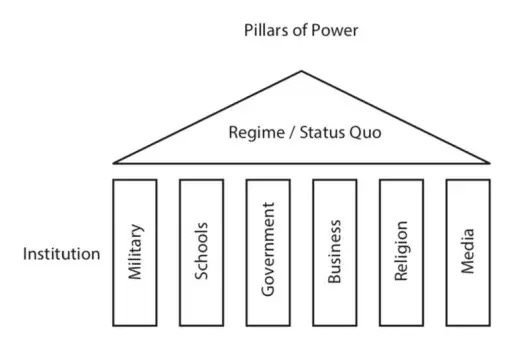
Politically, we must defend the independent branches, levers, and levels of government. At the federal legislative level, our forces must pressure Democratic and vulnerable Republican representatives and senators to refuse compliance with the regime. Judicially, our front must challenge unlawful actions in the courts, and use public pressure to protect judicial autonomy. On an administrative level, we should organize and support federal workers to resist and contest unlawful actions from Trump and DOGE and to defend the autonomy of independent federal agencies. On a local and state level, we must organize to push elected officials to resist, contest, and refuse compliance with the authoritarian agenda of the New Confederacy. Mass mobilization, protest, and street heat will be key to pushing all these fronts of struggle along.
Socially, we must defend the autonomy of civil society institutions including organized labor; oppressed nationality, women’s, and LGBTQ+ organizations; universities; independent media outlets; advocacy organizations; civic associations; and faith groups. The New Confederacy cannot impose autocracy without the passive or active consent, compliance, and complicity of many people working within a variety of organizations and institutions. We should organize within all those “pillars of power” to win people and organizations to our united front, and push them to refuse, resist, and contest compliance with unlawful and antidemocratic actions by the Trump regime.
We must coordinate our political and social self-defense, while respecting the autonomy of these two domains of struggle. Strategic social self-defense can help provide pressure and cover to strengthen our strategic defensive within and over the branches and levels of government. Strategic political defense can create cover and pressure for strengthened struggles within and over the institutions of civil society. We should leverage social and political defensive strategies in ways that support and reinforce each other, and coordinate these efforts where possible, while respecting their autonomy.
Example: When several New York City hospitals announced they would cease providing gender-affirming care in compliance with new White House directives, thousands mobilized in protest. Healthcare workers organized within these institutions to protect their trans patients. The New York State Attorney General formally notified hospital administration that ceasing service would violate equitable care provisions under state law. The combination of social and political defense caused many hospitals to reverse course and restore gender-affirming care.
Ultimately, we need to use both political and social defensive battles to lay the groundwork for a strategic counter-offensive to reverse autocracy and reconstruct democracy. The counter-offensive strategy needed to reverse autocracy depends on the stage to which autocratic transformation has progressed:
In democracies where there has merely been an autocratic attempt, democratic backsliding can be reversed through an “electoral correction.” Because core mechanisms that ensure democratic governance remain intact, the autocratic regime can be ousted electorally, and a new governing agenda initiated without requiring structural changes to the political system.
In a fully consolidated autocracy, ousting an autocrat requires “extra-electoral restitution.” Because it is not possible to remove the autocratic regime through free and fair elections, democratic transition requires revolution, and if a revolution is successful the democratic system must be fully reconstructed.
In between these two extremes, a “quasi-electoral restitution” is needed where there has been an autocratic breakthrough, but not yet full autocratic consolidation. In this scenario, autocratic regimes can be reversed through a mixture of electoral and extra-electoral mobilization, while the partial degradation of democratic structures will require some degree of democratic reconstruction of the political order. This is the scenario we are now in.
Ousting the New Confederate regime will require a combination of mass electoral mobilization and mass nonviolent social action before, during, and after elections. Regardless of the level of autocratic consolidation, elections remain crucial focal points for mobilizing robust collective action. Where elections are more free and fair, mass electoral mobilization allows for a democratic transfer of power. But even in deeply authoritarian regimes, widespread pre-election and post-election protests are strongly correlated with successful democratic transition. We should thus use elections as flashpoints around which we plan and coordinate both widespread electoral mobilization and widespread nonviolent social action—protests, economic boycotts, strikes and work stoppages, social noncooperation, etc.
Example: In 2020, electoral mass mobilization drove a presidential electoral victory for Joe Biden. Yet Trump refused to recognize the results, and sought to overturn them through both legal challenges and extra-legal means. Having prepared for this possibility, state and local organizers mobilized rapid response to protect poll-counting sites. National groups held rallies, business elites called for the election results to be honored, and media sources (including right-wing outlets like Fox News) accurately reported the election results. Ultimately, this combination of electoral mobilization and civic society mobilization successfully defeated an autocratic coup attempt and ensured a democratic transition of power.
Our forces should plan a three-year counter-offensive that uses elections as flashpoints to build political and social power, with the ultimate aim of unseating the New Confederate autocratic regime in 2028. At a federal level, we should attempt to break the Republican House majority in 2026, and to retake the Senate and the presidency in 2028. Just as crucial will be efforts focused on the state level. By or before 2028, we should aim to help secure Democratic trifectas in 5 or more additional states (potentially Virginia, Michigan, Minnesota, Nevada, Arizona, Wisconsin, or Pennsylvania) while defending and strengthening majorities in current “blue” states. We should seek to break Republican trifectas in three or more states (potentially Georgia, Iowa, Texas, or New Hampshire) while weakening Republican majorities in other “red” states. We should aim to secure at least as many Democratic state trifectas as Republican state trifectas by 2028.
Simultaneously, we must prepare the foundation to push for and implement a Third Reconstruction program in the event that we unseat the New Confederacy. Our already deeply flawed democracy will have been further degraded by the time we unseat fascist autocracy in 2028, assuming we are able to do so. We will thus need to develop and implement a program to reconstruct our democracy at the national level and through state and local governments that pro-democracy forces control. Four domains have been deeply degraded: our political system, our social and economic rights, our environment, and international cooperation. We will thus need to reconstruct our democracy, society, and foreign policy. We call this a “Third Reconstruction” because it will advance the unfinished work of the United States’ First (1865-’77) and Second (1954-1971) Reconstructions. A Third Reconstruction program must be developed and led by left-progressive forces rooted in the multiracial working class, the oppressed nationalities and genders, and the social movements, which we discuss in more detail below.
Example: Following the 2020 general election, many forms of democratic reconstruction were proposed, from using the 14th Amendment to bar Trump from running again for office, to passing the John Lewis Voting Rights Act to protect voting rights from violation. Ultimately, few of these measures were enacted. There was an electoral correction, but insufficient democratic restitution, meaning the institutional mechanisms of democracy remained partly degraded—setting the stage for Trump’s second ascent to office and his second autocratic coup attempt.
B. Broaden the anti-fascist front around the defense of the people’s rights
We must forge tactical alliances with diverse class and social forces. As in past reconstruction periods, defeating reaction will require an alliance that spans identities, constituencies, and ideology—uniting everyone committed to the survival and renewal of democratic life. Because the success of our efforts will be based, in part, on the size and representativeness of our front, we must seek to unite with a wide variety of social forces. Study of other autocratic regimes shows that successfully resisting and reversing autocracy requires forging a broad front across racial, ethnic, class, gender, religious, regional, and ideological lines. We must continuously seek to broaden our base of support and narrow that of the autocratic New Confederate regime.
These forces will hold a variety of progressive, moderate, and center-right political positions. There is a latent anti-fascist, pro-democracy majority in this country who are covertly or overtly opposed to the New Confederate regime; as the negative impacts of the regime take effect, there will be many opportunities to broaden our front still further. Within this broad front are many different political forces. We identify progressive forces as those within our front who strongly align with our agenda of race, class, and gender justice; moderate forces as those who weakly align with these three pillars, or who strongly align with at least one but do not align with others; and center-right forces as those who weakly align with some components of this agenda, but actively oppose us in other areas (for instance, never-Trump sections of the Republican Party).
We must unite this broad and contradictory front in opposition to the New Confederacy. Doing so will require us to step out of our comfort zones, embrace contradictions, and be willing to engage people with whom we have deep disagreements. We don’t need to ignore or deny those differences, but we do need to recognize our shared interest in preserving a liberal democracy (however imperfect) where our ability to struggle over those disagreements is defended. Thus, where differences threaten to fracture our coalition’s ability to oppose fascist autocracy, we must subordinate them to our shared commitment to defend our existing democracy and the people’s rights.
Our key points of unity must be defense of the people’s existing political, civil, social, and economic rights. While forces in the pro-democracy front will disagree on many things, we must hold our entire front together around defense of the people’s existing rights, including but not limited to:
Political rights - the right to vote in free and fair elections; to join a political party; to run for office; and to participate freely in political rallies, events, and protests.
Civil rights and liberties - the right to a fair trial; to protection from unreasonable searches and seizures; to equal opportunity in employment and housing; and to form unions and bargain collectively.
Socio-economic rights - the right to public education; to access to healthcare and medical treatment; to social security, including unemployment benefits, pensions, and disability benefits.
Example: the “hands off!” framework used by organizers of the April 5, 2025, National Day of Action is a great example of a unifying rallying cry around defense of existing rights. The framework allowed for the articulation of a common slogan connecting different defensive struggles (e.g., “Hands off Medicare!” “Hands off union contracts!” “Hands off our bodies!”) to a unifying narrative framework. At the current stage of struggle this narrative frame is still largely defensive; one of our tasks for the coming period will be to maintain this orientation as we build toward a strategic counter-offensive that can connect different issue fights within a unifying programmatic framework.
We must rally the front in defense of fascism’s first targets: immigrants, trans people, pro-Palestinian organizers, and others singled out for attack. Because fascists always start by targeting the “weak points” where they perceive our front as most vulnerable, it will be especially important to rally the front in defense of fascism’s early targets—currently immigrants, trans people, and pro-Palestinian protesters—as well as other emergent targets subsequently singled out for attack. In the early days of the Trump 2.0 era, mass mobilization has largely focused on democracy in abstract terms, personal attacks on Trump and Musk, and to a lesser extent on cuts to federal workers and programs. These are important, but we must also work to focus the resistance on opposition to mass deportation, racial oppression and ethnic cleansing; gender oppression and the assault on trans’ and women’s rights; and the persecution of political protesters in general and pro-Palestinian organizers in particular. Not everyone in our front will agree with the politics and demands of these groups, but we must hold them together around defense of their social, civil, and political rights.
At the international level, we must broaden the front in defense of two core principles: the right of all nations to self-determination, and solidarity with the struggles of all oppressed and exploited peoples within and across nations. Over the next three years, we will be facing climate catastrophe, geopolitical fragmentation, and faltering profits that increase the barbarism of many ruling regimes, and spark military conflicts—all of this erupting in unpredictable ways that will require our constant tracking. We must be ready to unite with broad forces to defend the right of all nations to self-determination, whether or not we consider the regimes in power in those nations to be progressive, and regardless of who is the imperialist aggressor. This is a core principle that must be applied consistently and universally. As the US remains the largest imperialist power, it is especially critical for us to oppose US military, political and economic dominance—and especially to build a broad front against the ongoing genocide in Gaza, Israel’s annexation of the occupied territories, and their ethnic cleansing project. However, we must also support the right to self-determination of nations who are targeted by other imperialist powers, such as the Ukrainians and Kurds. Simultaneously, we must seek to foster international solidarity with all oppressed and exploited people, whatever national regime they are living under. This includes supporting oppressed genders, sexualities, national and religious minorities, and working people in struggles against their own ruling classes and national regimes, even as we oppose foreign interference in the affairs of those nations. In solidarity with peace-loving people everywhere, we must organize the broadest possible front against war and fascism, and for democracy, social and economic justice, and peace.
To foment broad resistance across all sectors of society, we should encourage a diversity of nonviolent tactics. Because we will need widespread resistance across many sectors of political and civil society, we should embrace and encourage a diversity of nonviolent tactics. This creates a low barrier for entry, and allows different groups and organizations to plan actions that make sense for different contexts. Gene Sharp’s “198 Methods of Nonviolent Action” offers an overview of different tactics that can be used to stoke resistance against the regime.
We should maintain unity around nonviolence as a core component of our defensive strategy (while recognizing the right and necessity of self-defense). Our insistence on nonviolence is strategic. Although movement scholar Erica Chenoweth has found that nonviolent strategies are generally more effective even against deeply repressive regimes, we recognize armed resistance as a valid strategy for oppressed people to pursue under certain conditions. Under our current conditions, we believe that maintaining unity around nonviolent resistance is crucial to increasing mass moral and physical involvement in our pro-democracy united front. This will help us gain higher levels of participation and greater movement resilience, increase opportunities for disruption, and increase the likelihood of shifting support away from the authoritarian regime and toward our pro-democracy movement. We distinguish nonviolence from self-defense, particularly when threatened by far-right militia and extremist groups, and support the right and necessity of self-defense, especially for oppressed nationality communities and other oppressed groups.
We should coordinate large-scale defensive actions and mobilizations, but also encourage local autonomy and decentralized leadership. Alignment and coordination of our opposition efforts will be critical to our success. Where possible, we should collectivize assessments, coordinate actions, and communicate about tactical maneuvers. At the same time, the scale and scope of sites of strategic self-defense will necessitate flexibility and local autonomy and initiative, which will also help prevent movement defeat in the event that the regime targets prominent opposition and resistance leaders.
Wherever possible, we should connect protests and mass mobilization to long-term, place- and structure-based organizing. At present, emergent protest movements are often led by self-organized and often ephemeral local networks and coordinated via social media, with large national groups often endorsing events and providing some high-level messaging and other guidance, but very little material support or durable infrastructure. Groups like Indivisible are providing more consistent ongoing support, with the latter’s flexible federated structure and heterogenous political character allowing it to capture the movement’s momentum, but limiting overall political, strategic, and organizational coherence. As much as possible, we should connect mass mobilization to long-term organization, both by ensuring IPOs, labor unions, and other base-building organizations have an organizational presence at these protests, and by connecting new layers of activists from these protests to long-term, place-based organization.
C. Build the power of left-progressive forces to lead a strategic counter-offensive toward a Third Reconstruction.
We must build the independent power of the left-progressive sections of our front, rooted in the multiracial/multinational working class, the oppressed nationality movements, and the women’s and LGBTQ+ movements. While it is important that we broaden our anti-fascist front, the Multiracial Pro-Democracy United Front will be unable to mount a successful strategic counter-offensive against the New Confederacy so long as the backwards and centrist elements lead it. It is crucial that we build the power of the left-progressive sector of our front, and especially of mass membership organizations rooted in the multiracial/multinational working class, the oppressed nationalities, and the women’s and LGBTQ+ movements.
Politically, we must build the power of independent political organizations (IPOs) to fight for a deep-seated democratic transformation of the state. We continue to believe that the best means to organize politically under contemporary conditions is through the creation of durable, mass membership organizations that possess a core electoral competency, that unite the multiracial working class and oppressed nationalities and genders, and that are organizationally and financially independent of the Democratic Party apparatus and capable of autonomous initiative, while simultaneously being able to engage within the Democratic Party coalition to fight to defeat the New Confederacy.
Socially, we must build the power of labor and social movement organizations to fight for a deep-seated democratic transformation of our economy and civil society. We must rebuild the power of mass fighting organizations of the multiracial working class and the social movements, building organs of popular power and structures of direct democracy within civil society. As Stuart Hall put it: “Without the deepening of popular participation in national-cultural life, ordinary people don’t have any experience of actually running anything. We need to re-acquire the notion that politics is about expanding popular capacities, the capacities of ordinary people.” This means rebuilding democratic mass membership organizations that give people the opportunity to exercise power and participate in meaningful decision-making, including over the internal decisions and democratic functioning of their own organizations.
Labor and social movement organizations and IPOs must increase tactical and strategic alignment, building toward a shared “political instrument.” We can think of organizational alignment along a spectrum. At one end of the spectrum are the types of tactical alignments that many of us are most familiar with. These include coalitions to win an election or issue campaign as well as other collaborative projects that organizations come together to carry out before going back to their own independent programming. At the next stage of development, organizations form strategic alignments that are based on a shared long-term strategy. While tactical alignments are collaborations to exert as much collective power as possible under the particular conditions of a given moment, strategic alignments help organizations both respond to the current political terrain and build power together to shift the terrain in a manner that serves the long-term interests of everyone involved. The most developed form of organizational alignment is a political instrument in which many organizations and social movement forces come together to drive a shared vehicle that advances a collectively determined long-term strategy.
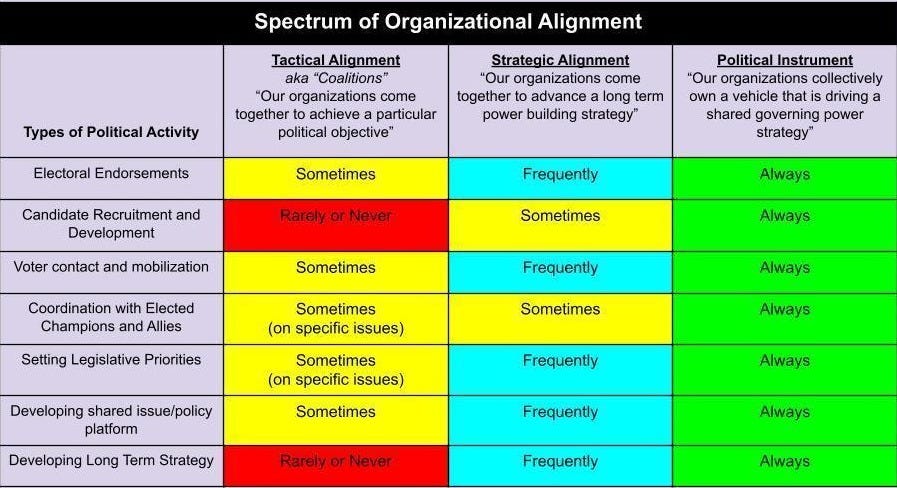
Our goal should be to construct political instruments that represent multiple labor, civil society, and social movement groups with an organized mass membership, with a focus at the state level. In general, we believe the state level is the most effective level for coordination, both because of the disproportionate influence of state government in our federal system and because very few of our organizations have an engaged, organized, and politically coherent mass membership at the national level. Because no single organization possesses the resources, know-how, or membership needed to drive a governing power strategy in isolation, it is important that such state-based political vehicles represent multiple organized constituencies. Broadly, there are two paths to achieve this, each with pros and cons:
In some cases an existing IPO may be or become “the” vehicle for a multitude of social forces. However, IPOs that pursue their own organization- and base-building work have to balance their individual internal organizational goals and priorities with the ability to fairly and accurately represent the collective goals and priorities of the participating groups. This is difficult to do, and can lead to (real or perceived) sectarianism; even where decisions are formally collective, there is a risk that the “real” decision has been made elsewhere. To account for this, the formation must create structures and processes that equitably balance participation in decision-making, and the vehicle’s leadership must proactively look out for and correct (often unconscious) organizational sectarianism.
In other cases, a set of labor and social movement forces may create a new umbrella organization, build intra-organizational infrastructure, affiliate with an “outside” (e.g., national) entity, or operate through a nimble “stealth” formation like Florida’s StateWide Alignment Group. Here, the risk is the inverse: because the collective political vehicle is one level removed from direct base-building work, there is a risk that it becomes disconnected from and unaccountable to a mass membership. This risk is particularly heightened if participating labor and social movement organizations themselves struggle to do effective base-building. To account for this, the political vehicle should base decision-making influence on the size of participating organizations’ active membership. This does not have to be on a one-to-one basis; for a variety of reasons, the representation of particular constituencies may be “weighted,” but this must indeed be representation—that is, at all costs individual voices must not be conflated with the “voice” of a community they claim to (but do not actually) represent.
Example: the experience of two IPO projects some of our members have been involved with illustrates this contrast. In North Carolina, the Carolina Federation (CF) operates on the “stand-alone” IPO model. In 2024, CF ran the largest voter contact program in the state, knocking 850,000 doors, and helping defend a critical state supreme court race. However, the demands of rigorous base-building work have restricted CF’s efforts to six of the states’ 100 counties, and at times have pulled capacity away from leading broader coalition efforts at the state level, restricting its sphere of influence. In Connecticut, Connecticut for All (C4A) is a coalition of over 70 community, faith, and labor organizations. With breadth and buy-in across regions and movement sectors, the coalition has developed a joint Equity Agenda pushing a $2.5 billion state investment in education, health care, housing, and social services, funded by a new capital gains tax. However, as a coalitional project that does not itself pursue direct base-building, C4A is only as strong as its member organizations, and has limits to how much it can direct or influence the latter’s internal organizing and base building. In these examples, the relative size and strength of existing community and labor groups may have impacted the choice of model. With the fourth-highest union density in the country, Connecticut had many strong unions that could participate in a coalition; in contrast, North Carolina has the lowest union density in the US. Note also the relatively greater emphasis on governance struggles in Connecticut (a trifecta Democratic state) and the greater emphasis on electoral contestation in North Carolina (a contested purple state). While C4A coalition members also do electoral work, and CF does issue organizing and co-governance work (especially at the local level), the choice of emphasis is dictated partly by the differing political terrain (discussed in section IV).
The process of building tactical, strategic, and (ultimately) organizational alignment will vary depending on the particular state context. Where levels of existing alignment and coordination are low, we should begin with smaller tactical coordination, with a focus on immediate social self-defense and political defensive struggles. Where levels of existing alignment and coordination are higher, we should focus on strategic coordination, with a focus on connecting immediate actions to a three-year strategic counter-offensive. The concrete tasks involved will vary with the political terrain, which we discuss in Section IV, “Applying this Strategy to Diverse Terrains.” As they develop, mass organizational coalitions should formulate clear coalitional decision-making structures and stable leadership teams, avoiding the “tyranny of structurelessness” that has become prevalent in such spaces. Decisions made by (and selection of) coalition leadership should reflect internal democratic decision-making processes inside participating organizations.
Where mass organizations are not yet sufficiently consolidated to form or join a collective political instrument, left “fractions” working within and across them should informally coordinate interventions. Left forces active in mass organizations with low or uneven levels of political consolidation and other internal contradictions should organize internally to develop the membership and increase strategic capacity. Simultaneously, they should coordinate informally with left forces active in other organizations and movement sectors to help facilitate increased tactical, strategic, and political alignment. In some cases, this may be done through formal internal structures (e.g., union “reform caucuses”) but where this is not possible they can operate as a left “fraction”—that is, a subgroup that shares a common political viewpoint and works together to advance it within the broader organization or movement. In contrast to unprincipled forms of entryism, frontism, and/or factionalism, fractions respect internal democratic processes and work to win over majorities within their organizations to their line and strategy through a process of mass line. It is thus crucial that fraction members are rooted in the masses and have or work to win trust from and organic leadership within mass organizations. This connects to Liberation Road’s longstanding practice of “red mass work” and our current central task (see Section V).
At the national level, we should connect mass membership organizations to the Working Families Party as the seeds of a nationwide political instrument. Whatever its unevenness and contradictions, WFP provides the most developed container for left and progressive forces to advance an independent political strategy at the national level and to coordinate national and state-based efforts. WFP provides much-needed electoral infrastructure and expertise; material support for candidates running for office and electeds in governance; and connective tissue between candidates, electeds, and movement organizations. While WFP has made some very limited attempts at direct base-building, it largely functions as an “umbrella” political vehicle for other base-building organizations generally, and a concrete collective decision-making structure for state chapter affiliates, in particular. As such, the strength of its mass base is directly correlated to the breadth and depth of participation from organized labor, movement organizations, and IPOs. Where sufficient organizational consolidation exists, these groups should join WFP as national member organizations or through its state chapters. Where this is not yet possible, left fractions should increase informal coordination with WFP and its partners at the state and national level.
What do we mean by a “political instrument?” We take the term from the Chilean Marxist strategist Marta Harnecker, who used it to refer to new forms of organization that fused the social movement and party left. Harnecker’s conception of a political instrument does not refer to a universal organizational structure; indeed, one of her criticisms of many sectors of the left is that they have prioritized the problem of organizational structure over the needs of the struggle, when it should be the reverse—organizational structures organically adapting to time, place, and conditions. But broadly she conceived of the political instrument as both a federation of social movement organizations and a political party, operating with significantly more sectoral and regional autonomy than the traditional Marxist-Leninist party model, which she felt had been overly rigidly applied. Some examples of what this might look like include the Workers Party in Brazil, Podemos in Spain, and Bolivia’s Movimiento al Socialismo, which defines itself as a “Political Instrument for the Sovereignty of the Peoples.”
These efforts should build toward the development of a popular political program and a slate of progressive political candidates—including a credible presidential candidate—by 2028. Two things are necessary to ensure the left wields real influence, not only in the resistance against the New Confederacy, but in governance once we defeat them: 1) militant mass social movements that have developed bold, broadly popular, and actionable demands, and 2) progressive political candidates who can catalyze momentum for those demands and, ideally, enact them once in office. On the terrain of civil society, the left must coordinate our efforts toward the development of a genuinely popular program that emerges out of organized movements of the multiracial, multigender working-class masses, and that are recognized and claimed by the masses as their own. Politically, we must build the capacity and infrastructure to run viable progressive candidates, including cohering around a single, credible left-progressive presidential candidate. While respecting their relative autonomy and differing roles, these social and political efforts should be in dialectical relationship with each other: social movements fueling electoral effortings, including a left-progressive presidential campaign, and the electoral and political campaigns strengthening social movements.
These efforts must orient toward building the social and political power to win a Third Reconstruction. We envision a Third Reconstruction as a political period during which a very broad front of popular forces has gained sufficient strength to institute a wide range of transformative reforms that shift the balance of power away from the white, male, and wealthy few toward a broad united front led by left forces rooted in an organized social base of the multiracial working class, people of color, and women and LGBTQ+ people, as one stage in a longer-term struggle toward socialism. Lifelong Communist and Black radical Jack O’Dell’s “Democracy Charter,” inspired by the South African Freedom Charter that galvanized the overthrow of apartheid, provides one template that left forces could look to as a model. But the concrete demands of a Third Reconstruction agenda must be developed in and through the process of building a militant mass left. Some elements of this agenda could include:
Political Reconstruction. Restore and strengthen the Voting Rights Act; reconstruct fundamentally anti-democratic institutions like the Electoral College, the US Senate, and the US Supreme Court; implement reforms such as rank-choice voting and proportional representation; and expand mechanisms of direct democracy such as ballot initiatives, recalls, and referenda.
Social and Economic Reconstruction. Fully fund childcare, K-12 education, and community college; ensure universal low-cost, high-quality health care; strengthen union rights, overturn right to work legislation, and expand workplace democracy; invest in community-based alternatives to policing; enshrine a national right to abortion access and gender-affirming care; establish a living wage, a universal jobs program, and mandatory vacation, parental, and sick leave.
Environmental Reconstruction. Transform our energy system to 100 percent renewable energy; decarbonize transportation, invest in public transit and a high-speed rail network; restore and expand land and water conservation goals and return land stewardship to indigenous people; ensure a just transition for communities and workers.
International Reconstruction. Implement a just foreign policy which focuses on democracy, human rights, diplomacy and peace, and economic fairness; end military aid to repressive regimes, including Israel; facilitate mutual, international disarmament of nuclear, chemical, and conventional weapons. This will require deep shifts in the US "common sense" about what constitutes safety and national security, and about the US’s role in the world.
Example: After a coalition of IPOs, labor unions, and community organizations helped secure a Democratic governing trifecta in 2022, the Minnesota legislature passed a slate of legislation in just four months, including 12 weeks paid parental leave, child tax credits, free public college tuition, free lunch in schools, stronger protections for workers seeking to unionize, universal drivers license access regardless of citizenship status, a “trans refuge law” protecting trans-affirming healthcare for in-state and out-of state youth, strengthened abortion access, and an expanded public healthcare option. This provides one concrete example of what implementation of a Third Reconstruction agenda can look like at the state level.
IV. APPLYING THIS STRATEGY TO DIVERSE TERRAINS
A. Tactical Objectives: Resist, Contest, Refuse, and Reconstruct
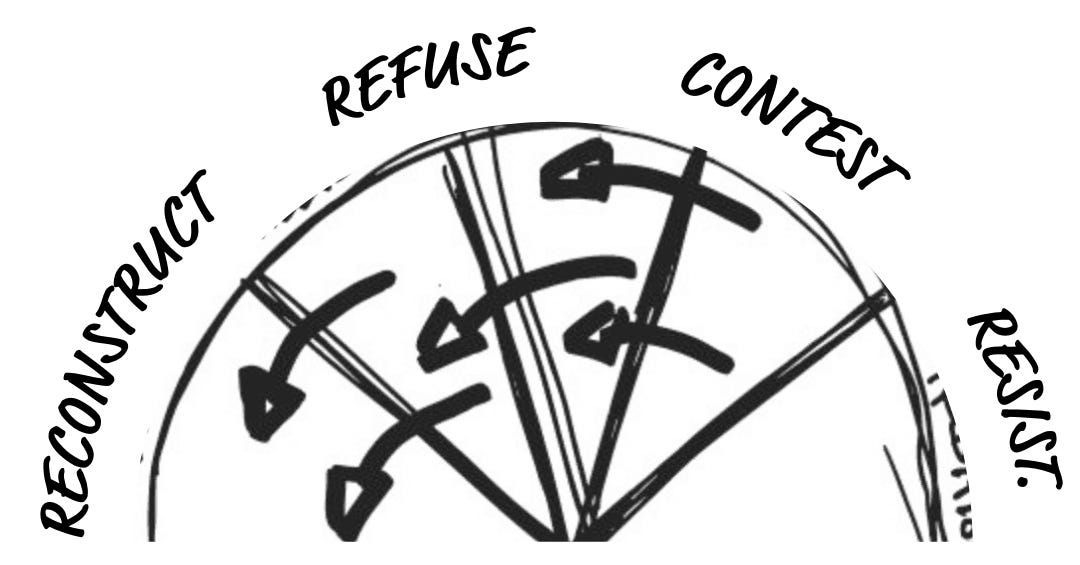
While the strategic objectives of “block,” “broaden,” and “build” apply to all advanced forces in the US, the predominant tactics through which to advance this strategy will vary depending on the balance of power on any given political or social terrain:
In New Confederate strongholds, we must resist the New Confederacy, using civil resistance tactics to delay, diminish, distract, and detract fascist forces and building infrastructure to materially and spiritually sustain our communities under siege.
In contested terrain, we must contest the New Confederacy, using electoral and issue fights to build durable pro-democracy majorities that tip the balance of power away from reaction and toward reconstruction.
In pro-democracy strongholds, we must refuse the New Confederacy and push visionary demands that begin to lay the groundwork for reconstruction.
RESISTANCE tactics in New Confederate strongholds. (“Red” states and cities; institutions and organizations where fascist forces hold power.)
In these places, our objective is to obstruct fascist consolidation and defend our people under conditions of authoritarian control. Resistance means using methods of noncooperation and civil disobedience to delay, disrupt, distract, and delegitimize the functioning of the fascist New Confederate regime. This includes public whistleblowing, targeted legal challenges, and forms of disruptive protest that draw national attention to localized repression. Resistance also means organizing infrastructure to materially and spiritually sustain our communities under siege: building sanctuary networks, alternative service delivery systems, and mutual aid infrastructure to meet basic needs. Even in deeply New Confederate-dominated territory, there are cracks: universities, unions, churches, gay bars, mutual aid networks, and community centers that can become defensive nodes in a hostile landscape. Where our path to governing power is blocked, we can build infrastructure for self-governance—including people’s assemblies, cooperatives, and other organs of direct democracy. These formations are not just stopgaps; they are the seeds of a new society within the shell of the old. Importantly, we must also prepare for moments of rupture—crises, scandals, or backlash that create unexpected opportunities to mobilize mass opposition and shift public sentiment. Despite the difficult terrain, resistance is not only about survival. Our aim is to hold ground, weaken fascist cohesion, and strengthen the organizing vehicles that will lead when national conditions shift.
CONTESTATION tactics on contested terrain. (“Purple” states and divided government; institutions and organizations where power is split or up for grabs.)
In contested terrain, we are in a direct fight for power—socially, politically, ideologically, and institutionally. Our goal here is to tip the scales—through both deep organization and mass mobilization—toward a durable pro-democracy, antifascist majority. This means engaging in both electoral and extra-electoral campaigns, using every fight—from budget battles to ballot initiatives—to clarify stakes, polarize against the right, and grow our organized base. Social movements should focus major energy here, initiating issue fights that can win concrete gains while developing long-term organization and infrastructure. IPOs must play a leading role—recruiting, training, and supporting candidates aligned with a Third Reconstruction agenda, and linking electoral work to year-round organizing. This is the terrain where the “inside/outside” strategy comes most fully into play: tying electoral and legislative campaigns to ongoing base-building and leadership development. In many ways, contested terrain is the decisive battleground of this period—what happens here will deeply impact the balance of power within state and federal government in 2026 and 2028. Social movements should target these areas for issue campaigns; IPOs should begin prospecting, recruiting, and training candidates for 2026 and 2028 right now; sitting electeds should engage their voter base year-round; and all of these efforts should be synergized and coordinated.
REFUSAL and RECONSTRUCTION tactics in pro-democracy strongholds. (“Blue” states and cities; institutions and organizations where actually or nominally pro-democracy forces hold power.)
We must create sanctuaries and refuges where we have the power to say, “This will not happen here.” In these places, we must enshrine and defend existing rights—around abortion access, gender-affirming healthcare, immigrant justice, civil liberties, labor rights, and much more—while defying federal attempts to roll them back. Refusal tactics include passing local and state legislation that proactively defies federal directives, leveraging social power to shield targeted communities, and organizing within institutions to defend the autonomy of civil society and the people’s rights. But defensive posture alone is not enough: these strongholds must also become laboratories of democratic possibility—prefigurative “zones of reconstruction,” where the values, structures, and programs of the Third Reconstruction are prototyped and tested. We must push for bold, visionary policy that addresses the real crises facing the multiracial working class, the oppressed nationalities, and oppressed gender people. This should include the construction of forms of direct self-governance—such as participatory budgeting and co-governance structures—that give ordinary people real power over the decisions that affect their lives. We should strive to make these spaces into beacons of hope and inspiration, sending out bat signals that another, better America is not only possible—its contours are already beginning to take shape.
What is the difference between “resistance” and “refusal”? While the two terms sound similar, there is a crucial distinction between them. “Resistance” occurs when we don’t have enough power to prevent an outcome; we can use tactics to delay, disrupt, and diminish its impacts, but we can’t actually stop it from happening. “Refusal” is when we actually have the power to change the outcome. In other words, the difference is based on the balance of forces: do we actually have enough power to prevent this from happening?
Resistance, contestation, and refusal/reconstruction struggles overlap, but the dominant element is generally determined by the balance of power at the state level—resistance in red states, contestation in purple states, and refusal and reconstruction in blue states. The three terrain types are not mutually exclusive. Deep blue states contain contested districts decisive to control of Congress. Deep red states have progressive regions that can become safe havens and sanctuaries. But our assessment is that one of the three forms is dominant in any given context, relative to the existing and prospective balance of power between the Pro-Democracy United Front and the New Confederacy. Given the disproportionate impact that state-level government holds over both state and national politics within our federated system, as well as the scale at which most of our movement forces are currently operating, our assessment is that the state-level balance of power will determine the dominant form that secondary struggles take in most cases.
Struggles on the terrain of civil society are influenced by the internal balance of power within institutions, but here too the state-level balance of political power plays a dominant role. Struggles within civil society organizations—faith groups, schools, hospitals, workplaces—will be impacted by the balance of power internal to each institution. However, our assessment is that these struggles are greatly influenced by the external political context, with the state-level balance of power generally playing a dominant role. For instance, struggles over inclusive K-12 curricular materials will play out differently depending on the politics of a school’s administration, staff, parents, and students. But overall, even the most “progressive” school district in a New Confederate stronghold like Florida will present more challenging terrain than a regressive school district in California.
While our tactics vary with the terrain, we are all part of the same fight, and at the national level we are all on the strategic defensive. At the national level, we are all now living in the equivalent of a red state. Even as we adapt our strategy to different terrains, this requires the entire front to adopt something of a red-state orientation: preparing for mass noncompliance, building sanctuary networks, and creating infrastructure that can operate independently of federal governmental support. It also means centering the strategic leadership of organizers in the South, Southwest, and other regions where fascist governance is already entrenched. For years, they have developed the tactics, organizational forms, and collective discipline needed to survive and fight under hostile conditions. Now, those strategies can provide a model for resisting New Confederacy autocracy nationwide.
As we build toward a strategic counter-offensive, our motto must be “one step forward, everywhere we fight.” Although the terrain varies, all of our tactics should ultimately build toward a national counter-offensive to reconstruct democracy from the ground up. This is not a call for uniform motion or maximalist leaps, but for coordinated movement grounded in the real conditions we are starting from. In New Confederate strongholds, we should use resistance tactics to build the mass momentum and social power to shift from purely defensive struggles toward active contestation. In contested terrain, we should use electoral and extra-electoral contestation to decisively defeat the New Confederacy, shifting the balance of power toward pro-democracy control and laying the foundations for us to govern. In pro-democracy strongholds, our task is to go beyond refusal to reconstruction—modeling new forms of governance that deepen popular participation and shift power downward and outward.
B. Secondary Contradictions With Establishment Forces
Even as left and progressive forces work within a br oad multi-tendency front to defend democracy and defeat the New Confederacy, we will continue to have secondary struggles against the moderate establishment and center-right factions of our front. Because we believe that the New Confederacy is the main enemy in this political period, whose decisive defeat will require the combined efforts of all those committed to opposing it, we believe these struggles must be understood as secondary. This does not mean they are not vitally important. Rather, it means that decisions as to how and when to engage them must be made with an eye to whether they strengthen or weaken the combined ability of our entire front to defeat the New Confederacy.
These secondary contradictions have both a non-antagonistic aspect and an antagonistic aspect. Antagonistic contradictions are irreconcilable differences between opposing forces that can only be resolved when one side or the other is decisively defeated. Non-antagonistic contradictions are disagreements that can be reconciled; because the interests of these forces are not fundamentally opposed, compromise is possible. Currently, contradictions between the people’s movements and our main enemy, the New Confederacy, are antagonistic, while internal contradictions within left and progressive people’s movements are generally non-antagonistic. However, contradictions between left-progressive forces and moderate and center-right forces have both non-antagonistic and antagonistic aspects.
In general, these contradictions are more antagonistic with the corporate Democratic political and business establishment, and less antagonistic with their moderate social base. Insofar as we share a common opponent and a shared objective, the interests of our entire front are aligned, and our contradictions are non-antagonistic. Beyond that shared conjunctural objective, however, the interests of forces within our front diverge, and have an antagonistic aspect. We should distinguish between (especially white, male) capitalist class elements and corporate Democratic political leadership, on the one hand, and the multiracial working- and middle-class masses who currently make up their base of support. When struggling against corporate Democratic leadership, part of what we are struggling for is the hearts and minds of this moderate mass social base.
The ratio of antagonistic and non-antagonist aspects of secondary contradictions varies based on time, place, and conditions. Contradictions are not static; at a future stage of struggle, if we are successful at defeating the New Confederacy, some of these currently secondary contradictions may become primary, and purely antagonistic. At our current stage of struggle, the balance of antagonistic and non-antagonistic elements varies based on place and conditions. In general this mixture falls into one of three categories:
Highly antagonist. Both sides are overtly contesting over leadership of the Pro-Democracy United Front. Struggles are visible, overtly antagonistic, and may assume (temporary) priority vis à vis the principal struggle.
Partly antagonistic, partly non-antagonistic. Both sides are quietly jockeying for position. Struggles are either covert or intermittent, with cooperation in some areas and contestation in others.
Low or no antagonism. Both sides are cooperating within the front. Struggles may persist, but are non-antagonistic, and subordinated to the shared struggle against a common enemy.
Two factors impact the ratio of antagonistic and non-antagonistic aspects: the internal balance of power within our front, and the external balance of power between our front and the New Confederacy. Externally, secondary contradictions are often at their most antagonistic in contexts where our front is strong, and the New Confederacy is weak—prefiguring the sharper struggles between left and center that will break out more broadly if we are successful at defeating our common enemy. In contexts where both progressive and establishment forces are weak relative to the New Confederacy, however, cooperation often persists between them for lengthy periods. Internally, the greater the power imbalance between factions in our front, the lower the intensity of secondary struggles—where establishment forces are strong and our forces weak, the establishment has the power to marginalize, contain, and/or co-opt progressive forces. In contrast, the smaller the internal power imbalance, the greater the intensity of struggle—as the prospect of losing leadership over the front increases, so too does the fight to preserve it.
When evaluating whether and how to engage in struggle with establishment forces, we should consider if doing so will strengthen or weaken our overall ability to block the New Confederacy, broaden the front, and build a counter-offensive toward a Third Reconstruction. Left forces should engage these secondary struggles when this strengthens our ability to defeat the New Confederacy, gives us an opportunity to win more people to our side, and shifts the overall balance inside our front to the left. We should avoid such struggles when they detract from our ability to defeat the New Confederacy, alienate people from our positions, and weaken or isolate the left within the front. A nuanced analysis of concrete conditions is necessary to determine when and where to contest with moderate establishment forces, and when to focus our shared energies on our common enemy.
Example: During the Democratic presidential primaries, Uncommitted organized swing state voters to cast protest votes against then-candidate Biden (and, later, Harris). This was an effective use of partisan primaries, which typically offer progressive forces the opportunity to contest directly against establishment Democrats for leadership over the pro-democracy front. Uncommitted leveraged the power built through these efforts to pressure the Harris campaign to agree to core demands, using an inside/outside approach that combined street protests outside the DNC with a sophisticated “inside” strategy on the floor of the convention. The Harris campaign’s moral and strategic failure to accede to any of these demands put movement organizers in an extremely challenging position. Faced with this, Uncommitted released a post-convention statement declaring that they 1) could not endorse Harris, 2) strongly opposed Trump’s presidency as even more unfavorable for both Palestine and the US anti-war movement, and thus 3) urged their supporters to vote for the Democratic presidential candidate, not as a vote to support Harris, but as a vote to defeat Trump—and create more favorable conditions to continue the struggle. Uncommitted’s sequence of maneuvers (and, especially, their complex, nuanced but analytically and strategically clear statement) provides a good example of how to navigate intensely antagonistic contradictions with establishment forces under challenging—and changing—conditions.
The content of secondary struggles varies with the political terrain. Just as our tactics to defeat the New Confederacy depend on the political terrain, so too do the kinds of struggles we have inside our front. Indeed, one of the primary things we struggle over with establishment forces is how—or if—to refuse, resist, and contest against the New Confederacy. In other words, the kinds of questions one struggles over in “red,” “blue,” and “purple” contexts are very different, and those differences of content impact the form that struggle takes:
In New Confederate strongholds, left-progressive and establishment forces primarily struggle over how we should defend against power (resistance strategy).
On contested terrain, left-progressive and centrist forces primarily struggle over how we should contest for power (campaign strategy)
In pro-democracy strongholds, left-progressive and establishment forces primarily struggle over how we should refuse the New Confederacy and exercise power (governance strategy).
While secondary struggles over resistance, contestation, refusal, and reconstruction overlap, the dominant content of secondary struggles will generally be determined by the balance of power at the state level. These three kinds of struggle are not mutually exclusive. In a majority-Democratic metro region in a contested purple state, for instance, progressives and establishment moderates might struggle over governance at the municipal level, disagree about campaign strategy when it comes to state-level electoral fights, and diverge around resistance tactics when the Trump administration puts pressure on local or state government or civil society institutions. However, just as the state level generally plays a dominant role on the level of the principle contradiction, so too on the level of secondary contradictions, the state level is generally dominant.
These categories for assessing the content and intensity of secondary contradictions apply to both political and social struggles. Many of our examples have concerned political struggles on the terrain of the state, because most people have context to make sense of these struggles and because it is easier to generalize about the balance of power when it comes to national and state-level government. However, these same categories for evaluating secondary struggles can be applied to social struggles on the terrain of civil society as they relate to our primary objective of defeating the New Confederacy and our secondary contradictions with moderate forces. Within any given institution or organization, the content of such struggles will vary based on the overall balance of power between New Confederate and pro-democracy forces, and both that and the internal balance of power between moderate and progressive forces will impact the intensity of secondary contradictions and their degree of antagonism.
Example: At a community college in which some of our members are active, the college president—an establishment moderate—initially signaled that he would comply with Trump’s directive authorizing ICE to detain students on college campuses. Progressive students, staff, and faculty organized to challenge this policy. At the level of the college itself, this was a struggle over governance: what rules and policies would the college adopt? Because this was ultimately a question of response to Trump’s executive orders, however, the content of this secondary struggle primarily concerned refusal strategy: how—or if—to refuse compliance with Trump’s agenda? This secondary struggle was ultimately non-antagonistic: while the administration was fearful that taking a bold stance would open the college to even more overt attack, they united with the underlying objective of keeping students safe. The context was complicated by the fact that the college was situated in a New Confederate-controlled rural region of a contested “purple state.” Understanding these nuances helped progressive forces determine the correct means to successfully push the administration to adopt a different policy that transformed most parts of the campus into “non-public” areas, preventing ICE from entering classroom buildings without a warrant..
We should approach secondary struggles with an eye to how they impact our primary tactical objective at the state level, and our overall strategic objectives. Secondary struggles possess a partial autonomy relative to the principal contradiction and our main strategic and tactical objectives. The fault lines in a particular local or sectoral organizing effort may differ from those of our broader strategic objectives, and must in part be evaluated on the terms of those more immediate campaign goals. However, in contemplating how (or if) to engage in such efforts, left and progressive forces must also consider how this impacts our overall strategic objectives of block, broaden, and build as well as the tactical objectives specific to our political terrain. In terms of the overall strategic objectives, we should ask: does this effort help us block the right, broaden the front, and build the left? Campaigns against secondary targets do not have to further all three of these objectives simultaneously, but they should not actively harm our ability to pursue any of them. In terms of our tactical objectives, comrades should ask: does this effort strengthen our front’s overall ability to achieve the primary tactical objective for our context—that is, to resist in New Confederate strongholds, refuse and reconstruct in pro-democracy ones, and contest on contested terrain?
C. Tertiary Contradictions Within the People’s Movements
Among progressive forces, there are both left errors that exaggerate our differences with the establishment and right errors that overly minimize them. Right errors occur when our movements tail popular opinion or the status quo (tailism) or sacrifice independent left initiative in favor of uncritical cooperation with moderate and center-right factions within our front (reformism). Left errors occur when activists attempt to lead with “super-revolutionary” ideas that are too far ahead of the level of popular consciousness among the masses (ultra-leftism) or overly prioritize the independence of small activist groups over collaboration with natural allies in a broader united front (left sectarianism). Both left errors and right errors negatively impact the strategic impact and effectiveness of our movements, weakening the ability of progressive forces to build the social and political power needed to defend the people's rights, defeat New Confederate autocracy, and set the stage for a Third Reconstruction.
Left errors are more common in places where the pro-democracy front is strongest, right errors are more common in New Confederate strongholds. Because left and progressive forces are often concentrated in major metropolitan areas and other pro-democracy strongholds, many of their day to day struggles are with establishment Democrats and moderate forces. This can lead to ultra-left errors where progressive forces overly prioritize these secondary struggles over the common struggle against the New Confederacy. Conversely, in geographic regions, social institutions and political contexts where the New Confederacy is very dominant, left and progressive forces risk overemphasizing common struggle and underemphasizing the need for independent left initiative, leading to right errors (tailism, reformism). However, in these contexts, ultra-leftism can sometimes also reappear in the form of “revolutionary pessimism.” (Since change appears blocked or impossible, left forces can retreat into self-marginalizing groups.)
Struggles within our movements are often the most intense in areas where our contradictions with other factions of our front are most antagonistic. Because left and right errors often concern disagreements about how to navigate secondary contradictions with moderate and center-right forces within our front, these tertiary struggles are often sharpest where secondary contradictions are at their most antagonistic. As secondary contradictions are often more antagonistic in pro-democracy strongholds where ultra-left errors are more common, this means struggles with ultra-leftists within our movements are often more intense than struggles with right errors and pragmatist forces. This is not just a question of place, but also of time: at moments when contradictions between establishment and progressive forces become sharper, so too do disagreements within our own movements.
Example: Although Alexandra Ocasio-Cortez has been one of the most pro-Palestinian voices in Congress, the Democratic Socialists of America voted to withdraw their endorsement of her 2024 election campaign over perceptions that her stance was insufficiently radical. In this case, Biden’s uncritical enabling of the US-abetted Israeli genocide in Gaza, which heightened secondary contradictions between progressives and establishment Democrats, also heightened internal divisions within the left about how to relate to this contradiction, contributing to DSA’s national leadership making an ultra-left error.
Struggles against left and right errors within our movements are generally non-antagonistic “contradictions among the people.” Because these are strategic and tactical disagreements among forces who share the same underlying interests and long-term objectives, contradictions in our movements should generally be handled through non-coercive methods such as debate, persuasion, and education. These contradictions may still be sharp, and this process may involve fierce struggle. However, we do so on the basis of unity-struggle-unity: knowing that we start from a baseline of alignment, we engage in principled struggle in order to work through differences, sharpen our ideas, and develop a stronger basis of mutual understanding that allows for greater unity, strength, and coherence.
Where wrong ideas are deeply held by a relatively small number of people, we should not prioritize struggle with a small group over effective mass politics. Many small socialist groups in the US are ideologically committed to forms of ultra-leftism. Because these errors are often deeply ingrained ideological tenets, it is often difficult or impossible to shift groups and individuals away from these positions. Because many of these groups are sectarian and disconnected from mass movements, their beliefs are generally neither reflective of nor impactful on those of the broader masses and of mass movement organizations. While recognizing that we share some unity with these forces in our long-term vision of socialism and liberation, we do not believe it is worth prioritizing struggling over our strategic disagreements with them in cases where this detracts from our ability to engage in effective organizing and mass politics.
However, where wrong ideas start to gain broader influence within our movements, we should struggle against their influence in a principled way. It becomes more important to contest against left and right errors when they start to exert greater influence over larger sections of the advanced forces within our movements and our front. In these cases, our efforts should primarily be focused on persuading the forces wavering between correct positions and left or right errors, rather than directly seeking to persuade forces deeply dug in around ultra-leftism or reformism. However, we should seek to maintain comradely relations with ultra-left and reformist forces, even amid intense struggle, wherever possible. Occasionally, contradictions within our movements can become antagonistic—threatening the integrity and very existence of our organizations, and jeopardizing our broader movements and front. In those cases, ultra-left or rightist actors must be isolated and disempowered in order to mitigate harm.
Where these contradictions are less intense, we should seek to foster comradely dialogue, cooperation, and left unity where possible. In cases where left forces hold different positions than ours, but are open to working through those differences in a genuine spirit of unity-struggle-unity, we should seek to do so. Where left forces have differences with us on some questions but have unity with us around others, we should seek to work with them on those areas of unity where there are opportunities to do so. Many of our cadre have found opportunities to work productively with left forces who disagree with our position on electoral politics, in other areas such as mutual aid or international solidarity. These common efforts often build the foundations to have more productive and generative discussion around areas of disagreement; generally, people change their positions through concrete political praxis, not abstract theoretical debate.
D. Putting the Pieces Together
With the above components in place, we can begin to sketch out a framework for how to apply a coherent strategic orientation to diverse contexts and terrains:
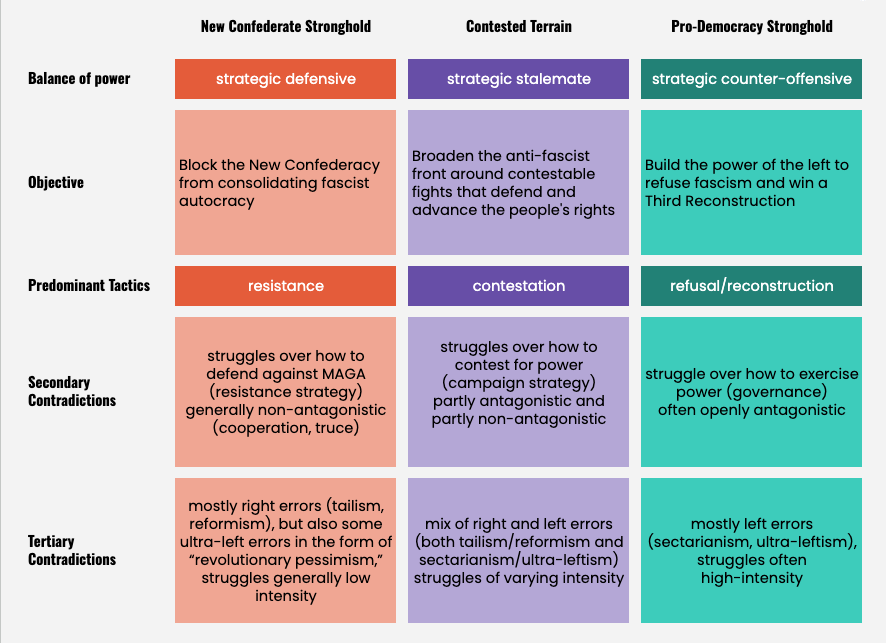
In states, localities, and institutions where pro-democracy forces hold power, our task is to refuse complicity with the New Confederacy and begin to prefigure a Third Reconstruction. These are our movement’s forward-operating bases—zones where we can organize to refuse fascist compliance, and fight to expand democratic rights. Struggles with the Democratic establishment and moderate forces are often sharp and antagonistic, but must not jeopardize the broader effort to defeat the New Confederacy; these contexts carry the risk of heightened ultra-leftism, given the distance between the most immediate struggles against corporate Democrats and the primary, national struggle against the New Confederacy. Contradictions within our movements often surface as strategic disorientation, political “purism,” or factionalism and sectarianism within the left itself—requiring deliberate efforts to stay grounded in mass politics. In these places, our three-year strategic counter-offensive objective should be to bridge from refusal to reconstruction—modeling new forms of governance that deepen popular participation and shift power downward and outward.
In red states, localities, and institutions captured by the New Confederacy, our work is primarily defensive. We must resist the New Confederacy by undermining its legitimacy, protecting the most vulnerable, and disrupting its efforts to consolidate autocratic power. Organizing in these conditions requires resilience, creativity, and courage—from mutual aid and community defense to institutional noncooperation and strategic defiance. These terrains demand strong movement infrastructure even when electoral openings are limited, and they often require cooperation with moderate forces despite ideological differences. While pragmatism and reformism can be right errors here, a countervailing risk is revolutionary pessimism: retreating into isolation or symbolic militancy disconnected from mass action. In these places, our three-year strategic counter-offensive should be to use resistance struggles to build the power to pick winnable fights that directly contest against the New Confederacy, especially as national-level cracks in MAGA power emerge.
In purple states and institutions and contexts where power is up for grabs, we are in a high-stakes fight to tip the balance, not just electorally, but in the hearts and minds of the masses and within the institutions of civil society. Here, the central objective is to broaden and solidify a durable pro-democracy majority while fighting for greater leadership within it, choosing fights that grow our forces, split the opposition, and test-drive demands that can win real support. The contradictions here are fluid and often mixed—both between progressives and corporate Democrats, and within our own movements. The left must stay rooted, disciplined, and responsive, building political vehicles and social formations that can shift the terrain decisively toward reconstruction. In these places, our three-year strategic objective should be focused on directly defeating the New Confederacy in head to head fights—electorally and otherwise—in order to actually win governing power and lay the foundations for a Third Reconstruction.
V. LIBERATION ROAD’S ROLE
Above, we have laid out three interrelated, simultaneous strategic objectives for this political period that we believe all advanced forces in the US should pursue. These objectives are complex and multifaceted, and advancing them will require concerted efforts from many organizations and individuals. Liberation Road has always recognized that we are but one small component of a broader movement we seek to help unite and build. Within the broad objectives outlined above, here is how we see our own role and tasks.
This final section of the strategy is primarily intended for members of Liberation Road, a cadre socialist organization. However, this section may also be of interest to non-members who wish to learn more about how Liberation Road operates and how we seek to relate to other sectors of the socialist, social movement, and labor left.
A. Our Central Task
Liberation Road’s central task for the 2025-2028 period is to:
Help cohere the advanced leaders of mass organizations in the left-progressive bloc—prioritizing the strategic alliance of the oppressed nationalities and the multiracial working class, and oppressed gender movements and leaders—to defend people's rights, defeat New Confederate autocracy, and set the stage for a Third Reconstruction.
Let’s break this down. We know what “our left/progressive bloc” is: it consists of those sections of our front—rooted in the multiracial/multinational working class, the oppressed nationality movements, and the women’s and LGBTQ+ movements—which have the most interest in advancing a Third Reconstruction program. Likewise, we have discussed the need to connect defensive social and political struggles to a strategic counter-offensive aimed at a deep-seated democratic transformation of our political system, economy, and civil society. This clearly cannot occur under the shadow of the corporate Democrats and without increased left leadership of our broad front.
But who—and where—are these “leaders” in need of cohering? They are organizing within the most far-sighted unions; they are advancing experimentation with independent political organization at municipal and state levels; they are pushing social movement organizations to deepen their bases and develop collective strategy and shared practice; they are establishing national tables to help coordinate mass resistance; they are working to raise the level of left media ecosystems; they are striving in left think tanks to raise the level of left strategizing; they are building socialist organization.
In speaking of mass leaders, we distinguish radical leadership as a practice of mass line from many capitalist misconceptions of leadership as a position of “authority.” Authorities are figures in a hierarchy with a formal role or title that gives them the power to command. In contrast, leaders are those who other people voluntarily look to for guidance, and who themselves voluntarily accept the responsibility of guiding those they lead. Leaders must continuously win the trust of the people, and must win them over to correct ideas through a process of mass line. Formal authorities may or may not have mass leadership, and mass leaders may or may not have formal authority. So the leaders we need to cohere are not necessarily directors of organizations or presidents of associations, although they may be. They are those providing leadership at every level of our left and progressive “trend”—from the shop floor of a workplace to nationwide organizations.
What do we mean by “the advanced?” In our last (2022-2025) Strategic Orientation we outlined several criteria that we think still largely hold true for identifying them. The most advanced mass leaders, organizers, and strategists are those who:
Are clear on the centrality of the struggle against the New Confederacy.
Unite with core elements of a Third Reconstruction program.
Understand the need to unite with centrist establishment forces toward the defeat of the New Confederacy.
Understand the need to struggle with establishment forces and corporate Democrats for leadership within the Multiracial Pro-Democracy United Front.
Understand the political conjuncture as one stage in a longer-term struggle toward broader social, political and economic transformation.
What about the strategic alliance? As we write in our “United Front Policy,” all deep social transformations in the US have been the result of the coming together of the workers' and oppressed nationality struggles. However, because of the effect of white supremacy and white privilege among white workers and because of the class interests of the middle strata among oppressed nationalities, these two powerful social forces have only sometimes come together and all too often have been pitted against one another. For this reason the strategic alliance is something that has to be built and consciously developed by socialists. Prioritizing the strategic alliance means centering oppressed nationality and workers’ organizations, drawing connections between them, and prioritizing the leadership of ON and working-class individuals within these and other organizations and movement sectors. Within all this work, we strive to prioritize and lift up the leadership and issues of trans and cis women, and other queer, trans and gender-oppressed people. Gender liberation is a crucial terrain of our struggle against the New Confederacy, and oppressed gender people are crucial leaders in all liberation struggles. The leadership of working-class female, queer, and trans people of color is especially central to building long-term revolutionary change in the U.S.
And what does “cohering” mean? There is growing theoretical and strategic coherence among the most advanced sections of our front, including widening understanding of the danger posed by the fascist New Confederacy, and increasing appreciation of the need to both broaden that front and build the relative power of the left/progressive bloc within it. Where our coherence is lacking is the practical application of this increasing alignment: not just theoretical strategic unity but practical unity of action. What we need is for left forces to coordinate the planning and implementation of progressive programmatic initiatives—both for strategic defense and strategic counter-offensive— within and across institutions and movement sectors and at every geographic level from the local, to state, to national. Creative and heroic efforts will suffer and risk stalling or retreating for lack of unified vision, coordination, and execution.
Finally, about that small word “help”: no single organization on the left (and certainly not our own) has the unified vision, strength, legitimacy, scope, and mass base to create this leading center on its own; it must be a collective project, in which all partners contribute their particular strengths to overcome all our weaknesses. We must help one another build what we need, with the knowledge that if we fail, our front will continue to be dominated by corporate Democrats and establishment forces unable (and often unwilling) to meet the challenge, both of blocking the fascist threat and building an emancipatory alternative.
The specific programmatic interventions we need advanced forces to pursue will vary based on time, place, and movement sector. The objectives outlined above are large, the interventions needed to implement them manifold, and the task of translating this overall framework into concrete interventions complex. Indeed, the scale, multiplicity, and complexity of the tasks at hand underscore why we need cadre socialist organization—and socialist cadre—equipped with the theoretical and practical competencies to cohere and lead advanced forces in carrying out this strategy. Immediately following Congress, cadre should meet collectively through their geographic districts, and within relevant national work teams and commissions, to discuss and determine how they will translate the central task and the broader objectives of this strategic orientation into interventions for their relevant geographical and/or movement sectors over the next three-year political period. We discuss this more in the “carrying out our central task” and “cadre deployment” sections below.
B. Carrying out our Central Task — Geographic Districts
Immediately following our Congress, districts should meet to discuss and determine how they will translate the central task and the broader objectives of this strategic orientation into specific interventions for the next three-year political period. National organizational leadership will make itself available to support this process. This should include discussing how the district will balance red work (both internal organizational work and external left unity work) with red mass work (collective interventions within mass movement organizations). Where districts already have established red mass work and red work structures, they should explore how to apply this central task and strategy within existing units, concentrations, and other teams and sub-teams. However, districts should also explore whether the central task, the broader strategic orientation, and any other directives established by Congress require any additions or modifications to these structures. Some general questions to ask are:
Mapping the Terrain: Where Are We Fighting?
What is the current balance of power in our state or region—are we in a pro-democracy stronghold, a New Confederate stronghold, or contested terrain?
Applying this strategic orientation to our geographic context, what strategic and tactical objectives do we need advanced forces to pursue? How much of their focus will need to be on resistance, contestation, refusal, or reconstruction? In what key sectors of struggle should we focus?
What are the key political and civil societal battlegrounds in our state or region? How can we leverage defensive battles toward a three-year strategic counter-offensive that advances the struggle “one step forward” relative to where we are now?
How should we adjust our state-based objectives to account for the national objectives of the organization, and to reflect the fact that we are all, nationally, operating from a red-state “resistance” baseline?
Mapping Left-Progressive Forces: Who are the advanced?
Who are the most advanced mass leaders, organizers, and strategists of the left-progressive bloc throughout our region (at both the local and state level)? How are we positioned in relation to them?
What degree of cohesion do advanced forces already have? Do they coordinate tactically? Strategically? Does this happen formally, or informally? Does a political instrument exist?
How do secondary contradictions show up in this context? To what degree are these contradictions antagonistic or non-antagonistic? How can we navigate them in ways that strengthen our front’s collective ability to refuse, resist, and contest against the New Confederacy? (See “secondary contradictions” section of Part IV.)
How do tertiary contradictions show up in our context? To what degree do they manifest as left errors or right errors? How significant are they? How can we navigate them in ways that strengthen the left’s ability to lead our front? (Refer to the “tertiary contradictions” section of Part IV.)
Identifying interventions: what key initiatives can we cohere advanced forces around?
Given this analysis, what are two to three interventions our district could help coordinate that strengthen our strategic social and political defensive toward a three-year strategic counter-offensive?
How can our district help cohere the advanced forces we’ve identified around these programmatic interventions?
At the district level, what internal structures, processes, and priorities do we need to adjust or establish to carry this out? How much of our capacity will be focused on red work, versus red mass work? What units, concentrations, teams, or sub-teams might we need to adjust or add?
How do these efforts relate to the national-level priorities of Liberation Road? How much capacity do we need to contribute to national work teams and commissions? How can our district relate to the priorities of those bodies and help carry them out?
Putting it all together. In a general sense, putting all of those questions together, here is the main question each district should ask (based on the overall geographic context):
Blue states: How can we unite advanced forces around key interventions that strengthen our front’s ability to refuse the New Confederacy—and ready the ground for a Third Reconstruction?
Red states: How can we unite advanced forces around key interventions that strengthen our front’s ability to resist the New Confederacy— and ready the ground to transform sites of defensive resistance into contested, winnable terrain?
Purple states: How can we unite advanced forces around key interventions that strengthen our front’s ability to contest the New Confederacy—and ready the ground to transform contested terrain into durable pro-democracy control?
C. Carrying out our Central Task — National Bodies
At the national level, organizational work teams and commissions with a focus on strengthening impacts in a concrete social movement sector through external red work and/or red mass work interventions should determine how they will translate this central task and the broader strategic objectives into specific interventions for their movement sector. This includes but is not limited to the Workers Commission, Oppressed Nationalities Commission, Oppressed Gender Commission, Eco Commission, and Red Communications Commission, as well as the the Left Relations Team, the International Relations Team, the Mexico Solidarity team, and the Independent Political Power (IPP) Work Team. These bodies should also consult the relevant sectoral analysis from section 6 of the 2022-2025 Main Political Report. Members of the National Executive Committee (NEC) will make themselves available to support work teams and commissions in this process. Some general questions to ask are:
Mapping the Terrain.
Applying this strategic orientation to our movement sector, what strategic and tactical objectives do we need advanced forces to pursue? How much of their focus will need to be on resistance, contestation, refusal, or reconstruction?
What are the key front lines of struggle in our movement sector? How can we leverage defensive struggles toward a three-year strategic counter-offensive that advances our movement sector “one step forward” relative to where we are now?
For our specific sector of struggle, how do these struggles manifest differently in pro-democracy strongholds, New Confederate strongholds, and on contested terrain? How will our strategic defensive and counter-offensive efforts differ in these places?
Mapping Left-Progressive Forces: Who are the Advanced?
Who are the most advanced mass leaders, organizers, and strategists of the left-progressive bloc within our movement sector (at the local, state, and national levels)? How are we positioned in relation to them?
What degree of cohesion do advanced forces already have within our movement sector? Do they coordinate tactically? Strategically? Does this happen formally, or informally? Does a political instrument exist?
How do secondary contradictions show up in our movement sector? To what degree are these contradictions antagonistic or non-antagonistic? How can we navigate them in ways that strengthen our movement’s collective ability to refuse, resist, and contest against the New Confederacy?
How do tertiary contradictions show up in our context? To what degree do they manifest as left errors or right errors? How significant are they? How can we navigate them in ways that strengthen our movement sector’s ability to assume greater leadership within the Pro-Democracy United Front—both within and beyond our movement sector?
Identifying interventions: what key initiatives can we cohere advanced forces around?
Given this analysis, what are two to three interventions our work team or commission could help coordinate within our social movement sector that strengthen our strategic social and political defensive toward a three-year strategic counter-offensive?
How can our work team or commission help cohere the advanced forces we’ve identified within our movement sector around these programmatic interventions?
Within our commission or work team, what internal structures, processes, and priorities do we need to adjust or establish to carry this out? How much of our capacity will be focused on red work versus red mass work? What sub-teams of this body might we need to adjust or add?
How do the nationwide efforts we’ve identified for our movement sector relate to the state-specific priorities of Liberation Road’s districts? How can we support districts in integrating these priorities into their own work and plans? How can our work team or commission help integrate and synthesize our organization’s various district-specific interventions into a nationwide program related to our movement sector?
The National Executive Committee (NEC) will plan how to support, coordinate, and oversee the development of concrete work plans for geographic districts (and any subsidiary units, concentrations, and sub-teams) and national work teams and commissions (and any subsidiary units, concentrations, and sub-teams) in carrying out concrete interventions that translate the central task and the broader strategic orientation into specific objectives for those bodies. In addition to supporting geographic districts and national work teams and commissions in carrying out the central task and strategic objectives, the NEC will determine what interventions will need to be directly led by the NEC itself.
D. Cadre Deployment
To deploy our cadre effectively, all cadre members of Liberation Road should participate in the following “cadre deployment” process through their district, and/or through a national-level work team or commission:
Step 1: All geographic districts and national commissions/work teams meet as a whole body to establish broad objectives within two months of Congress. Based on the central task, strategic orientation, and other directives established by Congress, develop a shared list of:
What do the organizational central task, strategic orientation, and other directives mean for what red work will need to look like for the coming period? Based on this, what red work structures will we need?
What do the organizational priorities, directive and central task mean for what red mass work will need to look like for the coming period? Based on this, what red mass work units, concentrations or other structures we need?
Which cadre will have red mass work as their main focus, and through which units, concentrations, or other structures? Which cadre will have red work as their main focus, and through what structures or sub-teams?
Within two months of Congress, all districts, work teams, and commissions should draft a brief (two- to four-paragraph) outline of the key strategic defensive and counter-offensive objectives that their body will prioritize over the coming three-year period, and submit this for consideration by the NEC, Policy Committee, and the broader organizational membership and leadership.
Step 2: Smaller units, concentrations, and sub-teams of geographic districts and national commissions/work teams meet to flesh out specific interventions and work plans for the coming period. This should include:
The concrete interventions that the subsidiary group will prioritize over the coming period, and how these interventions contribute to the broader strategic defensive and counter-offensive objectives of their relevant districts and/or national bodies.
Concrete plans for what each participating comrade’s contribution will be to these interventions, including:
In what mass organization (if applicable)
Through what internal organizational unit, concentration, or other structure
Concrete focuses and objectives of this work
How it will contribute to the central task and the broader strategic objectives
Within four months of Congress, all subsidiary units, concentrations, and sub-teams should submit a brief online of key planned interventions to the geographic districts and/or national-level commissions/work teams to which they report, including an overview of how those interventions strengthen district and/or national objectives and a brief outline of how individual cadre will contribute.
Step 3: Within six months of Congress, all geographic districts and national work teams/commissions will discuss and approve the work plans of subsidiary bodies and of individual cadres working within those bodies, in consultation with national leadership.
District leadership and relevant national work teams and commissions review and discuss the priority interventions and individual work plans submitted by subsidiary units, concentrations, and sub-teams.
Leadership of districts, work teams, and commissions synthesize these collective and individual work plans and suggest any needed changes or modifications, in consultation with national leadership.
Units, concentrations, and sub-teams incorporate feedback into finalized collective and individual work plans, in ongoing consultation with relevant district, sectoral, and national leadership.
Step 4: Annual check-ins and summation.
At least once a year, all organizational bodies will meet to sum up how the work has been going, and update individual and collective plans as needed.
Integration process for new cadre. New cadre members who join the organization between Congresses will participate in the cadre deployment process outlined above. The timeline starts with the completion of their recruitment study (rather than Congress):
Create a proposed work plan within two months after the end of their recruitment study, including how this will relate to geographic districts and/or national work teams and commissions, and subsidiary bodies.
Receive feedback on this proposed work plan from (veteran cadre within) relevant geographic districts and/or national work teams and commissions, and subsidiary bodies, within four months after end of the recruitment study.
Approval vote of this plan by the full district, work team, or commission within six months after the end of the recruitment study.
APPENDIX: LIBERATION ROAD’S PURPOSE & PRACTICES
Below we reiterate some of the general methods and practices through which Liberation Road strives to carry out our central task, our strategic orientation, and our broader work. For non-members of our organization, this is meant to demystify cadre socialist organization and provide some general insights into our methods of work. For cadre members of our organization, this is intended as a refresher and reminder.
A. Liberation Road’s Purpose: Developing and Deploying Cadre
The fundamental role of our organization is to recruit, develop, and deploy socialist cadre. Cadre are people who build our lives around our political commitment. Cadre commitment is not for everybody—and we don’t need everybody to be cadre—but in order to win revolutionary transformation, we do need a core of people who build their lives around this ultimate purpose. Democratic centralism means that we try to make all major decisions about where our cadre apply their focus and how they implement our strategy collectively and democratically. By building structures to hold cadre deployment collectively, we hope to help cadre members of our organization feel deep supportive solidarity in big life choices, and for our organization to effectively implement our central task, further our strategic objectives, and advance the struggle for socialism.
Our cadre contribute to the struggle for liberation by carrying out our organizational strategy and central task within two broad and interrelated sites of intervention—the social movements and the socialist left. Cadre contribute to these objectives through red mass work carried out in units and concentrations in the social movements, and through red work carried out within our organization and in external efforts with other socialist forces. There is a dialectic between these two sites of intervention and in a given strategic period our organizational focus may lean more toward one compared to the other.
When we speak of leadership, it is important to remember that we seek to develop both the leadership of our cadre and the leadership of our line. “Leadership of our cadre” is exactly what it sounds like—our cadre serving as leaders within particular sites of mass struggle. We use the term “leaders" broadly to include all of the different ways that we influence the behavior and attitudes of those we’re struggling alongside. This includes taking on formal leadership roles like union president, executive director, shop steward, precinct captain, organizer, etc. It also means influencing others through the power of our words and/or the example of our action, whether we have formal leadership titles and responsibilities or not. “Leadership of our line” means that our organizational analysis and strategic orientation is reflected in the strategy and program of a particular mass struggle.
B. Our Practices: Red Work and Red Mass Work
Mass movements are the engines of societal change; it is only through them that transformations of our economic, political, and social structures become possible. But social movements do not evolve toward transformative demands and strategy on their own. In order for social movements to contribute toward the development of socialism, we need a critical mass of conscious and organized socialists who are embedded as direct participants within the mass struggles and contesting for leadership through the practice of mass line. Our goal is to fuse Marxism with the movements of the people. When we are effective, our leadership helps develop and advance social movement strategies that not only win victories for those particular social movements, but also create linkages across sectors and help improve conditions for the broader socialist struggle. Without Marxist leadership, the dictates of immediate struggles often push conscious forces within mass movements toward right errors and left errors, weakening long-term objectives and contributing to strategic confusion.
Cadre members of Liberation Road practice Marxism within mass movements through red mass work. By red mass work, we mean the following:
The work is carried out in collaboration with other cadre who work together in a unit (inside a single mass organization) or concentration (coordinating a shared strategic intervention across multiple organizations).
The work relates to one or more fighting, base-building organizations primarily rooted in the multiracial working class, the oppressed nationalities, and/or oppressed gender people.
Cadre raise transformational demands in the work.
Cadre are struggling for leadership or our line leads in the work.
Cadre have clear collective accountability to and planning for at a district level and connection to the organization’s national bodies (commissions, work teams, etc.).
Cadre sum up the work according to common criteria.
In addition to playing our revolutionary role within the social movements, our organization also strives to help develop the strategy, program, and organization of the socialist left. In order to achieve the critical mass of revolutionary leadership we need within the social movements, we need formations that convene socialists to figure out what we should be doing (strategy), how we should go about doing it (program), and how to best coordinate our activities and resources (organization). But directly participating and providing leadership within the mass struggles is insufficient on its own. We also have to develop the capacity and infrastructure of the revolutionary socialist left to take on a mass character. We need a mass base of working class and oppressed people who see beyond the demands of the particular struggles they come out of and consciously join the struggle for socialism. This requires an explicitly socialist political instrument capable of raising consciousness and mobilizing our forces at scale.
Cadre members of Liberation Road help to develop the strategy, program, and organization of the socialist left through red work. Red work consists of:
Contributing internal organizational and political leadership to the organization.
Performing left unity work with other socialist organizations.
Publicly promoting Liberation Road’s revolutionary socialist ideas and organization.
Cadre members seeking additional information about our methods and practices should seek support from the relevant leadership of their unit, concentration, district, work team, and/or commission, and can consult the various resources in our “member resources” archive, such as the internal organizational document “Practice Marxism! The Purpose, Traits and Practices of Liberation Road.” Non-members seeking additional information about our methods and practices can consult the materials available on our website, subscribe to our Substack, or contact us at info@liberationroad.org.
Our analysis of patronal autocracy draws on a framework developed by Balint Magyar & Balint Madlovics. See The Anatomy of Post-Communist Regimes: A Conceptual Framework. (Budapest: Central European University Press. 2021)