

By Bennett Carpenter, Jeffrey L., and Max D.
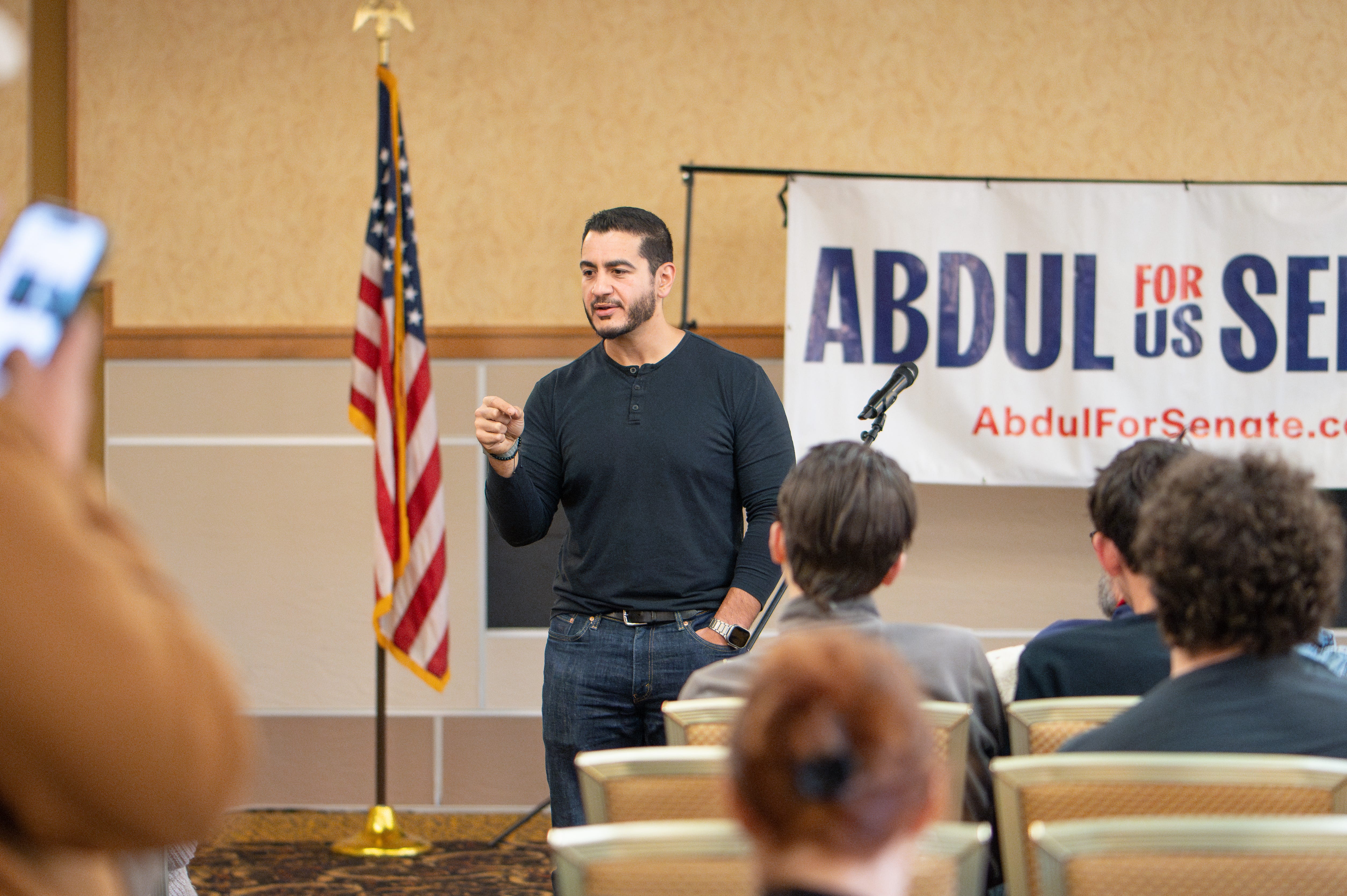
Abdul El-Sayed’s recent Michigan Senate race and Francesca Hong’s Wisconsin gubernatorial campaign were both important tests for the socialist left: could our growing success in deep-blue districts translate to statewide races in purple territory? The two campaigns followed similar trajectories. Both candidates emerged as early frontrunners, at points opening up commanding leads over their centrist rivals. Yet both races tightened dramatically in their final weeks, as establishment forces consolidated behind their opponents. Ultimately, El-Sayed held on to a narrow win, while Hong fell just short of victory.
What lessons should socialists draw from these experiences? Much of the analysis so far has focused on the candidates’ ideological and cultural positioning, the demographics of their electoral coalitions, and their individual strengths and weaknesses. Here, we want to look behind the curtain at the machinery of the candidates’ campaign plans and models: which voter-contact methods they relied on, decisions about the timing and distribution of campaign spending, and how those choices shaped their ability to reach and persuade voters. The socialist left has developed a distinctive campaign model that has proven increasingly successful in deep-blue districts. Hong and El-Sayed give us an opportunity to ask how well it works at statewide scale.
We argue that the two races reveal both the strengths and limits of the left’s approach to elections. Broadly, socialist campaigns build support early and deep, relying on field and organic media to generate enthusiasm. In contrast, establishment forces often strike late and broad, spending millions to reach a wider electorate just as it begins paying attention. Winning statewide will require building an air game capable of weathering those attacks, while adapting our formidable ground game to larger, more geographically and politically diverse terrain.
The Municipal Socialist Model
Over the past decade, the left has developed a genuinely effective electoral model combining ideological polarization, organic social media momentum, and a formidable grassroots operation. At the heart of what some call the “DSA difference” is a large and increasingly skilled army of socialist activists ready to put thousands of volunteer hours into knocking tens of thousands of doors. Because those volunteers are genuinely excited about the candidate—not just afraid of the other guy—their conversations with voters are compelling, bringing still more supporters and volunteers into the campaign.
The same dynamic plays out on social media, where close to 60% of all voters, and close to 90% of young voters get their information. A few supporters share their excitement about a candidate; others repost it, make their own videos, or show up at a canvass and post a selfie. Larger content creators begin joining in, and momentum builds. Where conventional campaigns often focus on expensive air wars—raising large sums of money to reach voters through television, mail, and digital advertising—the socialist model has bet heavily on this combination of volunteer field and organic social media. In dense, deep-blue districts, that bet has paid off, powering socialist victories from city councils to state legislatures.
Two statewide stress tests
Hong and El-Sayed showed the strengths of the socialist model. Both built commanding early leads, fueled by enthusiastic volunteers, strong field operations, and enormous organic attention. But as the races entered their final weeks, both encountered challenges that suggest the limits of relying primarily on door-knocking and organic media to reach a statewide electorate in the face of concerted establishment attacks.
In both races, establishment forces responded to the threat of a left-wing victory by flooding the closing weeks with paid media. In Michigan, the Stevens campaign and six supporting super PACs spent more than $60 million on advertising—an extraordinary sum even for a costly Senate race. In Wisconsin’s lower-cost gubernatorial primary, Crowley and outside supporters still spent more than $4 million—dwarfing the state’s last competitive Democratic gubernatorial primary in 2018, when candidate spending was in the low hundreds of thousands.
That money bought something field and organic social media could not: the ability to reach huge swaths of the statewide electorate at once. Michigan’s airwaves were blanketed with opposition advertising, while in Wisconsin attacks on Hong’s past statements helped turn the closing weeks into a referendum on whether she was too radical to govern the state. In a matter of weeks, both candidates’ commanding leads collapsed.
The timing here was key. Early in a primary, the people paying closest attention are disproportionately the highly engaged voters who also volunteer, donate, and drive organic momentum online. Many less-engaged voters tune in much later; As late as July, 18% of Michigan voters and fully 45% of Wisconsin voters remained undecided. Those voters were making up their minds in the final weeks or even days before the primary—exactly when establishment forces were flooding the airwaves with paid attacks.
What allowed El-Sayed to weather these attacks better than Hong? One factor was his ability to fight back on the air. El-Sayed had raised more than $12 million by the end of June and spent more than $3 million on advertising. While still outspent, this allowed him to invest in a paid air game enough to help staunch the bleeding. Even so, some of his strongest performances came in places like the Upper Peninsula and the southwest border counties, regions largely outside the main Michigan media markets where Stevens and her allies concentrated their TV ad buys. In other words, the places least saturated by attack ads were also among the places where his early support held up best.
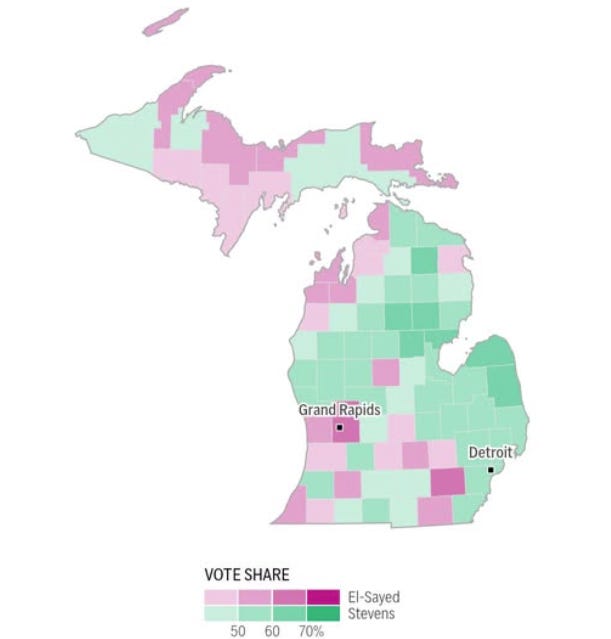
In contrast, Hong entered the closing stretch with far less money and a campaign much more reliant on field and organic media. Most strikingly, Hong spent nothing on traditional TV ad buys and just $150,000 on digital. When attacks against her began reaching voters statewide, she had no comparable way to answer them at the same scale. Just as less-engaged voters were tuning in, her campaign largely ceded the paid-media environment in which many were encountering the race for the first time.
The Limits of the Municipal Socialist Model
The experiences of Hong and El-Sayed point to two related challenges in scaling the municipal socialist model: one spatial, the other temporal. Spatially, deep, face-to-face conversations can be enormously persuasive, but are difficult to scale; paid media offers far less depth, but vastly greater reach. Temporally, insurgent campaigns need to build enthusiasm early, while establishment forces can concentrate their resources late—just as the broader electorate begins tuning in.
Ground vs. Air: How Scale Changes the Math
Size-wise, while a strong ground game can beat out air wars in local and state legislative races, congressional races begin to change the math, and statewide races change it even more.
Door-knocking is ultimately a game of margins. A volunteer canvasser might knock 75 doors in a shift, find 15 or 20 people home, and identify perhaps 10 supporters. In a compact district, thousands of volunteer shifts can reach a meaningful share of the electorate. Across a state with hundreds of thousands or millions of voters, even a formidable field program will touch only a fraction—particularly when voters are dispersed across cities, suburbs, small towns, and rural areas.
The larger the race, then, the more important the role of the air wars becomes. And while organic social media can play a role here, it too has limitations. Algorithms often segregate the content of people with different media diets. This can give a misleading impression that a candidate is broadly going viral, when really that momentum is limited to a particular echo chamber of the internet.
This is where paid media comes into its own. An ad offers nothing like the depth of a conversation on the doors, but it can reach hundreds of thousands of voters at once—including the large majority who will never answer a canvasser’s knock or see that left influencer’s TikTok post. That breadth is often unnecessary in municipal races, where buying television means paying to reach an entire media market for a relatively small electorate. But as the electorate grows, the scale of the race begins to match the scale of the medium. Whether on broadcast television, or targeted social media ads or ads on streaming, it’s only through paid media that a statewide campaign can ensure it reaches ALL the voters it needs to.
The Establishment’s Late-Break Advantage
Establishment candidates also have a temporal advantage. Insurgent candidates need to define themselves early if they want to recruit volunteers, raise small-dollar donations, and build organic momentum. Establishment candidates face less pressure to inspire that kind of early commitment. They can remain relatively undefined, accumulate money and endorsements, and wait for the race to take shape.If the insurgent looks capable of winning, establishment forces have a strong incentive to consolidate behind the strongest alternative, pooling endorsements and money just as the broader electorate begins tuning in.
Money held in reserve also becomes more powerful late, when the broader electorate is finally paying attention and beginning to make up its mind. Because left candidates have to show their hand early, opponents have had ample time to scrutinize their positions and identify potential lines of attack. And negative advertising is particularly well suited to the task. The establishment doesn’t necessarily need late-deciding voters to love its candidate—just to make them nervous enough about the insurgent to vote for the alternative. This means statewide socialist campaigns need a real air game of our own. We may not match establishment spending dollar for dollar, but we need enough paid media to absorb the blow and counterpunch.
Adapting the Left’s Ground Game
Does this mean the left should abandon our focus on field? Absolutely not. A formidable ground game remains one of our greatest comparative advantages. But just as we need to add an air game at statewide scale, we also need to adapt our field strategy to larger, more geographically and politically diverse terrain.
The socialist field model has been refined primarily in dense urban districts, where existing left networks are stronger and organizers can reach large numbers of voters relatively efficiently. Statewide campaigns have to organize across suburbs, small cities and rural areas where supporters are fewer and farther between. El-Sayed’s performance in the Upper Peninsula offers one example of how to approach that challenge. His strength there wasn’t simply a product of escaping the opposition air war. He repeatedly traveled to smaller cities and rural communities, encouraged local organizing, and built a visible presence well before election day. By late June, El-Sayed signs were ubiquitous in parts of the UP, far outnumbering those for either Stevens or Rogers.
Statewide races also involve talking to voters with much more varied ideological identities than one encounters in Brooklyn’s “commie corridor” or other deep-blue urban districts. This requires learning how to communicate left politics beyond our existing base. El-Sayed did this particularly well, framing equality and dignity for immigrants, trans people, and other marginalized groups as fundamentally American values. When a heckler disrupted one event, he and his supporters responded by chanting “USA.” Hong’s former comments about Thanksgiving, by contrast, gave opponents an easy opening to portray her as outside the cultural mainstream. To build a political majority, the left needs to root our politics in widely shared values while fighting to define those values on our own terms, rather than positioning ourselves outside the cultural mainstream.
Implications for electoral strategy
Winning at statewide scale will require expanding the socialist left’s electoral toolkit. We need to preserve the organizing depth and grassroots enthusiasm that have powered our victories so far. But we also need to learn how to:
Raise money at a greater scale without becoming dependent on the donor class. Socialist candidates running for Congress and statewide office need to build the capacity to raise millions from a broad grassroots base. But with establishment super PACs able to dump tens of millions into a race, candidate fundraising alone will rarely be enough. We also need to expand our independent-expenditure capacity, building up groups like Justice Democrats, Working Families Party, and others that can pool movement resources and mount serious outside spending when establishment money floods a race.
Contest paid media rather than treating it as inherently inferior to organizing. The unparalleled reach and power of paid media is undeniable when we are taking on responsibility to win congressional and statewide races. We can continue to advocate for campaign budgets that put more resources into organizing than establishment consultants might suggest, but we can’t avoid making large investments in paid media.
Preserve the power of volunteer-driven conversations while adapting how we reach voters. Volunteer-driven conversations should remain at the heart of our field model, but statewide campaigns will need to rely less exclusively on traditional canvassing and more on relational organizing—building networks of local volunteers who can organize their friends, coworkers, neighbors, and communities.
Develop political messages capable of persuading much more ideologically heterogeneous electorates. Statewide campaigns need messages that can move voters who don’t share the left’s existing political language or cultural reference points. We need to root our politics in widely shared values, even as we fight to redefine those values on our own terms.
Bennett Carpenter is a queer Southern organizer, trainer, and movement strategist. They are a member of the National Executive Committee of Liberation Road.
Jeffrey L. has done bothersome and occasionally disruptive labor, community, and political organizing in the South and on the East Coast. He also sometimes writes.
Max D. organizes workers on the West Coast, and regularly tries his hand at elections.
From tonight, Angie Dixon beat Alex Vindman. Vindman spent $2.2 million 66 times more than Nixon on advertising. I don't think (as a comms guy) that air war shouldn't be a tool but I do think it has limited impact when you don't hit the right notes.
I found this analysis very strategic. Socialists do not have the resources and money of the establishment. Even if socialists did have the money and resources, what really matters is not the ability to communicate a message, but the content of that message. Does it tap into the lived experience and thinking of those who potentially could be supporters? Socialists need to be good listeners: from the masses to the masses; socialists need to articulate the needs, the desires, and aspirations of those on the losing side of the American dream. A great piece that speaks to one of the challenges of success.