


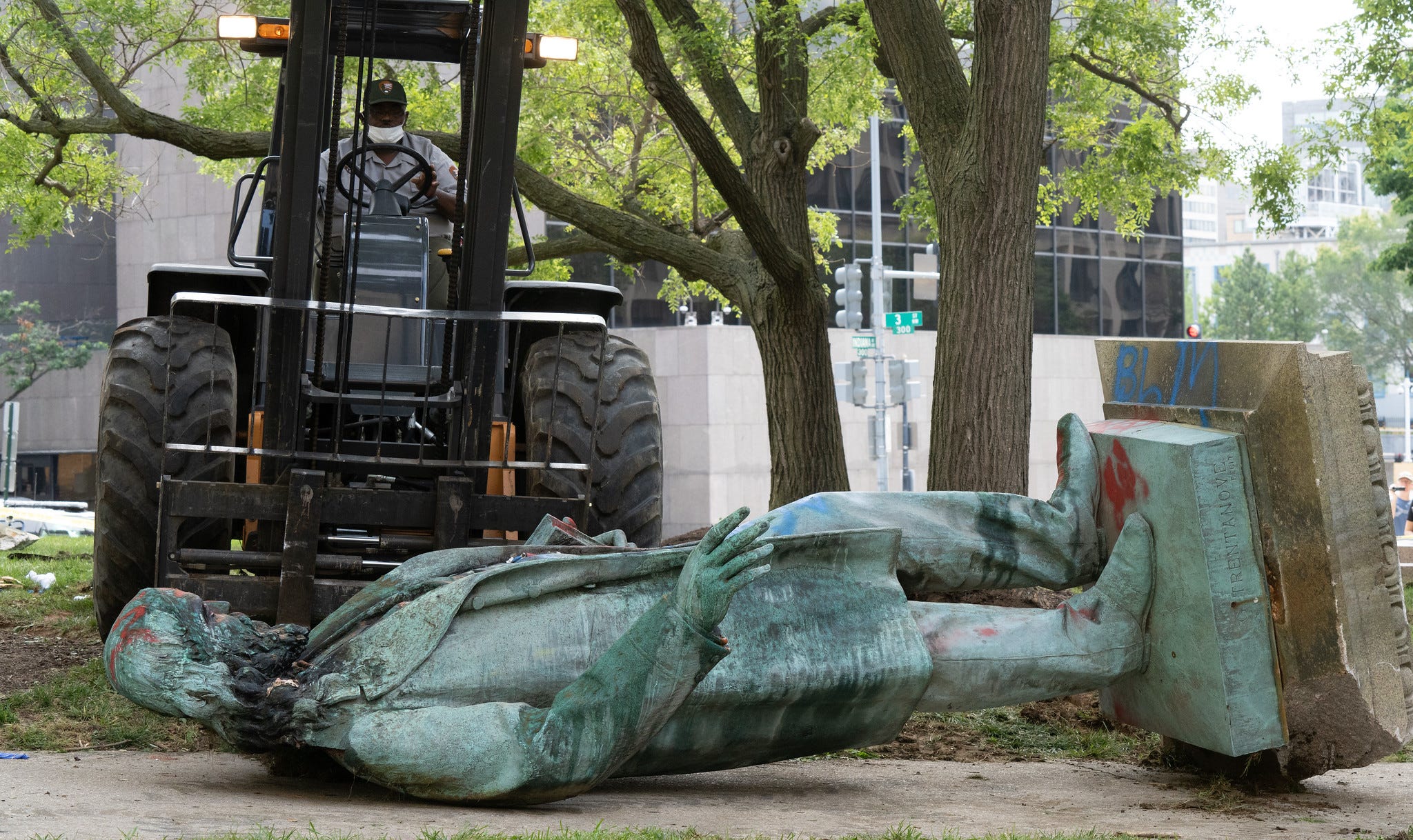
Wow. What a truly historic election. As with all historic events, it will take time to determine its full significance. Liberation Road members are still talking through the results, and we’ll likely put out a more formal statement once we’ve made a collective assessment.
But these first few days are a critical window for shaping how people make sense of the results, and what they mean for the path ahead. So with that in mind, I want to offer some initial thoughts.
This is the first of a two-part analysis. Here, I look at the scale of MAGA’s defeat and the overlapping struggles that drove it. I argue:
Americans dealt the MAGA New Confederacy a crushing defeat of potentially realigning proportions. Whether it opens a new political era depends on whether this electoral majority coheres into a lasting coalition around a new governing paradigm.
The sources of this repudiation were multiple and overlapping. Anger over rising costs, war, ICE raids, racist gerrymanders, gender oppression, corruption, and attacks on democracy converged in a historic rejection of MAGA, with Black and Brown voters playing a decisive role.
In part two, I’ll turn to the battle over what this victory means—and what it will take to turn a shared rejection of MAGA into a common project of reconstruction. I will argue that:
Reducing this victory to “affordability” erases those intersecting struggles and the people who drove them, narrowing the meaning of this election and its mandate. More dangerously, it risks legitimizing a governing agenda that pairs economic redistribution with retreat on racial and gender justice.
Meeting this moment requires linking economic transformation, advances in racial and gender justice, accountability for MAGA’s crimes, and political reconstruction of our deeply flawed and fraying democracy. Our task is to turn this diverse rejection of MAGA into a conscious reconstruction coalition—a common “we” that understands our fights as interconnected and our futures as bound together.
A Decisive Rejection of the MAGA New Confederacy
This was an election of truly historic proportions. Earlier this year, I laid out three scenarios for how big a wave we might see in November. At that point, polls already pointed toward a D+8 environment, analogous to the blue “wave” elections of 2006 and 2018. But if the regime’s contradictions kept compounding, I argued we could see an even larger margin, closer to Reagan’s 1980 landslide. The most dramatic scenario I considered was a blowout on the scale of 1932, when Roosevelt won by 18 points, setting in motion a full-scale political realignment.
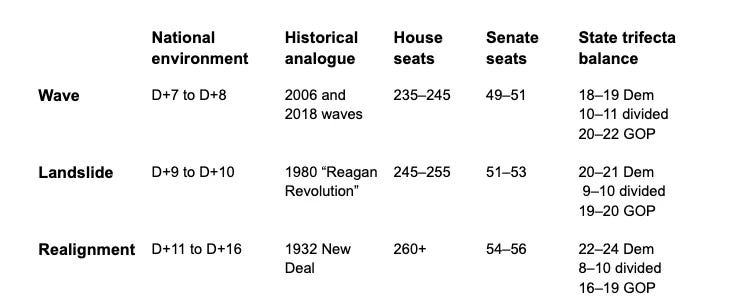
In the end, the scale of the victory came close to 1932 levels. Democrats won the national House vote by an estimated 13 to 14 points, the largest margin in at least half a century. As I write, they look on track to reach 260 seats in the House and an 85-seat majority, the largest since 1992. In the Senate, Democrats have won at least 54 seats, flipping Kansas, Iowa, and South Carolina, all states Trump carried by double digits just two years ago. If current leads hold, we may yet win Senate races in Alaska and—incredibly—Mississippi.
Down-ballot victories were just as significant. This cycle offered Democrats a chance to “flip” the balance of power at the state level, winning more governing trifectas than Republicans for the first time since 2010. Sure enough, that’s what happened. Before the election, Democrats held 16 trifectas to Republicans’ 23. Now Democrats lead at least 21 to 18, with a chance that we will reach 24 trifectas once all the votes are in.
Pro-democracy voters broke Republican trifectas in five states: Georgia, Iowa, Ohio, New Hampshire, and Texas. And we won new Democratic trifectas in at least five states: Michigan, Minnesota, Nevada, Pennsylvania, and Wisconsin. With ballots still being counted, Democrats could still gain trifectas in Arizona and Alaska—and potentially North Carolina, where we flipped a Republican state House majority into a Democratic near-supermajority and are within a hair’s breadth of taking the state Senate.
In my scenarios, I used four benchmarks to gauge the scale of a Democratic victory—the party’s margin in the national House vote, its seat totals in the House and Senate, and the number of state trifectas it wound up with. I set the bar for a realignment election as a D+11 to D+16 national environment, in which Democrats won at least 260 House seats, 54 to 56 Senate seats, and between 22 and 24 state trifectas. The extent to which the final results lined up with that scenario is almost uncanny.
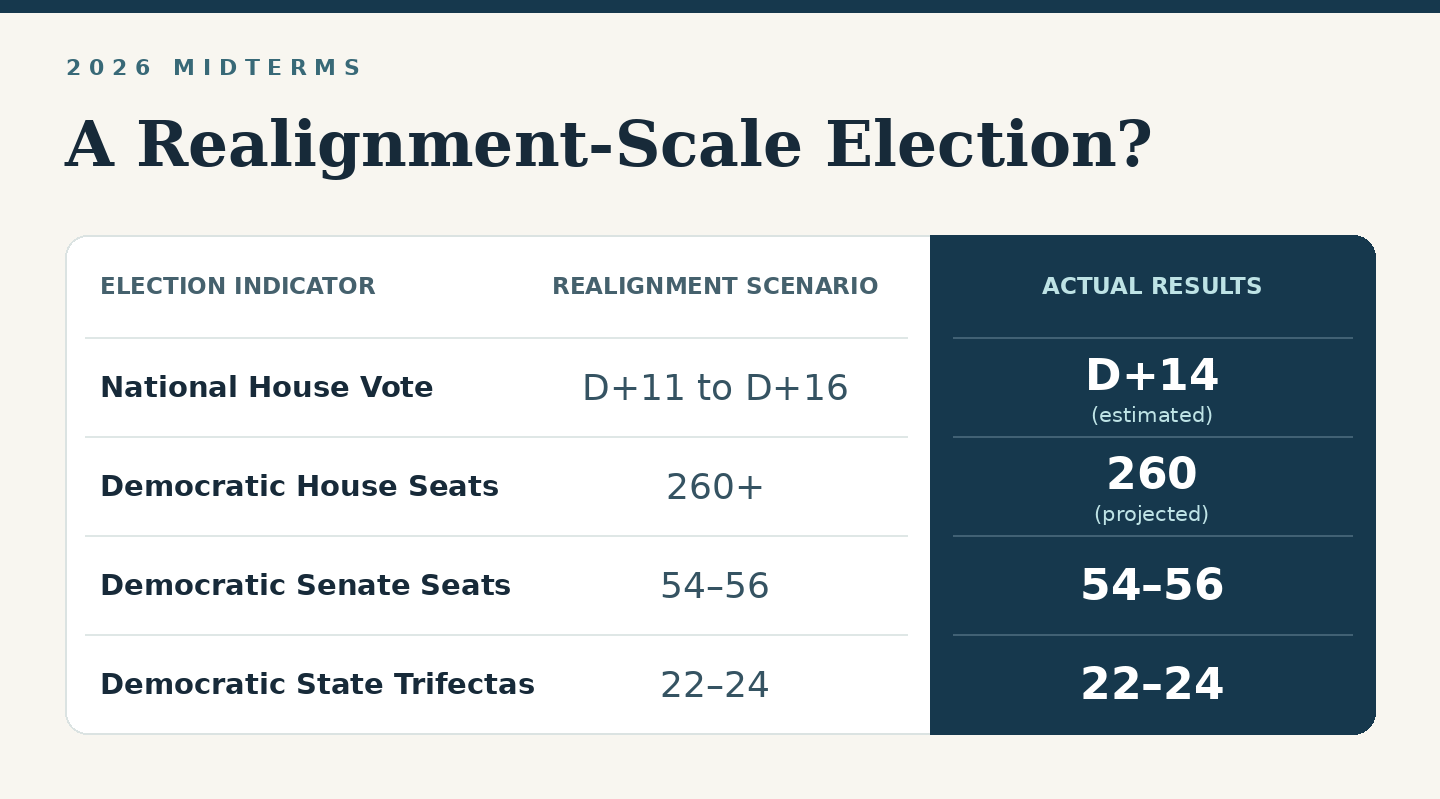
By my own definition, then, this would appear to have been a victory of realignment proportions. But did it actually mark a realignment?
The answer is “too soon to tell.” A realignment election is one that marks a significant and lasting shift in the political allegiances of voters. For instance, FDR’s 1932 election realigned Northern white workers and Black people with white Southern Democrats, forging a new coalition around a sweeping program of economic, social, and political reforms—the New Deal. Reagan’s 1980 election unravelled that coalition, drawing white Southerners and some Northern blue-collar Democrats into a new majority that married racial backlash and social conservatism to tax cuts and deregulation.
Qualitatively, then, the test of a realignment is twofold. First, will the groups that came together this November form a coalition as durable as Roosevelt’s New Deal coalition, or Reagan’s neoliberal one? Second, will that coalition consolidate around a new governing paradigm that reshapes the political common sense—defining the terms of debate and shaping the direction of public policy for decades to come?
Those questions can only be answered by the course of future struggle. But the scale of this victory should not obscure the challenge ahead. Americans came together to reject MAGA’s fascist agenda. But they have not yet consolidated around a shared alternative. To turn a heterogeneous rejection of MAGA into a conscious reconstruction coalition, we need to understand both what brought people together and the many differences that still remain.
It Wasn’t Just About the Price of Gas
While rejection of MAGA’s autocratic coup attempt was widespread, its sources were diverse and contradictory. People were united in saying “no,” but they said no for different reasons.
To say it wasn’t just about gas is to acknowledge that gas prices played a real role. Skyrocketing fuel costs hit voters hard. And they hit hardest in rural areas with long commutes, and farming communities dependent on diesel. Unlike other economic pain points whose causes can be hard for voters to trace, pain at the gas pump had an obvious source: Trump’s needless and unpopular war with Iran. For angry voters, this told a devastatingly simple story. The president who promised lower prices and “America First” had launched another foreign war, and working people were paying for it.
But the economic anger behind this election ran much deeper than gas. From mounting grocery bills to unobtainable childcare to skyrocketing rent, the foundations of working-class life have been collapsing. Mamdani’s 2025 New York mayoral campaign gave this simmering crisis a political frame that Democrats across the country have since adopted—affordability. The term captured something powerful about the concrete ways that working-class people experience material pressures. As Corey Robin notes, “It’s also almost a spiritual term, a sense of the enshittification of life, the grinding worsening of material and therefore cultural conditions.”
But “affordability,” for all its power, does not capture the full scope or stakes of this election. People were also voting against ICE raids that terrorized their communities; against Callais and the broader rollback of racial justice and civil rights; against attacks on women’s and trans people’s bodily autonomy; against the brazen corruption and lawlessness of a government hell-bent on dismantling democracy at home and abroad. To flatten these and other motivations into a singular story about affordability diminishes what this election was actually about.
First and foremost, it erases the decisive role of Black voters in securing astonishing wins across the South. After Callais, too many national Democrats were ready to write off their remaining House seats in the deep South, calculating that gains elsewhere could offset those losses. But Black voters refused to surrender political power won through generations of struggle.
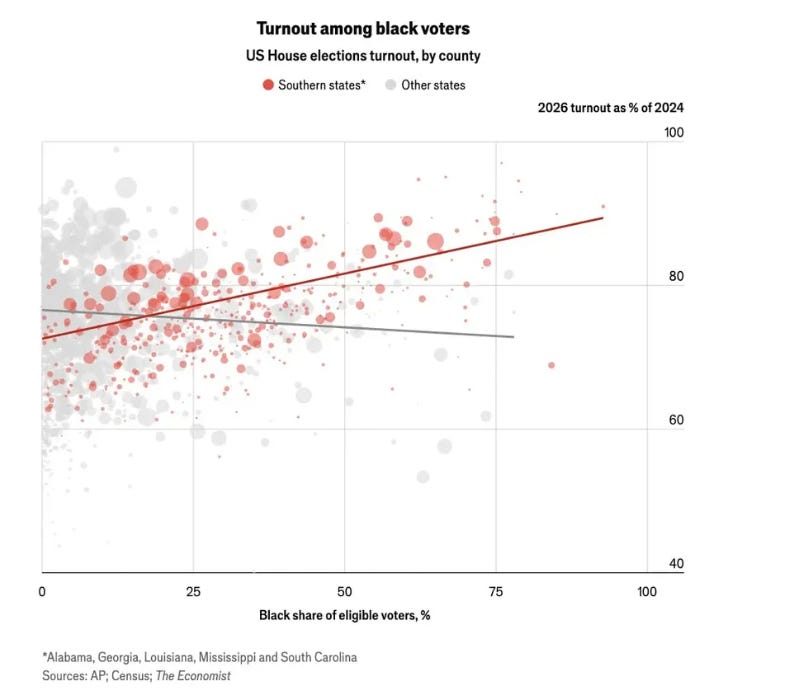
According to estimates by Strength in Numbers, Black voter turnout surged across the deep South, reaching about 96% of presidential-year levels, compared to 71% for white voters. No comparable increase occurred outside the region, suggesting high turnout was a direct response to the renewed attacks on voting rights by the Supreme Court and red-state legislatures. Indeed, polls found Black voter enthusiasm began to rise during the 2025 redistricting push, then surged after the Supreme Court gutted the Voting Rights Act. As one astonished GOP strategist working on races in North Carolina and Florida told Politico, “I’ve never seen anything like this before.”
Newly rigged maps in Texas, Florida, Tennessee, Louisiana, Alabama, and North Carolina had been predicted to net Republicans 13 additional House Seats. But those maps, drawn based on conventional midterm election models, simply could not withstand this historic “Blacklash.” Instead, Black voter mobilization led to a net increase of at least nine Southern House seats, and played a decisive role in flipping Senate seats in Texas, North Carolina, and, hopefully, Mississippi.
Latine voters played a similarly decisive role in this election, both turning out in record numbers and swinging sharply to the left. According to Unido, “Latino voters had the largest turnout ever in a midterm election.” And while literally every single demographic shifted toward Democrats this cycle, Latino voters had the largest swing of any racial or ethnic group. Among young Latino men, the swing was a staggering 43 points. Among Tejana voters in the Rio Grande Valley, it was even larger: Starr County, with a 97% Latino population, saw a 74 point swing toward Democrats.
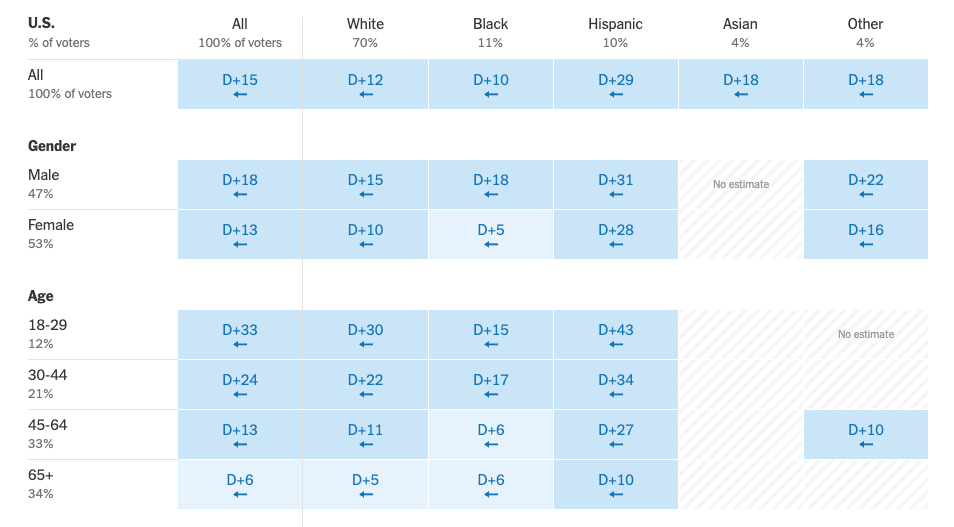
This Latino voter power-up happened everywhere around the country. But Latino voters surged the most in the places that have been hit hardest by ICE’s brutal body-snatching campaign. As Adrian Carrasquillo reported in the Bulwark: “In Minnesota, site of heavy ICE and Border Patrol activity last winter that left two U.S. citizens dead, people left their “I Voted” stickers at memorials for Renée Good and Alex Pretti. There, the early Latino vote increased 217 percent compared with 2022.”
Where gender and abortion rights were on the ballot, they were a huge motivator for women and trans and queer people. In Idaho, nearly six in ten women said abortion access had a major impact on their decision to vote. Nationwide, 74% of LGBTQ+ voters named “civil rights and equal protections for LGBTQ+ people” as one of their top motivators. The broader electorate delivered a more mixed verdict, expanding abortion rights in some states while rolling back trans rights in others. But in Missouri, voters soundly rejected a measure that attacked both, suggesting trans rights can win majority support when connected to a broader story about bodily autonomy.
So far I’ve mainly discussed issues of racial, immigrant, and gender justice as if they only mattered to those whose rights were most directly under attack. But that’s not true. In pre-election polling, 82% of all Democrats said protecting or expanding abortion access mattered to their vote, and 71% said the same about trans rights. In a Civil Rights Monitor poll, 57% of voters of all races and parties said they were concerned about the rise of white supremacy. 53% of voters who planned to vote Democrat said immigration was “very important” to their vote. This wasn’t just dyed-in-the-wool liberals. In a poll of former-Trump voters who planned to vote Democrat or were still undecided, 77% agreed Trump was too focused on deportations, and 32% cited “ICE deployment to cities” as one of the biggest reasons they had turned against Trump and the GOP.
Voters of all races and beliefs were deeply motivated by the degradation of our democracy. Polls consistently found “government corruption” to be a top issue for voters this cycle, ranking on par with or even above cost of living. “Corruption,” the term used by most pollsters, does not actually tell us very much about what, exactly, voters are reacting to. But polls that asked more detailed questions give us a bit more texture.
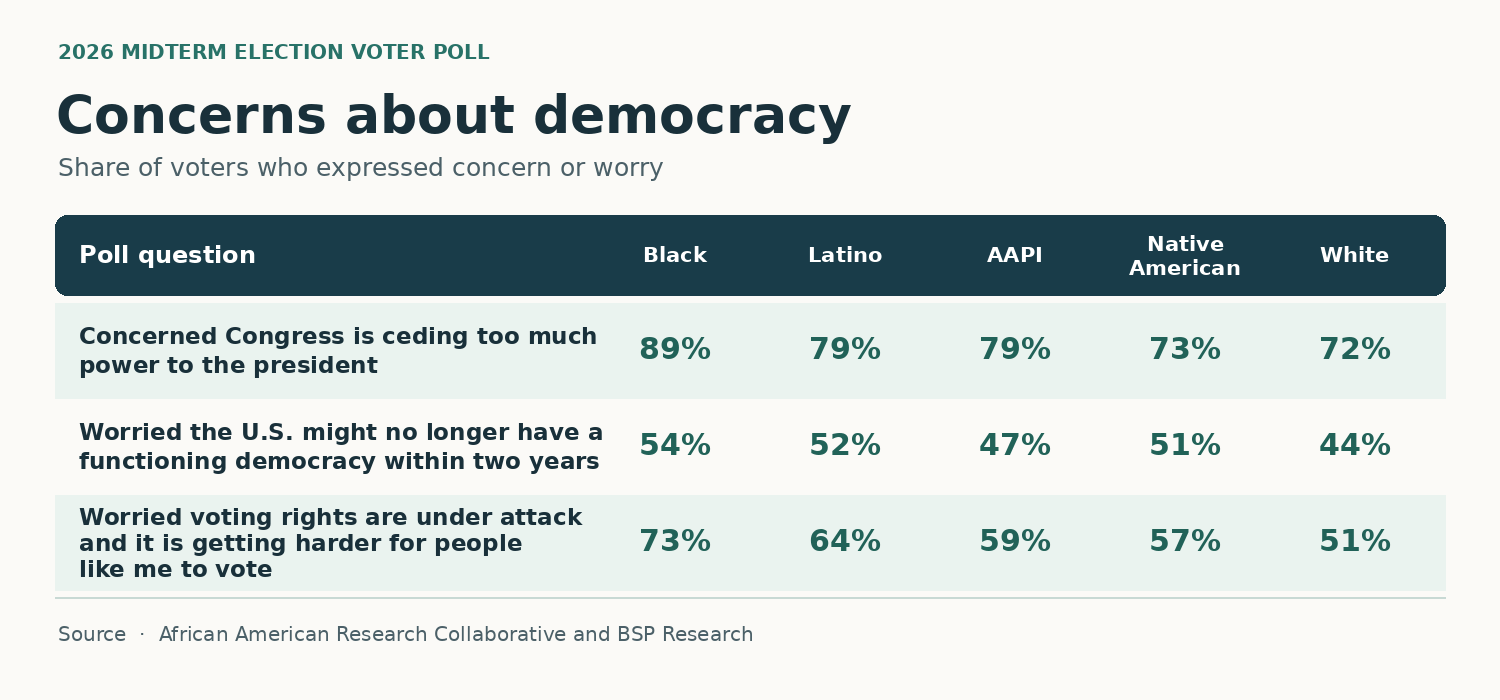
63% of respondents to one Reuters-Ipsos poll objected to the Trump family cashing in on crypto while he was in office, and 76% told the Guardian politicians cared more about enriching themselves than helping ordinary people. But greed and graft was only part of it. In an AP–NORC poll, 69% of registered voters called partisan gerrymandering a major problem. A post-election survey of 10,000 voters found more than 70% in every racial group were concerned that Congress had given up too much authority to the president, with almost half saying they were either “worried” or “very worried” that “there is a chance we will no longer have a functioning democracy within the next 2 years.” (See cross tabs here.)
Conclusion
With a historic popular-vote margin, sweeping congressional gains, and breakthroughs deep in Republican strongholds, this election delivered a defeat of potentially realigning proportions. But is it actually realignment? Too soon to tell.
This decisive repudiation of Trump and MAGA grew out of multiple, overlapping sources of anger: rising costs, war, racist gerrymanders, ICE raids, gender oppression, corruption, and attacks on democracy. And yet, too much of the post-election coverage has collapsed this overdetermined revolt into an overly simplistic story about prices.
In the aftermath of the election, familiar squabbles have broken out between “progressives” and “moderates.” But realignment means the old divides and terms of debate are being scrambled. We risk using old labels to describe new fault lines whose contours are still emerging.
In part two, I will argue that the greatest divide within our front right now is not between moderates and progressives, but between “broke economic populism” and “woke economic populism.” From moderates, we hear that Democrats won by pairing economic populism with “cultural moderation”—a polite term for retreat from the halting gains toward racial and gender justice we have made over the last decades. From parts of the left, we hear that Democrats can now consolidate these gains by finally focusing on the “real” economic issues that unite working people.
These arguments differ, but both risk reducing many-sided class struggle to a narrow set of “bread and butter” demands. There’s an old name for that error: economism.
The danger is that we end up with a governing agenda that offers economic relief while leaving the structures of racial oppression, gender domination, and minority rule intact—or even reinforcing them. That would abandon key forces behind this victory while preserving the bases of power from which the New Confederacy could regroup and reverse our gains.
As I will argue, the only way to decisively defeat the MAGA New Confederacy is to turn the anti-MAGA “rejectionist front” into a conscious reconstruction coalition. That does not mean assuming everyone who voted against MAGA already shares a common politics. They don’t. So our task will not be easy. But the currents animating this victory give us something to build upon.
A full-fledged Third Reconstruction must deliver a better life for working people, advance racial and gender liberation, hold MAGA accountable for its crimes, and rebuild our deeply flawed and fraying democracy. We don’t have to choose which of those goals to pursue. We can—and must—do all of them.
We can eat our cake and stay woke, too. Reconstruction 3.0 is going to be crazy.
Bennett Carpenter is a queer Southern organizer, trainer, and movement strategist. They are a member of the National Executive Committee of Liberation Road.