

By Tom Goodkind
In 1963, following George Wallace’s January speech demanding “Segregation now, segregation tomorrow, segregation forever,” following the daily sit-ins and marches of the SCLC’s spring Birmingham campaign, following MLK’s Letter From Birmingham Jail, following the attack on the Birmingham Children’s Crusade with dogs and firehoses, following the June Jackson Mississippi assassination of Medgar Evers, following the August March on Washington, following the September KKK bombing of the 16th Street Baptist Church killing Addie Mae Collins, Denise McNair, Carole Robertson, and Cynthia Wesley, and following the November assassination of JFK, my white New York family packed up our blue Rambler American station wagon and drove south to the Florida Everglades. It was just 65 years since the final violent overthrow of Reconstruction and only 8 years since the lynching of Emmett Till.
We saw oranges and grapefruits in the trees, armadillos on the ground, and alligators in the swamps. But as a wide-eyed 12-year-old, after experiencing the “colored” and “white” water fountains, benches, bathrooms, and counters, and the Black chain gangs policed by shotgun-wielding sunglassed white police, I was never the same.
I didn’t read W.E.B. Du Bois’s magisterial Black Reconstruction in America until 11 years later. Du Bois had absorbed everything there was to find about Reconstruction; he relied on reams of government reports, primary sources, and unpublished research theses “by young Negro scholars.” He divided his copious secondary sources into “Standard—Anti-Negro,” “Propaganda,” “Fair to Indifferent on the Negro,” historians who “have studied the history of Negroes and write sympathetically about them,” and “Negro Historians…some judicial, some eager and even bitter in defense.” His is a work of stupendous scholarship, documentation, interpretation, and applied Marxism, and for me it opened up the continent of U.S. history.
Du Bois states of Reconstruction “…there was being put into force one of the most extraordinary experiments of Marxism that the world, before the Russian revolution, had seen” (358). He ends by observing, “We are still too blind and infatuated to conceive of the emancipation of the laboring class in half the nation as a revolution comparable to the upheavals in France in the past, and in Russia, Spain, India and China today” (708), finally closing with “…we are blind and led by the blind. We discern in it no part of our labor movement…” (727).
White Communists Weigh In
Communist Party historian James S. Allen wrote Reconstruction: The Battle for Democracy 1865-1876 in response to Du Bois’s work. Allen’s book was published in 1937, two years after Black Reconstruction, and republished by the CPUSA in 1942, 1943, 1955, 1963, 1966, 1970 and 2021. Reading Du Bois and Allen side by side is an instructive study project—especially for those of us concerned with the history and prospects of the U.S. labor movement. Two themes among others stood out for Allen: the objective limits to what could be accomplished in Reconstruction, and the relative “immaturity” of the (white) proletariat.
The “Editor’s Foreword” to Allen’s book responds directly to Du Bois, calling Black Reconstruction “praiseworthy” and noting condescendingly that it is “A refreshing antidote to the traditional acceptance of Negro inferiority and passiveness…” The International Publishers editor goes on to lecture Du Bois on Marxist theory (with which Du Bois was in fact well acquainted):
Du Bois’s failure to grasp the fundamental bourgeois character of the revolution leads him to the mistaken notion that what was occurring in the South during Reconstruction ‘was one of the most extraordinary experiments in Marxism that the world…had seen.’ Du Bois therefore very naturally falls into the error of characterizing the Reconstruction governments of the epoch as dictatorships of labor (that is, the proletariat) despite the fact that at the time such a type of dictatorship was out of the question (11).
Thus Allen’s aim was, in part, to rescue Reconstruction from Du Bois’s supposed idealism and, above all, to exonerate the white section of the working class from any responsibility for the revolution’s defeat. As against both Marx and Lenin, and like many in the Communist Party at the time, his theory was rooted in an evolutionist form of what Lenin might call “left-wing” economism. It implied that if only the Black workers could have waited for the maturation of a self-conscious industrial proletariat, their full freedom might have been won, but in the moment it was simply impossible. But Black workers would not wait; instead, for example, in the world as they found it, they were forced to create a “Colored National Labor Union” alongside William Sylvis’s white-only National Labor Union. The great communist labor leader William Z Foster in his 1954 book The Negro People in American History generally followed James Allen’s position, but he did point out:
The N.L.U. had no Reconstruction program for the South. Practically no attention was paid to the fight for the right of the Negroes to vote, and none at all to their struggle for the land. Sylvis, the most advanced of the N.L.U. leaders, denounced the Freedmen’s Bureau as “a stupendous fraud.” He proposed instead “to loan the planters a few millions of dollars at a reasonable rate of interest…$20,000,000 loaned in this manner,” he said, “would have done more to ‘reconstruct’ the South than a thousand millions spent upon the Freedmen’s Bureau.” The first convention of the N.L.U. endorsed the policy of President Johnson which was for “a speedy restoration of the South” at the expense of the Negro people, and ultimately, also of the white workers in the North (347).
(Du Bois, on the other hand, asserts that “In the Freedmen’s Bureau, the United States started upon a dictatorship by which the landowner and the capitalist were to be openly and deliberately curbed and which directed its efforts in the interest of a black and white labor class,” and goes on to call it “the most extraordinary and far-reaching institution of social uplift that America has ever attempted.” 219)
Working-Class Political Power Hiding in Plain Sight
Ask yourself what has been the political highwater mark in the rich history of U.S. working-class struggle: the 1877 railroad worker and miner uprisings? The late 1880s battle for the 8-hour day? The 1912 Bread and Roses strike? The two million votes for Eugene Debs in 1912 and 1920? The 1935 founding of the CIO coupled with the 1937 Flint sit-down strike?
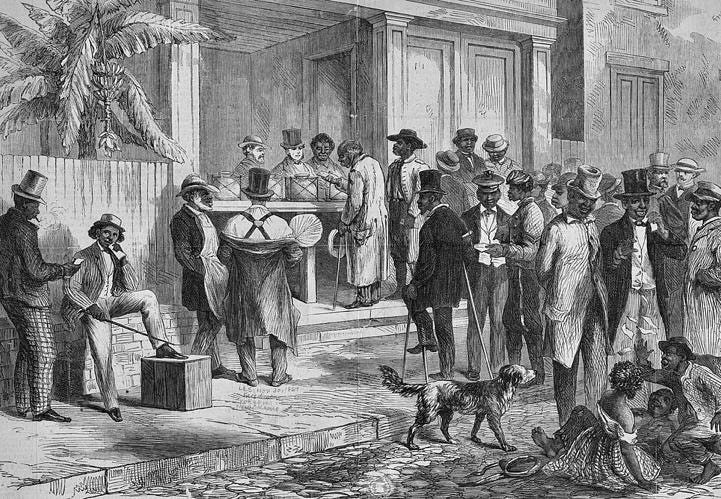
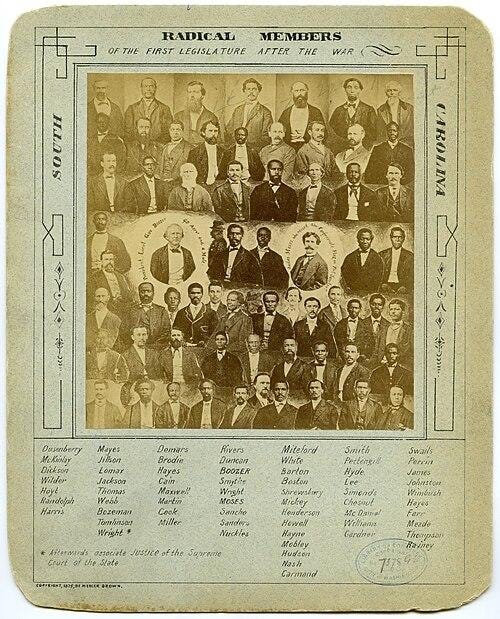
Yet it was precisely in the Civil War, and especially in Reconstruction, that the characteristic form of capitalist rule in the young United States was most radically exposed and threatened. It was the closest thing to the Paris Commune that we have ever known–when the African-American people, the overwhelming majority of whom were workers, coalesced and with a diverse mix of working-class and other allies used the federal government as a shield behind which to organize their revolutionary democratic struggle. And it was by reversing the working-class gains of Reconstruction—taking advantage of white labor’s indifference or worse, northern betrayal, southern terror and Jim Crow—that the Redeemers at both state and federal levels engaged in the first significant restructuring of white privilege since the establishment of racial slavery. It was at least as violent a counterrevolution as the defeat of the Paris Commune.
If you’re willing to wade through pages of Lenin’s 1921 denunciations of Trotsky and Bukharin, you’ll arrive at this timeless Marxist assertion: “…politics is a concentrated expression of economics...Politics must take precedence over economics. To argue otherwise is to forget the ABC of Marxism.” Here’s a simple way to think about that: if there’s one thing capitalism likes more than making profits, it’s continuing to make profits, and the political level of the class struggle is all about that continuation.
In historical fact, the closest thing to working-class political power this country has ever seen occurred in the Confederate states between 1863 and the bloody Wilmington Coup of 1898, and it’s remarkable how many socialists are blind to that actuality, even though today the country is in many ways closer to 1875 than to 1935.
Capitalism in the abstract exists exactly nowhere; instead, each capitalist social formation develops in the concrete conditions of its own inheritances and class struggles. And here in the U.S., just 150 years from our first Reconstruction and 80 years from our second, today’s Redeemers throughout three federal branches and half the states are engaged in the largest restructuring of white privilege since Jim Crow. And as Black and Brown working class people are hunted and murdered in our streets by federal agents and the flag of the Confederacy is carried throughout the country, it is worth remembering the foundational and continuing role played specifically by white supremacy in this particular historically constituted brand of capitalism. All leftists should be reading Black Reconstruction today and making our plans steeped in its lessons.
* * *
In June of 1964, just before the Civil Rights Act was signed into law and 14 months before the signing of the now-gutted Voting Rights Act, six months after our tour of the segregated South and less than 90 years since the defeat of the First Reconstruction, my white Jewish family moved from Long Island to the northern suburbs of Chicago. On my first day there, my father drove us through the small towns with large trees and larger houses. “This one,” he said, “is ‘restricted’: no Blacks or Jews allowed.” The Second Reconstruction had not yet made its way north. The Third is yet to come.
Tom Goodkind is a longtime machinist, rank-and-file labor activist, union president, and Liberation Road member.
You nailed it, comrade, especially with the side-by-side comparison with James Allen.
Brilliant!