

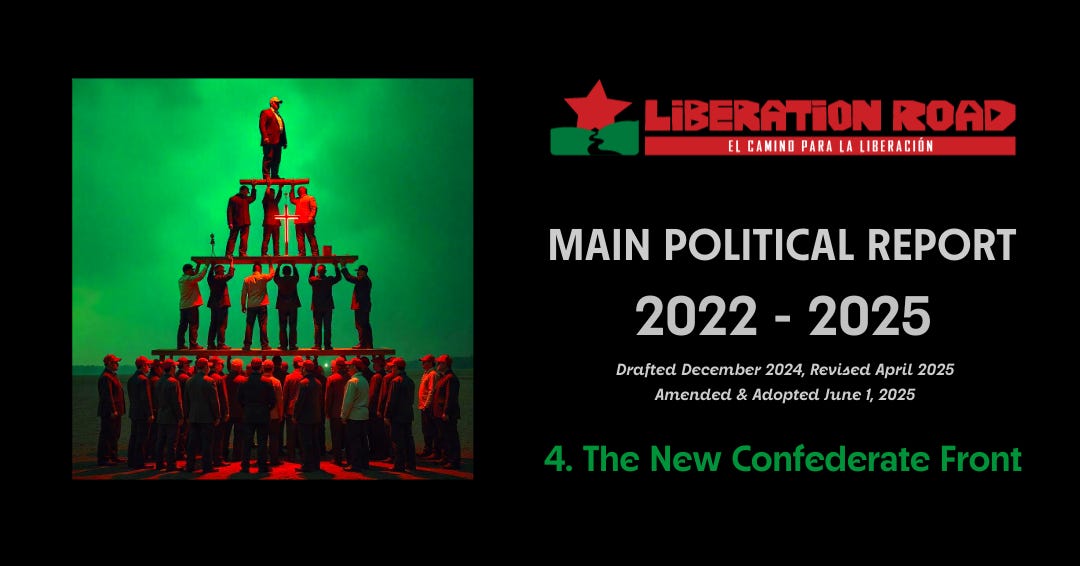
As part of our 14th triennial Congress, Liberation Road adopted our 2022 - 2025 Main Political Report on June 1st, 2025. We will release the sections of the report in six installments over the coming weeks, prior to publishing the full analysis as a single, integrated report. This is part four: “The New Confederate Front.” Read on for our analysis of key shifts and developments within the US right, including: changes in its social base; it ideological radicalization into a right-wing revolutionary force; distinctions between its MAGA nativist, Christian nationalist and techno-capitalist factions; and how these factions relate to Trump.
We will add links to the other sections as they are released:
The New Confederate Front
SECTION 4: THE NEW CONFEDERATE FRONT
4.1 From Conservatism to Right-Wing Revolution
4.1.1 Factional Balance of Power
On the right, this three-year period saw Trump’s near-total consolidation of leadership over the New Confederate front. Following the failed January 6th insurrection, the Republican old guard made a brief attempt to reclaim control, and the underperformance of MAGA candidates in the 2022 midterms led some to speculate that Trump’s influence might wane. But these hopes quickly faded. Trump’s decisive victories in the 2024 primaries, his ability to block a bipartisan immigration deal, and the elevation of Lara Trump to RNC chair confirmed his dominance— over the Republican voter base, elected leadership, and institutional machinery.
This consolidation marked the final stage in a broader realignment that had been reshaping the GOP since the early 2010s. For decades, the party had been governed by a “fusionist” pact: economic neoliberals and foreign policy hawks held power, while the religious right provided mass electoral support from a junior position. This balance began to fracture with the rise of the Tea Party, a populist rebellion against the party establishment. Over time, that populist energy radicalized into the MAGA movement, whose focus shifted from constitutional conservatism to reactionary nativism and cultural grievance. Simultaneously, the religious right evolved from a politically subordinate force into a core ideological engine of white Christian nationalism, increasingly aligned with MAGA’s militant posture. These two factions gained more and more power, especially after Trump’s 2016 election, and by 2024 they had nearly completed their takeover. Most establishment Republicans have now either been pushed out, silenced, or forced to fall in line with MAGA’s agenda.
At the same time, Trump and MAGA’s political domination of the New Confederate front sits uneasily alongside the continued economic dominance of the network of billionaires whose contributions underwrite the Republican Party. This right-libertarian faction of the capitalist class seeks the same agenda they had pressed for under the Republican old guard: lower taxes, fewer regulations, free trade, privatized services, and a smaller government—except when it comes to defending military power, property rights, and business interests. A segment of this faction, led by techno-feudalists like Peter Thiel, now pursue an even more radicalized version of this right-libertarian project.
4.1.2 Ideological Radicalization
As these factions displaced the Republican establishment, the ideological character of the right underwent a profound transformation—from a conservatism that sought to preserve the status quo to a revolutionary project intent on overthrowing it. The New Confederate front no longer primarily defends inherited institutions; it seeks to reshape the political and social order. Its ideological center has fractured into three increasingly radical and assertive currents: ethnonationalism, Christian fundamentalism, and techno-authoritarianism. Each one grew out of tensions and contradictions within the old fusionist coalition, and each represents both a continuation and a negation of that tradition.
In the heyday of neoliberalism, efforts to protect racial, gender, and class privilege were usually framed as defending “freedom” against government overreach. Since many oppressed groups—like women, LGBTQ+ people, people of color, and working-class communities—had used the federal government to push for justice, those trying to protect the status quo claimed they were simply standing up for individual rights and limited government. Class, race, and gender hierarchies were rarely explicitly advocated. Instead, the right argued that efforts to address inequality were “unnatural” and interfered with personal liberty and the free market—which, it just so happened, “naturally” reinforced these hierarchies. In reality, their aim was to protect corporate power, white supremacy, and male dominance. But all of this was hidden behind the language of neoliberalism: “limited government, free markets, and individual freedom.”
That façade has now largely fallen. As the promises of the fusionist pact unraveled—particularly the idea that neoliberal capitalism would preserve traditional hierarchies of race, class and gender privilege—each of the emerging factions began to embrace more direct, and often authoritarian, methods. MAGA populists, once suspicious of federal power, now call for using it to crush political enemies, punish “woke” corporations, and impose their values on blue states and marginalized communities. Christian nationalists have shifted from advocating religious liberty to demanding Christian dominance, openly pursuing theocratic goals. And techno-capitalists, who once cloaked their ambitions in libertarianism, increasingly envision a future in which democratic governance is replaced by corporate sovereignty.
What unites these differing ideological projects is their shared opposition to (neo)liberal democracy. No longer a conservative program seeking to defend the status quo from change, all three have become right-wing revolutionary projects seeking to transform or overthrow the social, political, and economic order as reflected in the existing balance of power within the state. However, they don’t all want the same kind of future.
4.2 Three Revolutionary Projects: MAGA Ethnostate, Dominionist State, and CEO State
While the factions of the New Confederate front remain internally diverse, each is increasingly defined by its own vision for replacing (neo)liberal-democratic governance. These visions are not merely ideological—they are organizational and strategic, with distinct goals for state power, economic policy, and social order. What follows is an outline of the three major projects within this coalition: the MAGA ethnostate, the Christian dominionist state, and the techno-capitalist CEO state. Each of these seeks to construct a radically different future, but all rest on shared foundations within an integrated system of cisheteropatriarchal racial capitalism.
4.2.1 A MAGA Ethnostate: Economic, Welfare, and Symbolic Nativism
The populist wing of the New Confederacy seeks to create an exclusionary ethnostate, where the rights and benefits of full citizenship—material, legal, and symbolic—are reserved for a narrow definition of “real Americans.” At its core, this vision is driven by white supremacy, building on a long history of favoring white, US-born people over both internal oppressed nationalities and new immigrant groups (including many who would later “become’ white).
But while white supremacy remains central, this project is not strictly racial. Instead, it creates an idea of a national identity—an American "ethnos"—that combines racial, religious, cultural, political, gendered, sexual, and other markers. This flexible definition helps MAGA populists both shore up and grow a white united front, centered around (straight, Christian, conservative) white people, but selectively inclusive of non-white or immigrant individuals who conform to its values.
This nativist politics relies on both punishment and reward. Immigrants, racialized communities, and other groups are targeted through restrictive policies, including mass deportations, attacks on birthright citizenship, and the rollback of anti-discrimination protections. Simultaneously, “deserving” Americans—especially rural and white working-class communities—are rewarded through welfare chauvinism, support for protectionist labor policies, and occasional gestures toward economic populism.
4.2.2 A Christian Dominionist State: Reproducing the Patriarchal Christian Family
The Christian nationalist wing seeks to transform the US into a Dominionist state—one governed by biblical law and patriarchal authority. Their vision extends beyond government to include total control over cultural and civil society institutions: schools, media, medicine, the arts, and the family. Their organizing principle is the cisheteropatriarchal family, modeled on a strict, authoritarian structure where the father rules, the wife obeys, and children are molded into “right” citizens. Significantly, the first “promise” of Project 2025, highlighted as the foundation of its entire political project, was to “restore the family as the centerpiece of American life and protect our children.” This is indeed a restorationist project, which seeks to use government power to reward and incentivize traditional, heterosexual, patriarchal families—and to punish or exclude anyone who doesn’t fit that mold.
The disciplinary components of this cisheteropatriarchal program include aggressive rollbacks of reproductive rights, gender-affirming care, and legal protections for LGBTQ+ people; censorship of public education; and criminalization of what they call “gender propaganda.” Meanwhile, they envision increased financial and symbolic rewards for married, heterosexual families: expanded child tax credits for middle-class couples (but not single parents, unmarried couples, or low-income families), subsidies for stay-at-home spouses, and workplace policies designed to reinforce traditional gender roles and religious observance.
4.2.3 CEO State: Techno-Authoritarian Capitalism
The techno-capitalist wing of the New Confederacy wants to reshape the US into a “CEO state”—a country run more like a private corporation than a democracy. This faction is made up of ultra-wealthy entrepreneurs, venture capitalists, and libertarian tech elites who believe government should be stripped down to its bare minimum, or even replaced by corporate rule altogether. At the heart of this vision is the idea that markets are better than governments, and that billionaires and tech CEOs should run society instead of elected leaders. Privileged citizens are treated more like shareholders or consumers than active participants in a democracy; less privileged groups are viewed merely as an exploitable workforce.
Their agenda includes dismantling the regulatory state, lowering or eliminating corporate and income taxes; weakening labor protections; and privatizing education, healthcare, and social welfare. In its most extreme form, the project envisions dismantling the government entirely, replacing it with unfettered corporate rule, or carving out autonomous “charter cities” and “innovation zones” where corporate law overrides democratic accountability.
4.3 Internal Contradictions
What unites these forces is not a coherent ideology but a set of enemies and a common rejection of egalitarianism. Each faction sees the expansion of civil rights, pluralism, and democratic participation as threats to their vision of a properly ordered society. In this sense, they all share a fascist impulse. Fascism, at its core, is not just about authoritarianism, but about violently reordering society around a mythic past, enforcing rigid hierarchies, and fusing state and corporate power. Each faction contributes a piece of this puzzle. Yet serious contradictions remain beneath this surface unity.
One of the most glaring contradictions concerns the role of the state. MAGA populists and Christian supremacists increasingly embrace a powerful, interventionist government to enforce their cultural and moral agendas, from banning abortion to censoring education. Techno- capitalists, by contrast, are ideologically committed to shrinking the state, dismantling regulation, and replacing public governance with private, corporate control. On immigration, MAGA populists are vehemently nativist, but the techno-capitalist faction relies on immigrant labor and prefers open borders.
Economically, the techno-capitalist wing of the Trump coalition prioritizes a hyper-libertarian economic agenda—favoring deregulation, privatization, low taxes, and unrestricted capital flows—that serves the interests of global finance and the top 1%. In contrast, the MAGA populist faction seeks to protect domestic jobs, reward “deserving” families, and selectively redistribute resources, creating deep contradictions in their economic visions. While some Christian fundamentalists support the idea of shrinking government, believing that churches or private groups should take over social services, others are increasingly interested in an expanded pro-natalist welfare state and see unfettered corporate power as a threat to their vision of the family.
In terms of social policy, contradictions exist with the fundamentalist vision and regressive patriarchal values of the Christian right. MAGA populists often align with these priorities rhetorically, but their cultural worldview is more fragmented: some celebrate restrictions on abortion and LGBTQ+ rights, while others promote a libertarian masculinity that is hostile to state-imposed moral discipline. In the techno-capitalist wing, attitudes are even more ambivalent or contradictory; while some embrace reactionary anti-woke branding, others support policies like drug legalization, sex work, or biotech that challenge the religious right’s “traditional” values.
These contradictions are often papered over by shared enemies and short-term gains, but as each faction pushes to realize its version of “revolution from the right,” they risk undermining one another’s priorities—setting the stage for internal conflict as much as for external conquest.
4.4 Trump’s Patronal Project: A Mafia State
Donald Trump functions as both the unifying symbol and operational core who fuses the three factions of the New Confederacy into a shared political force, despite their contradictions. MAGA populists see in him a voice for white grievance and national restoration; Christian nationalists embrace him as a flawed but effective vehicle for advancing theocratic goals; and techno-capitalists view his presidency as an opportunity to slash regulations, lower taxes, and weaken public institutions. Trump’s strength is not ideological coherence—it is his ability to fuse these agendas into a single, compelling narrative of grievance, domination, and restoration.
Under Trump, the fusion of right-wing populism, Christian nationalism, and techno-authoritarian capitalism has produced not an ideologically coherent regime, but something more fluid and adaptive: a personalistic regime structured around power for its own sake. Policy commitments are flexible, discarded or revived depending on how well they serve the consolidation of control. Loyalty is the supreme currency. Trumpism is not bound to any consistent ideology because its core function is not ideological—it is relational. It is about control, protection, and domination.
In this way, Trump is attempting to build what some political scientists call a patronal autocracy or mafia state—a system in which formal structures like elections and law remain, but real power flows through informal networks of loyalty, patronage, and coercion. The state ceases to serve the public interest and becomes an extension of the ruler’s personal authority. This does not just centralize power, it privatizes it—replacing governance with loyalty, public interest with personal vendetta, and democratic negotiation with a leader’s whims. In this patronal autocracy, Trump is not simply a president; he is the patron, the boss at the center of a pyramid of loyalty, fear, and reward. The system functions less like a democratic republic and more like an organized crime syndicate—where allegiance to the Don guarantees protection, advancement, and impunity, and where betrayal is met with retaliation.
4.5 Social Composition
At its core, the New Confederacy remains an alliance between a portion of the capitalist class and a predominantly white social base animated by racial and patriarchal grievance. In broad strokes this resembles the class composition of most authoritarian and fascist regimes, which combine the most reactionary sections of a divided capitalist class with the most reactionary sections of the popular classes. As the Comintern had noted in 1933:
Fascism is the open, terrorist dictatorship of the most reactionary, most chauvinist and most imperialist elements of finance capital. Fascism tries to secure a mass basis for monopolistic capital among the petty bourgeoisie, appealing to the peasantry, artisans, office employees and civil servants who have been thrown out of their normal course of life, and particularly to the declassed elements in the big cities, also trying to penetrate into the working class.
While often mischaracterized as a movement of the “white working class,” the New Confederacy’s core base is more accurately located within the middle strata, including groups like small business owners, skilled tradespeople, independent contractors, and salespeople, particularly in industries like real estate, insurance, and auto sales. Note that none of these sectors require a college degree—a metric that is often used in the US as an unreliable proxy for class status. A sociological analysis of participants in the January 6th insurrection is illustrative: although a majority lacked four-year college degrees, the largest single employment group was small business owners; meanwhile, a significant minority were highly credentialed professionals (doctors, lawyers, architects, etc). Only 17% were blue-collar workers—less than the 18% with a background in military or law enforcement. This data can be taken as a rough snapshot of the hard core of the New Confederacy, which like many reactionary movements, draws on the status anxieties of middle strata in the face of pressures from above and channels them towards those below.
However, it is true that decades of neoliberalism have contributed to a rightward drift among some white sections of the multiracial/multinational working class, particularly among disorganized workers and workers deskilled through offshoring and automation, a phenomenon that has intensified in the Trump era. As union density declined and industrial jobs were hollowed out, many white workers—especially in deindustrialized regions—faced economic precarity without the collective infrastructure to interpret or resist it through a class lens. In the absence of strong labor institutions or left political alternatives, right-wing narratives filled the vacuum, redirecting economic anxiety into cultural grievance and racial resentment. While some of these workers continue to support populist economic policies—such as tariffs or opposition to free trade—their incorporation into the MAGA bloc has largely occurred through the idioms of race, gender, and national identity rather than class solidarity. As a result, this rightward drift has reinforced the broader architecture of the New Confederate front, even as it reflects unresolved contradictions within it.
In recent years, this gendered and racialized base has been selectively expanded through backlash politics. By preying on backlash to the #MeToo movement and artificially stoked “trans panic,” the New Confederacy has drawn in some individuals who might otherwise support reproductive or women’s rights, consolidating a broader “gender revanchist” front. Similarly, anti-immigrant politics have deepened fractures within and between communities of color, pitting documented immigrants against undocumented ones, and older immigrant populations against newer arrivals. This dynamic has enabled the selective incorporation of some non-white voters—most notably a growing segment of Latino men—into a reconfigured racial hierarchy, echoing earlier moments when previously racialized immigrant communities were invited into whiteness to preserve social order.
Above and behind this social bloc is a class project driven by key segments of the capitalist elite. Not all components of the owning class belong to or support the New Confederacy, but its agenda has long been driven by a network of capitalists of whom the Koch Brothers are only the most prominent. The latter made their fortune in petroleum, and extractive (oil, gas, and mining) capital is a core force within the New Confederacy, alongside agriculture, petrochemicals, and the construction industry. But the recent period has seen a decisive shift among sectors of tech and finance, as figures like Elon Musk, Jeff Bezos, and Mark Zuckerberg—who once stood apart from partisan politics—have increasingly aligned with the far right. This shift has been partly driven by backlash against D.E.I. programs and cultural liberalism, but also by mounting resistance to regulatory efforts, including antitrust action pursued by the Biden administration. In effect, tech sector titans are now in open revolt against democracy, with worrying consequences for the coming period.