

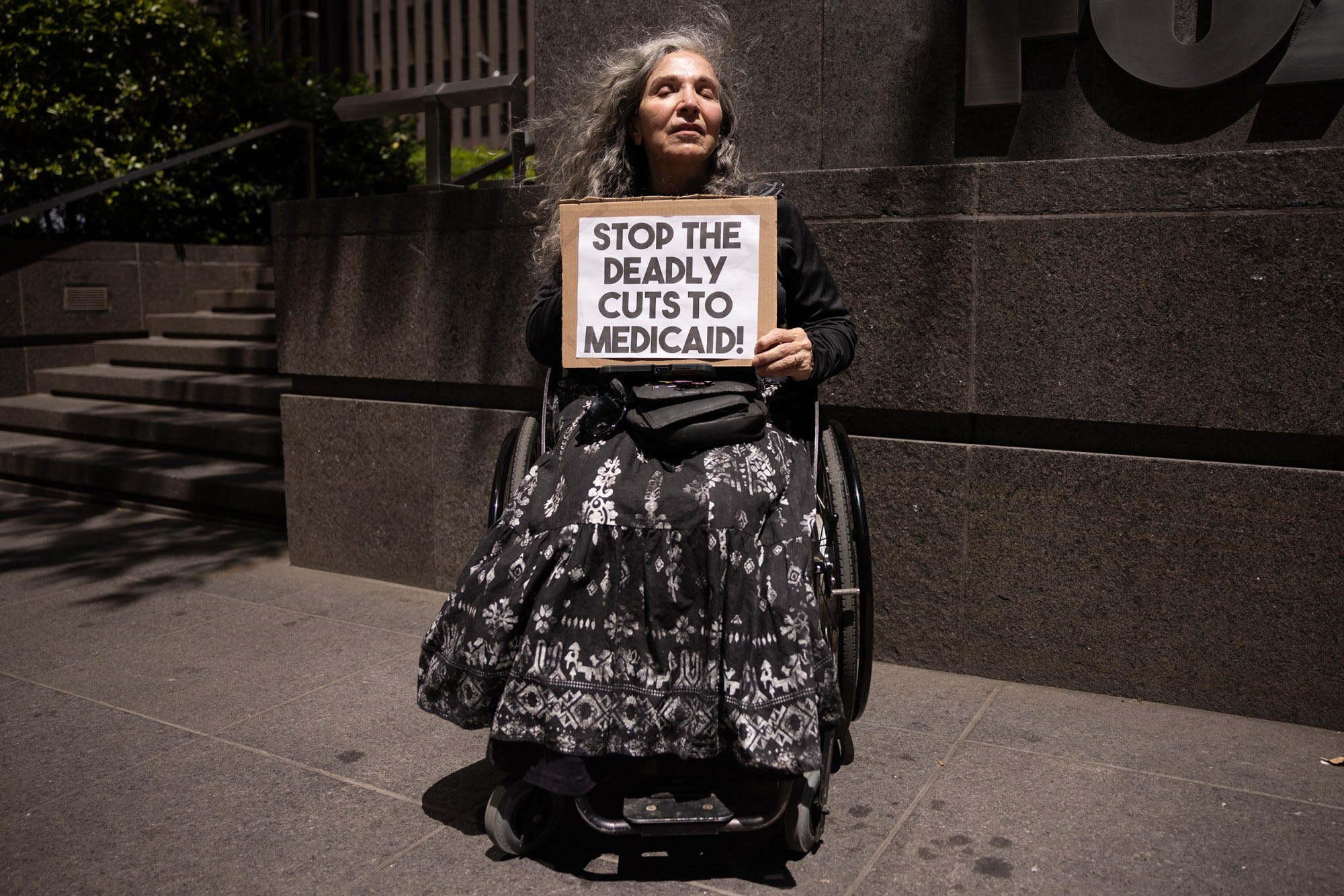
By Peter Shapiro
The struggle over Medicaid represents an existential threat to an already overburdened system and the millions who depend on it. But the left must do more than defend Medicaid; we must use this crisis moment as an opportunity to call for a universal, publicly funded health care system.
The massive cuts to Medicaid passed by the House in mid-May promise devastation, not only to the 13 million people who will be stripped of eligibility, but to hospitals and clinics in rural and other underserved communities that rely on Medicaid funds to remain solvent. Many will close, or be taken over by private investors who specialize in buying public entities and "downsizing" them, maintaining only those services that turn a profit. Public hospitals everywhere will tighten their belts, laying off workers and stonewalling in contract talks. People who have been cut off Medicaid will have nowhere else to go for care but already overburdened emergency rooms.
Sooner or later, most seniors and people with disabilities requiring long-term care wind up relying on Medicaid to pay for it, because it can wipe out your savings in a hurry. As of July 2024, Medicaid is the primary payer for 63% of nursing home residents; the cuts will put them in an impossible situation. In the Black community, maternal mortality rates are already shockingly high; the cuts will push them even higher.
House Republicans claim they are saving money by stripping away eligibility from illegal immigrants and the people who don't meet work requirements (what were known in Victorian England as "the undeserving poor"). But nearly two-thirds of those on Medicaid actually do hold jobs, and most of the rest are either ill, disabled, or serving as primary caregivers for someone else. As for the undocumented, federal spending on their health care is already against the law. In states where all residents are eligible, regardless of citizenship or immigration status, the state picks up the tab for their care.
Far more people will be affected by the cuts than the GOP is letting on. Rep. David Valadao represents Bakersfield, California, and the surrounding area. Nearly two-thirds of his constituents are on MediCal, California's version of Medicaid. Valadao promised to oppose any cuts to Medicaid, but when it came time to vote on the House budget bill, he caved and voted yes. There are others in Congress like him. If only one of them had voted no, the House budget would not have passed.
But the Republicans are right about one thing: soaring health care costs are making both Medicaid and Medicare unsustainable. There is an enormous amount of waste built into both programs, and continuing down the current path is fiscally irresponsible.
This isn't because the wrong people are getting coverage. It's because, over the years, every move by the federal government to extend health care access has been accomplished with massive subsidies of private capital. Many people were helped by the Affordable Care Act, but the private insurance industry benefited from it to the tune of $10 billion of our federal tax dollars. A majority of people on Medicare now get it from private Medicare Advantage plans, paid for out of the Medicare trust fund. These are a gold mine for corporations like United Health, bilking the system even further by claiming patients are sicker than they actually are, while denying costly claims for those who are truly sick.
In North Carolina, Republicans counter Democratic charges of throwing the poor under the bus by pointing out the Democratic Party’s ties with corporate hospital chains. And private for-profit hospitals do, in fact, make a killing off federal programs, often at the expense of patient care.
The threatened cuts to federal health care spending are symptoms of a crisis that neither party has shown a willingness to confront, despite efforts by a minority of Congressional Democrats to promote single payer. Each party uses the health care system's failures to attack the other, but only independent political organizing can defend the millions of people whose lives and well-being are at stake.
This applies not only to electoral politics but to unions. Maintaining health benefits in the face of steadily rising costs has long been a millstone around the neck of organized labor. Union negotiators are forced to sacrifice much of their leverage at the bargaining table not to win better coverage, but just to keep what they have. Any time contract talks break down, health coverage is usually the cause.
Organized labor is arguably the only institution with the resources and infrastructure to counter the influence of the health care industry. Union leaders who have had to bargain over health benefits know all too well the stiff price of a system of private, employer-based health coverage. Many will readily acknowledge that a universal, publicly funded health care system would be far better for workers. But union political behavior is notoriously risk-averse, and telling your members that they can no longer count on the union to win decent coverage is an admission of defeat that few union officials are willing to make. For them to do more than simply pass single payer resolutions at conventions, their members will have to demand it.
Perhaps necessarily, health care reform has been a lower priority in recent years for many in labor and the left. But the struggle over the federal budget has pushed it onto the front burner, whether we like it or not. It's time for us to take it up in earnest. It represents not only a threat, but an opportunity to raise the level of political discourse and strengthen the anti-MAGA front.
Peter Shapiro has been a health care activist since he represented his union at the founding conference of the Labor Campaign for Single Payer. He works with the Mexico Solidarity Project.
A timely article. Seems we are confronted with a perma-crises situation with attacks coming on all fronts foreign and domestic. I wonder how much people can take as all that's solid melts into air. The war drums are sounding in E Asia, W Asia, and genocide is being livestreamed from Gaza. Federal workers are in the crosshairs and certain technofacsists are building an integrated database to track us all. Hard to see the trade war leading anywhere good and our ruling class seems ruthlessly driven to taking everything leaving nothing of value untouched. Institutions are losing legitimacy and careerist democrats seem like deer caught in the headlights. How long can this fester before it explodes, and will there be entities capable of directing agency into constructive action rather than adventurist individualist acts?
Very good, very clear and to the point.