

by Matt Bates
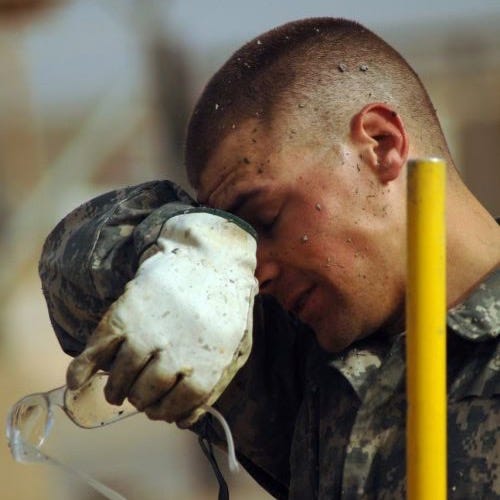
“Me and Silver were exhausted…I felt like I was getting ready to die. My vision was blurry, and I passed out and hit the back of my head on the pavement. Silver shook me and woke me up. Said I’d been out for a minute or so. An hour later, Silver collapsed face-first to the pavement. When I turned him over, his eyes were rolling in the back of his head. He was in and out of consciousness, crying in pain about having leg cramps…asking for someone to massage his legs.
“Our supervisor told us to get the f--k back to work.”
⎯Travis Christian, sanitation worker, Baltimore, MD. His co-worker, Ronald Silver, died of heat stroke shortly after collapsing on August 22, 2024. The heat index that day was 1080F. Christian and Silver had been emptying trash barrels for 8 1/2 hours.
A “heat dome” packing triple-digit temperatures blanketed much of the continental US in June 2025, just as the federal Occupational Safety and Health Administration (OSHA) was hearing public comments on proposals to protect workers from dangerous exposures to heat. As temperatures rise, so too is a growing mass movement demanding immediate, nationwide action to protect workers from extreme heat.
OSHA’s proposals were a long time coming. The agency had repeatedly considered (and rejected) such protections since Gerald Ford was president. Finally, in 2021, the Biden administration began the complex rule-making process that winds down this fall with OSHA deciding to adopt, modify or reject the proposed standards. But what Biden began is now in the hands of President Trump and GOP-led Congress who are busy taking a wrecking ball to the regulatory state. Trump already fired the scientific team at the National Institute for Safety and Health (NIOSH) whose research laid the basis for the proposed heat rules. If the firings were any indication (and it would be difficult to read them otherwise), the fate of the long-delayed protections is dire.
The Bureau of Labor Statistics (BLS) reports an average of 40 on-the-job deaths and 378 injuries and illnesses from heat exposure in the US each year. OSHA calls the BLS numbers “vast underestimates.” Credible research places the actual annual toll at between 600 and 700 heat-related deaths and 170,000 illnesses and injuries.
Heat is a known killer. More people die each year from heat stress than from floods, hurricanes, or any other weather-related cause, according to the World Health Organization.
Exposure to temperatures 90oF and higher can cause heat stroke, rhabdomyolysis (muscle breakdown, often with kidney damage), weakness, dizziness, blurred vision, fainting, vomiting, and cardiac arrhythmia. Heat can aggravate underlying health conditions, including asthma and heart disease. Workplace accidents are also far more likely to occur when people are tired and not thinking clearly, and their hands are slick with sweat. The danger is growing as global temperatures rise.
While the danger is well-understood, only seven states (California, Colorado, Maryland, Minnesota, Nevada, Oregon, and Washington) have enforceable standards protecting workers from excessive heat. Some of the laws are weak and riddled with loopholes. Only four of the seven states protect both indoor and outdoor workers, and Colorado’s statute applies solely to agriculture. Meanwhile, workers in the remaining 43 states have no enforceable heat protections whatsoever, apart from what their union contracts may provide. (In acts of gratuitous cruelty, Florida and Texas outlawed local ordinances requiring rest and water breaks for workers performing outdoor labor.)
Who’s at Greatest Risk?
Jobs carrying the highest risk of heat exposure include agriculture, building and road construction, laundries, kitchens, warehousing, and manufacturing. People of color, noncitizen immigrants, and people with low incomes are more likely to work in these jobs. The lowest-paid US workers suffer five times as many heat-related injuries as the highest paid. And Latinos—overrepresented in industries like agriculture and construction—accounted for one-third of all reported heat fatalities since 2010. (Many lower-income workers face an additional risk: the lack of air-conditioned homes and tree-shaded neighborhoods where they can cool off and recover after work.)
“The lowest-paid US workers suffer five times as many heat-related injuries as the highest-paid.”
“Farmworkers are the most vulnerable population in the country,” according to Dulce Lopez, an advocate for immigrant workers with the South Carolina ACLU. Most speak little or no English and, lacking transportation, are isolated in remote housing camps and fields, she said.
“I’ve never heard of OSHA or the state department of labor coming to check on their conditions,” Dolce added. Without union representation or access to government agencies, they have “no way to advocate for themselves through the legal or medical systems. They are completely unprotected.”
Poorly paid or not, all workers are in danger when they labor in hot, humid conditions without regular rest, water breaks, shade, and adequate ventilation.
David Williams stocks shelves at a Dollar General store in New Orleans. “On a regular day, it can be 85 to 87 degrees,” he said, “but when the humidity comes in you get a whole extra layer of hot in the store. There’s not enough circulation, so you’re stuck at work, drenched in sweat, suffering, and close to passing out. A lot of employees are afraid they’ll lose their jobs if they speak up. But you could also lose your life, so people got to think about what’s more important.”
The physics are brutally simple: There are strict limits to the amount of heat the human body can absorb. Our bodies release heat through blood flowing near the surface of our skin and the evaporation of sweat. Humidity and poor ventilation make it harder to evaporate sweat. Insufficient water makes it harder to produce sweat and maintain an adequate blood flow. Once the body’s core temperature exceeds 1040F, our internal systems begin to fail, one after the other. Death from heat stroke can occur in as few as 10 minutes.
OSHA’s Proposed Rule
OSHA’s proposed rule would establish, for the first time, enforceable, nationwide rules on heat exposure. Titled Heat Injury and Illness Prevention in Outdoor and Indoor Work Settings, the standard would require all US employers to:
Develop and implement site-specific injury and illness prevention plans to evaluate and control heat hazards.
Identify heat hazards for indoor and outdoor worksites.
Monitor and record temperatures in identified heat hazard areas.
Implement separate protocols for worksite temperatures between 80oF and 89oF, and 90oF and higher. Protocols include acclimatizing new and returning workers in high-heat areas, mandatory paid rest and water breaks, regular training of workers and supervisors on identifying symptoms of heat-related illness, and proper methods of treatment.
Business groups are raising the same objections they’ve used for 54 years to keep OSHA from regulating heat exposure. OSHA wants to impose a costly, cumbersome, “one-size-fits-all” solution on all businesses, they complain. They claim heat is difficult to measure and affects different people in different ways. They warn workers will abuse rest and water breaks, which would also interrupt the flow of work.
Nonsense, responds Rebecca Reindel, safety and health director for the AFL-CIO. The proposed standards were designed to be adaptable to the needs of individual industries and worksites. Furthermore, she continued, identifying sources of occupational heat exposure is no different than identifying sources of toxic chemicals or excessive noise, and well-established methods exist for measuring indoor and outdoor temperatures and for mitigating exposures to hazardous levels of heat.
Mass Action for Heat Justice
As global temperatures climb and “100-year storms” become annual events, the impetus for organized mass action will grow, as will the need to clearly identify the source of the problem: an arrogant ruling class willing to fight more than half a century for its “right” to expose workers to deadly levels of heat; a capitalist system that must continually expand, like a cancer, creating a world too hot for human survival.
“We’re not waiting for Washington. The south is writing its own heat justice playbook.”—Brittney Jenkins, NCOSH southern states organizer
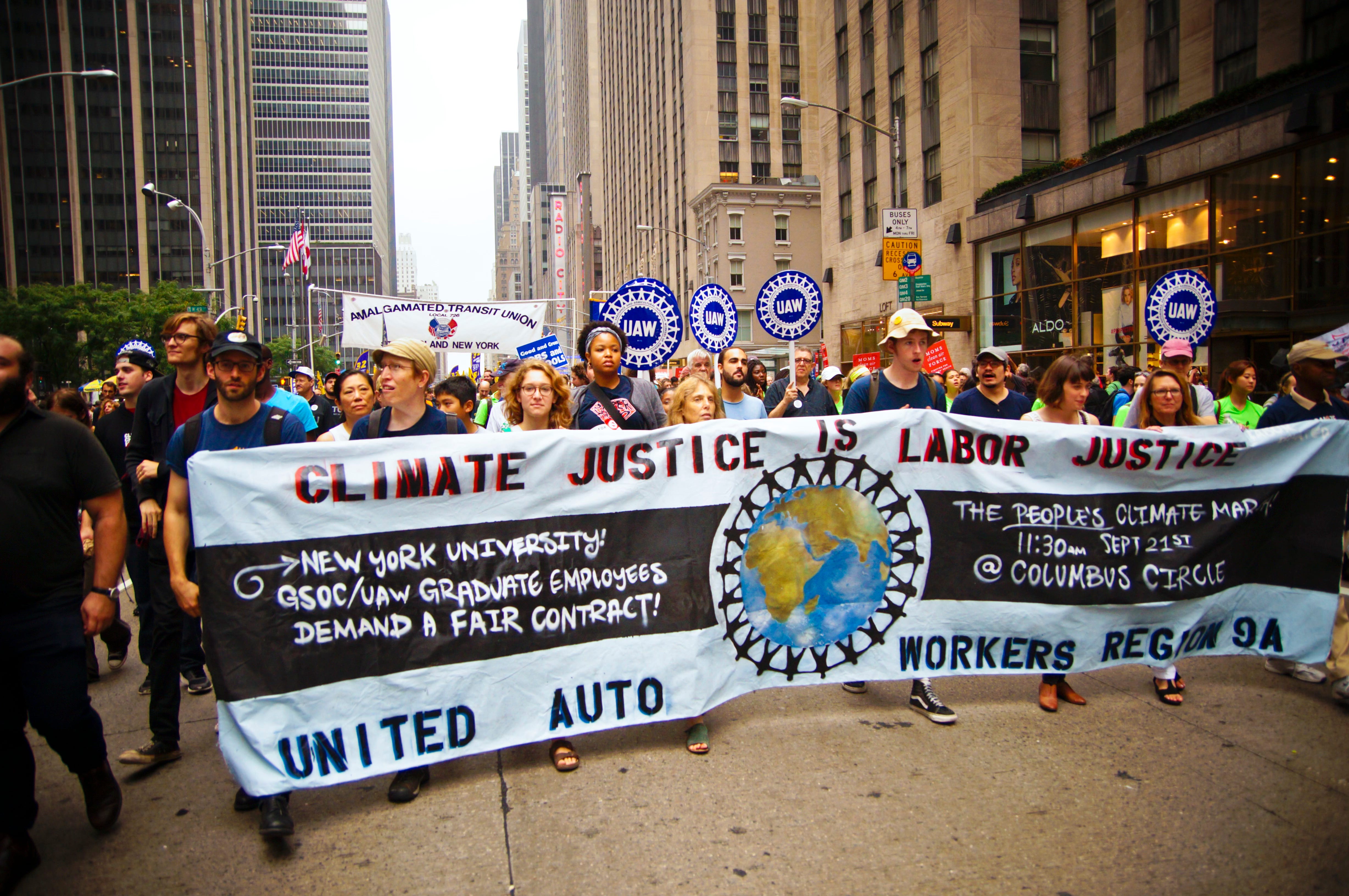
Whatever OSHA does (or fails to do) this fall; whatever becomes of the laboriously crafted standards, the movement for “heat justice” is on fire and burning bright. Fired Up! Workers for Heat Justice!, led by the National Council for Safety and Health (NCOSH), has built cross-class, multi-racial coalitions in 25 states, uniting environmentalists, immigrant workers, unions, racial justice activists, students, scientists, faith-based groups, and public health organizations. Eight of the coalitions are in the deep south.
Well aware that OSHA may, again, refuse to act, the coalitions are pressing city and state governments, as well as employers, for protections against workplace heat exposure. They are staging rallies and marches, and holding teach-ins to spread awareness about the dangers of heat stress and how to identify, treat, and prevent heat-related illnesses. The Farm Labor Organizing Committee (FLOC) took direct action in May by unilaterally implementing heat protection guidelines for more than 9,000 of its members in the southern US.
“This issue has deep grassroots support,” said NCOSH Executive Director Jessica Martinez, pointing to the “more than 50,000 comments” submitted to OSHA on regulating heat exposure: “a record-breaking number for any proposed standard.”
“We’re not waiting on Washington,” declared Brittney Jenkins, NCOSH’s organizer for the southern US. “From Phoenix to Tampa, the south is writing its own heat justice playbook.” Five southern states (Arizona, Florida, Louisiana, Nevada, and Texas) accounted for 61 percent of all reported heat deaths in the US in 2023, she pointed out. “Every year, more people are seeing the problems with heat getting worse and worse, and the movement is growing. We’re getting bigger, gaining experience, and getting smarter.”
Matt Bates is a retired editor/communication representative for the International Association of Machinists and the Connecticut AFL-CIO.
This is really useful, Matt. Combination of facts including history, and analysis. When I was 18 and first worked in a factory one summer, I loved the heat. Got older and wiser -- and hotter. I am sending this to my union officers to see if they can use it for our union newspaper.
Thanks Matt. Heat protection even more important than ever with climate catastrophe heat events.