


I’ve always had mixed feelings about the Fourth of July. As a young child in the 1940s, I was terrified of the loud fireworks, despite the colorful beauty they brought to the dark skies.
But to me in those years, the holiday was mainly about extended families. We would pick a park with decent swimming pools, and the clan would gather around picnic tables under trees. I had all varieties of potato and macaroni salads, hot dogs and burgers cooking on the grill, and a dozen varieties of desserts. The kids had games, like potato sack races. At some point, the older men would organize a serious baseball game. When I got older, I could play too.
In those years, I was growing up as a blue-collar greaser. Fifteen of us had black corduroy jackets, with “Satan’s Angels” on the back, a halo surrounding a red devil’s head. Our patriotism, such as it was, fit in with the outlaws: Wille Nelson, Waylon Jennings, and Johnny Cash.
But as I entered college, I was awakened by things that were new to me. I was a jazz fan, and read Jack Kerouac’s On the Road as a celebration of America from its underside, warts and all. My high school never offered us anything like Steinbeck or Hemingway. I devoured their works on my own, especially The Grapes of Wrath. James Baldwin's Another Country left me with many questions about who I was, and who all of us were, as times changed in a dramatic way. Along with all my friends, I was deeply alienated from our country. At the same time, we surged in efforts to reform or even overthrow its government.
In 1966, after the civil rights leader James Meredith was shot in Mississippi, I walked 250 miles through that state on the Freedom March with the Student Nonviolent Coordinating Committee (SNCC). I was thoroughly radicalized after returning from Mississippi. But our SNCC comrades made an important point. We were more needed as “white mother country radicals,” finding ways to win over “white America.” I took it seriously. I made a small rule for myself. If I could not explain what I was doing and why, to my friends and family in Beaver County, then I had to study more, and learn better ways to teach. I didn’t think I could win over all of my family and friends—too idealistic. But I could win over a large militant minority.
I had an important insight about change. Mao put it bluntly: “one divides into two.” I could see it everywhere, and it helped me think more about the Fourth of July: America divides into two. On the one hand, we have the America of slavery, war, and empire. On the other hand, we had the America of Native resistance, slave rebellions, and workers of all sorts trying to become a liberating force. I could easily celebrate the second America while fighting against the first.
Using “one divides into two” to study US history, I concluded that we have only rarely had a proletariat that is an active protagonist in a nationwide way. Class struggle in the US has rarely taken any pure form of “class against class.” We can draw diagrams and use statistics to define our multinational, multiracial, and multigender working class today. It would be helpful, but it would also be an abstraction. Abstractions are fine, as any reading of Marx will show you. But our analysis reveals that class struggle in the US tends to take the form of “historic bloc vs. historic bloc.”
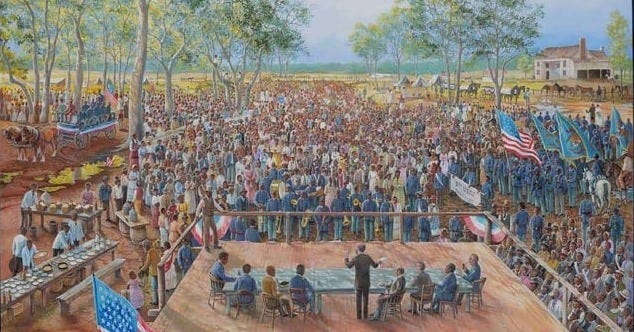
What are these “blocs” in US history? America from below has always waged struggle. I call these battles the struggle of the four ‘E’s: the expropriated (slaves), the exterminated (native peoples), the exploited (indentured servants), and the enclosed (Puerto Rico, Guam). They rarely joined together to make their fight for freedom more effective. Their greatest advance was the Reconstruction governments from 1865 to 1876. Here a core of Black freedmen and their “Scalawag” poor white allies established a nascent “abolition democracy,” as W.E.B. Dubois envisioned—not just ending chattel slavery, but creating new institutions and social relations to afford freed Black persons the economic, political, and social capital to live as equal members in a better society for all. But the Reconstruction governments were overthrown by a bloody white supremacist counter-revolution.
The “other America” promised during the First Reconstruction is one we can readily support. We saw abolition democracy again in the Second Reconstruction, led by Martin Luther King, Jr., and now again in a Third Reconstruction being called for by Rev. William Barbour II and others.
The Fourth of July, then, can be celebrated as our aspiration for abolition democracy. In a funny way, you can find it on the back of a $1 bill. On the right, you see the armed eagle ready to wage war, or if need be, to make a few concessions. This belongs to the America of war and empire. But what’s with the other side (a question that has plagued conspiracy theorists for years)? We can view the all-seeing Eye as a sign for being Wide Awake. The unfinished pyramid means our national project has yet to be finished. We have a Latin phrase about a “New Order” to win. And then the motto that would make Trump and Miller cringe: E Pluribus Unum. Out of Many, One!

We are not national nihilists. In my travels around the world, every left group I met has found a way to tip their hat to their national forebears. But in our case, we draw a line against the superpower chauvinism of our upper crust. Dig deep into Woody Guthrie, Willie Nelson, Leadbelly, and Rosanne Cash. You’ll find an America to celebrate on the Fourth.
Carl Davidson is a veteran organizer with roots in the New Left of the 1960s, where he served as a Vice President and National Secretary of Students for a Democratic Society. He continues to write prolifically.
