


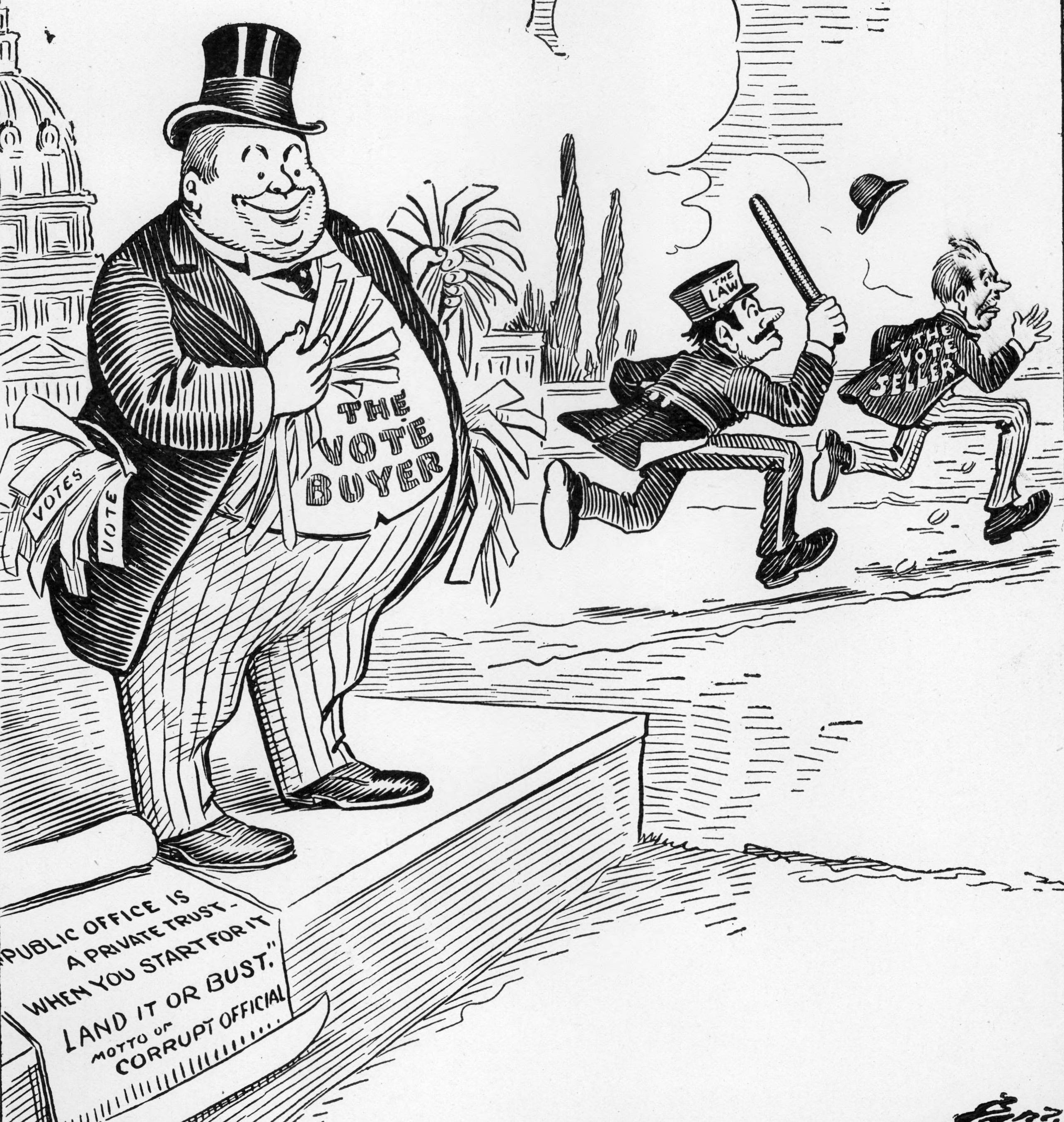
“If the Republicans win the House of Representatives and the United States Senate, both of them, because of our tremendous strength and success economically, I will issue a dividend to every adult citizen in the United States of America for $5,000.” —Donald Trump, 09/09/2026
Vote buying has a long and storied history, dating back to ancient times and spanning the globe. To our knowledge, however, no politician ever publicly announced a vote-buying scheme, for one and all to factor into their voting decisions and household finances. None, that is, until US President Donald Trump did so a quarter century ago at his midterm convention, a.k.a. “Trumpapalooza.”
“But wait,” an astute reporter asked the president. “If the economy is so great, why not give out checks right now? Your party already has control of the White House and Congress. Isn’t this just vote buying?” The president responded with a stream of invective involving descriptions of various female body parts. Unthinkable today, but no one blinked.
When Trump continued to promote his scheme, some career attorneys within the Department of Justice balked; Trump fired them all. Myriad democracy-oriented groups mounted lawsuits. The case ping-ponged among lower courts and quickly reached the US Supreme Court. There, the majority applied several creative legal theories to grease the skids for the president.
For instance, harkening back to the 2026 ballroom/bunker brouhaha, they opined that none of the plaintiffs had “standing.” That was because bribe implementation details had not been finalized—for example, where would the needed $1.2 trillion come from?—and no one could prove they would be harmed by receiving $5,000 should Republicans retain power.
“Who wouldn’t want $5,000?” Clarence Thomas asked. “Ginny and I would use ours to refurbish our RV, which we enjoy parking in Walmart lots when we’re not accepting the personal hospitality of our close billionaire friends on non-gift luxury vacations.”
The justices also sanctioned Trump’s DOJ shenanigans, invoking the court’s novel “unitary executive theory.” The president, they said, had complete control over the executive branch. Thus, he had every right to fire the malcontents and direct the Attorney General not to investigate a vote-buying scheme.
“The majority of us had a fun nickname for the unitary executive theory,” Justice Alito later revealed in his memoir. It was “TGDWTGD,” or “Trump’s Gonna Do What Trump’s Gonna Do.” Three members of the court, he said, were not amused. But the joke was on him when a few years later the number of Supreme Court justices changed, for the eighth time in its history.
Congress, during the Trump years, had also bought into TGDWTGD, Republicans by design and everyone else by default. But even some Republicans were fed up. “Imagine having to always be defending SNAP cuts and Nazi-themed social media posts and measles and whatnot at town halls and press conferences,” said one privately. “It’s downright exhausting.” Some wondered if they could continue coasting on their one legislative accomplishment—a regressive tax cut that massively enriched the wealthy while exploding the federal deficit.
Then, in November 2026, along came the midterm elections. About 60 percent of the electorate remembered how, two years earlier, Trump said he would end the Ukraine war on “Day One” and issue $5,000 “DOGE checks.” Neither materialized. Now, at the Trumpapalooza, he had promised that after the midterms the Iran war would end, gas prices would tumble, and if the GOP won there would be Trump Dividends for all.
Hmmm, thought the 60 percent. Maybe we shouldn’t do the same thing over again and expect a different result. That, along with housing and hunger and health insurance and ICE and mafia-style corruption and AI apocalypse and lettuce parasites, was on their minds as they went into the voting booths.
The rest is history.
Jennifer Thomas is a speculative fiction writer and occasional New Liberator contributor. You can read some of her stories at jenniferthomas.net.
A good polemic. Thanks!
Whoever makes or offers to make an expenditure to any person, either to vote or withhold his vote, or to vote for or against any candidate; and
Whoever solicits, accepts, or receives any such expenditure in consideration of his vote or the withholding of his vote—
Shall be fined under this title or imprisoned not more than one year, or both; and if the violation was willful, shall be fined under this title or imprisoned not more than two years, or both.
(June 25, 1948, ch. 645, 62 Stat. 721; Pub. L. 103–322, title XXXIII, § 330016(1)(H), Sept. 13, 1994, 108 Stat. 2147; Pub. L. 104–294, title VI, § 601(a)(12), Oct. 11, 1996, 110 Stat. 3498.)
Note that ACCEPTING a bribe like this is also a crime