

This is the final section of Liberation Road’s 2022 - 2025 Main Political Report, in which we assess key developments in US social movements over the past three years. Click here to read the other sections of the report:
State of the People’s Movements
SECTION 6: THE PEOPLE’S MOVEMENTS
If Section 5 traced the broad factions within the Multiracial Pro-Democracy United Front, Section 6 turns to the social movements that have powered its base and tested its strategic clarity.
A note about tone and intent: at various points, this section offers critical assessments of contradictions, weaknesses and challenges within our movements. We intend these assessments in the spirit of constructive criticism—and, in many cases, self-criticism, as they are often critiques of organizations and movement sectors our members are deeply involved in. We offer these assessments in the spirit of unity-struggle-unity, with the aim of strengthening our collective capacity to defeat the New Confederacy, advance a Third Reconstruction, and help advance the longer-term struggle for racial, gender and class liberation.
6.1 Strategic Fault Lines in the People’s Movements: the Left Sectarian, Pragmatist, and Inside/Outside Trends
To strengthen the leadership of progressive sectors of our Pro-Democracy United Front, left and progressive forces must balance competing imperatives: struggling against moderate establishment forces to strengthen the left’s position within the pro-democracy front, even as we cooperate with these same forces in the shared struggle against our common enemy, the fascist New Confederacy. Balancing these competing imperatives requires strategic dexterity and discernment, and it is easy for left and progressive forces to make both left and right errors.
Left errors overemphasize our struggle against moderate establishment forces and underemphasize our need for unity of action with them to defeat the right. Such errors can isolate the left from the rest of the Pro-Democracy United Front, alienate the masses from our positions, and weaken our collective capacity to fight the New Confederacy. Underlying such left errors is a rejection of the notion that the left needs centrist and center-right forces as even temporary or tactical allies in our shared fight against the New Confederacy, instead advocating for complete left independence. This exaggerates the size and strength of the left, misreads the level of consciousness among the people, and misdiagnoses the current stage of political struggle. When left forces repeatedly commit left errors, we refer to this tendency as “ultra-leftism.”
Right errors underemphasize our struggle against moderate establishment forces and overemphasize our need for accommodation with them. If left errors push for a “purist” position that is too far ahead of the current stage of struggle, right errors commit the opposite, tailist mistake of simply following the establishment, underestimating the readiness of the masses for more radical demands and bolder left leadership. Such errors neglect opportunities to win more people over to left and progressive positions, reinforcing the leadership and political dominance of the center and center-right and sacrificing independent left initiative. When organizations and individuals repeatedly commit right errors, we refer to this as “pragmatism.”
Given the overall weakness, fragmentation, and underdevelopment of the US left, it is understandable that our movements make many errors that are both right and left in nature. Over the past decade, however, the most grounded and strategic sectors of the progressive people’s movements have gradually been aligning around a balanced approach to unity of action with the center and independent left initiative—what we have elsewhere referred to as the “inside/outside” trend. This refers to the need to organize inside the terrain of electoral politics and the state as well as outside it in the realm of civil society, and to work inside a united front with centrist forces while building independent left infrastructure and organization outside of it. With origins extending at least as far back as the 1980s Rainbow Coalition, this inside/outside trend has especially gained strength since 2016.
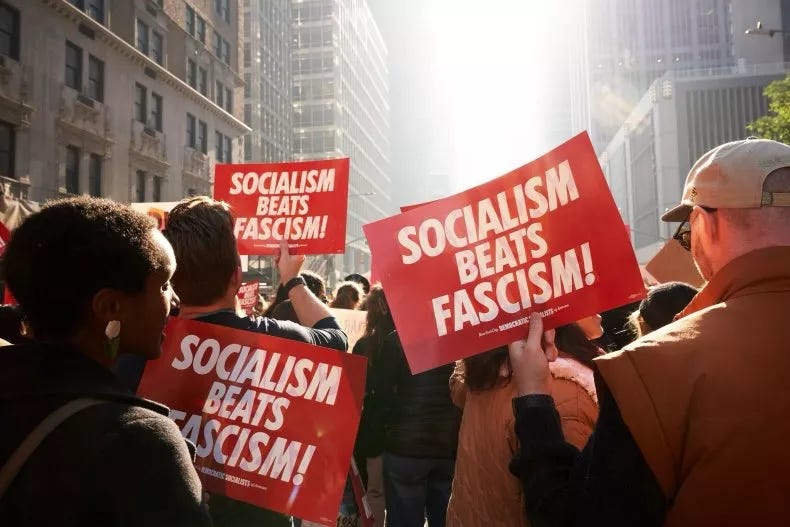
The past three years, however, have reignited old tendencies towards both left sectarianism and right pragmatism. In particular, the complicity of the Biden administration and the centrist Democratic Party establishment in the Israeli genocide in Gaza gave fuel to left sectarian tendencies toward abstentionism, third-partyism, and electoral rejectionism. The sharp, ongoing battles within DSA are illustrative of these errors. While caucuses like SMC and Groundwork organized electoral deployments through Socialism Beats Fascism and worked closely with movement forces in critical swing states, DSA as a national formation failed to offer strategic leadership in 2024—declining to make an endorsement or articulate a unified electoral strategy. And DSA's national leadership has largely stood aside from mass-based resistance efforts since the election, apparently for fear of ideological contamination. As a result, the largest nominally socialist organization in the country was and remains a wildcard— potentially powerful, but ideologically ambivalent, factionally divided, and structurally weakened.
At the same time, the failure of left and progressive forces to even attempt to find a credible progressive primary challenger to Biden was undeniably a “right error” that over-capitulated to the failing centrist establishment, with disastrous consequences. And especially in the aftermath of the 2024 elections, there has been a troubling resurgence of a class reductionist error that is “right in content, left in form.” Notably articulated by Jacobin’s founding editor Bhaskar Sunkara, this position advocates for a form of politics exclusively focused on narrow economic demands with ostensibly “universal appeal,” downgrading other issues and dismissing demands for racial and gender justice as supposedly “divisive” and “particularistic.” Framed as a radical left stance, this position in fact aligns with centrist, center-right, and even right-wing political ideas, underestimating both the importance of racial and gender justice and the left’s ability to unite the (multiracial, multinational, multi-gendered) working class around these demands.
And yet, in the face of both resurgent left and right errors and increased strategic confusion among our movements, those sectors of the left that were strategically aligned around an inside/outside framework acted with greater collective clarity and coordination in this period. In 2024, the emergence of the “Block and Build” framework functioned as an effective rhetorical articulation of the inside/outside strategy, whose widespread adoption pointed to a greater degree of strategic clarity and coordination across our “trend,” even amid strong political headwinds. The Uncommitted Movement was another example of an organizing effort that worked with great skill and discipline, in the face of unconscionable inaction from the Biden administration and Harris campaign, to carry out a set of objectives consciously articulated as an inside/outside strategy.
While promising, however, the organizing efforts of inside/outside forces remained too small in size and scale—relative both to other tendencies within our movements and, especially, beyond them. Meanwhile, increasing strategic alignment did not translate into sufficient practical and programmatic coordination across organizations and movement sectors. The task of cohering a stronger, more coherent inside/outside trend within our movements remains outstanding.
Below, we will analyze more detailed developments within a number of key social movement sectors: the oppressed nationality, labor, oppressed gender, and climate and ecological justice movements. Across the movement sectors surveyed in these subsections, all three of the trends outlined above can be found: left sectarianism, right pragmatism, and an inside/outside orientation. Following these subsections, we will zoom in on the inside/outside trend itself, as well as the particular organizational form we have called for to help cohere it: independent political organization (IPO). We will assess key developments related to the growth and cohesion of IPOs and related components of independent political infrastructure—understood not as a movement “sector” distinct from the other sectors assessed here, but as a political strategy to help cohere those movements and advance their demands.
To increase strategic, programmatic, and organizational alignment of IPOs, we have further argued that we need to build a socialist core within the inside/outside trend and the broader organized movements of the oppressed nationalities, oppressed gender people, and the multiracial/multinational working class.The final component of this section assesses developments connected to cohering such a socialist core over the past three years.
6.2 Oppressed Nationality Movements: Between Uprising, Genocide, and Repression
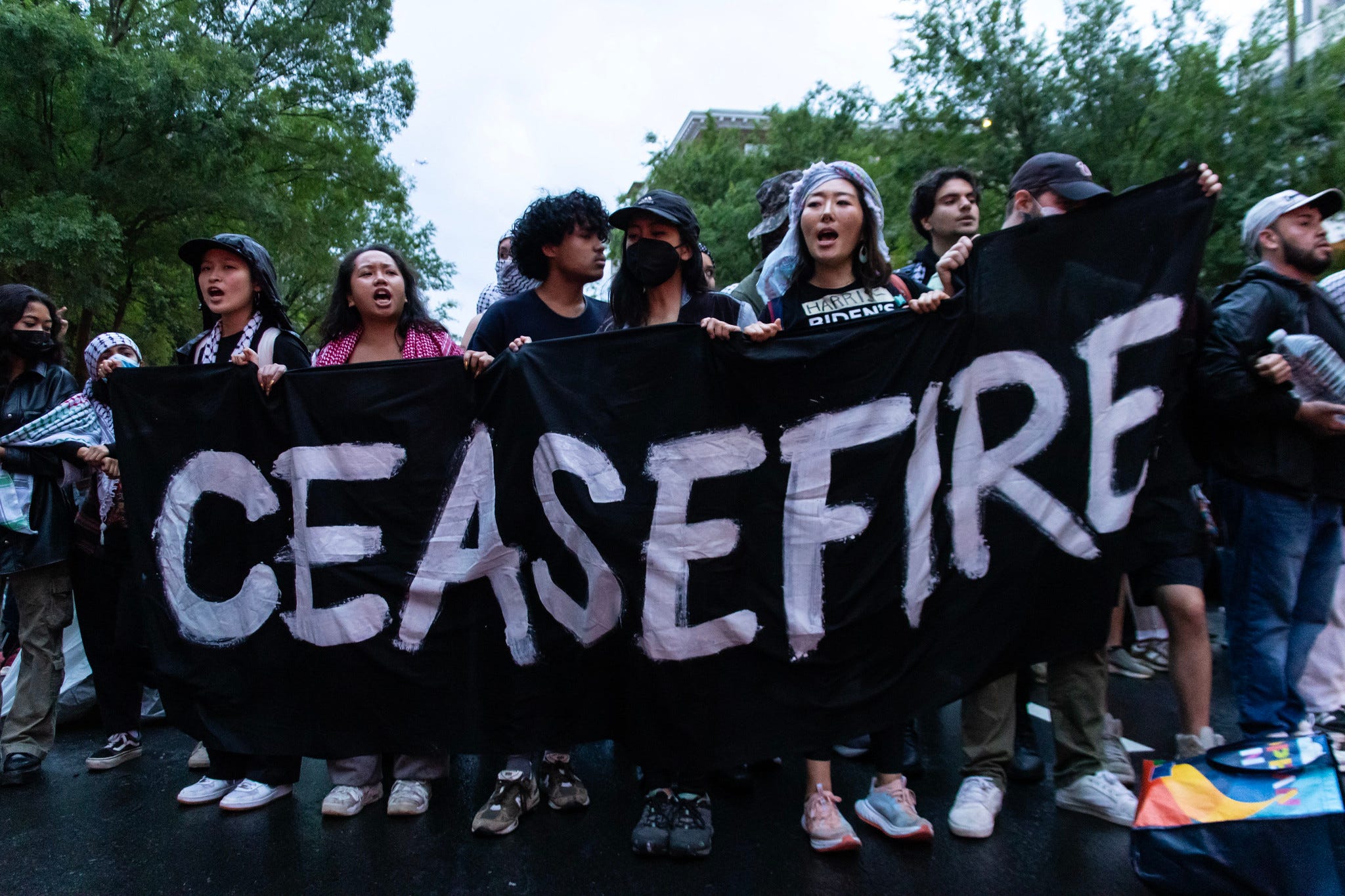
The last several years have brought both historic mobilizations and profound fragmentation across the movements of oppressed nationalities. From the 2020 Black-led uprising to the unprecedented explosion of Palestine solidarity organizing in 2023–24, oppressed nationality movements have been central to the terrain of struggle in this period. But they have also been subject to intense repression, internal contradictions, and strategic disorientation. In the aftermath of historic mobilizations, these movements are today in a defensive posture—searching for new forms of organization, coordination, and strategic clarity.
The most explosive development of the past 18 months has been the eruption of the US Palestine solidarity movement in response to Israel’s genocidal war on Gaza. The scale of this level of mobilization around Palestine is unprecedented in a US context: tens of thousands mobilized, hundreds of campuses involved, and a level of visibility that shook the legitimacy of US complicity with Zionism. The movement achieved significant breakthroughs in public discourse and consciousness, forcing open mainstream critique of U.S. complicity with Israeli apartheid. Yet the movement has also faced serious challenges. Demands were often unclear or unevenly articulated. Coordination was limited. Most critically, the movement was unprepared for the scale and intensity of the right-wing counterattack—framed around allegations of antisemitism and tied to broader efforts to criminalize protest. The repression has been fierce: suspensions, arrests, funding threats, and a new wave of legislative assaults and deportations.
There was also difficulty building a united front around the politics of the Israeli genocide. While members of the Squad, including Black leaders like Cori Bush and Jamaal Bowman, stood firmly in support of Palestinian liberation, they faced intense attacks from the Israel lobby. Efforts by Jewish Voice for Peace, Sunrise, IfNotNow, DSA, Seed the Vote and others were insufficient to defend their seats against AIPAC-funded primary challenges, sending a chilling message to the broader movement. Uncommitted coordinated impressive grassroots efforts in multiple swing states and led a disciplined strategic intervention at the DNC, but were unable to budge Harris. And while much of the Palestinian solidarity energy targeted Biden and Harris, there was less clarity on how to relate to Trump and the far right. This left the movement divided on how—or if—to prevent Trump’s reelection, and unprepared for the intensified repression of his second term.
The 2020 Black-led uprising was the largest protest wave in US history, which fundamentally reshaped the national conversation on race, policing, and public safety. It forced mainstream institutions and much of white America to reckon with legacies of structural racism—leading to school curriculum changes, cultural rebranding efforts, and shifts in media and corporate discourse. A legitimate and winnable alternative electoral program to the “law and order” politics which dominated municipal politics for 40 years has resulted in the election of dozens of reform district attorneys and sheriffs. Significant victories were won around criminal justice policy, primarily at the municipal and county level, but also in some states with Democratic trifectas—from establishing unarmed crisis response units, to expanding diversion programs, limiting money bail, reducing the use of three strike and mandatory minimums, and enacting prosecutorial policy that takes a more rehabilitative and health focused approach. At the federal level, the movement helped push the Biden administration to include significant carve-outs for oppressed nationality communities, most notably through the Justice 40 initiative.
And yet today, much of its organizational infrastructure has either disappeared or been absorbed into nonprofit policy initiatives. The movement made a sharp pivot from rebellion to reform—from “abolish the police,” which proved not to be the unifying slogan intended, to policy platforms. In some ways that has been a good thing—getting serious about concrete impacts, and forging unity of thought, but coordinated, strategic campaigns at the national level have been lacking. Some gains were made, but national coordination broke down, and many local chapters of Black Lives Matter dissolved or went dormant. M4BL remains one of the national formations articulating a racial justice agenda, but its reach is limited. The broader Black left—organizations such as Malcolm X Grassroots Movement, Community Movement Builders, and Cooperation Jackson—remains largely active at the very local level, and is also in a period of regrouping. A Black radical unity convening is scheduled for 2025.
The Chicano, Mexicano and Latine movements have faced a different set of contradictions. Deportations and immigration raids escalated under both Biden and Trump, fueling resistance but also deepening fear and repression. The rise of AMLO and now Claudia Sheinbaum in Mexico has created a new binational dynamic: many Mexican immigrants in the US view Mexico’s progressive government as a source of support, especially in contrast to the threat posed by US immigration policy under Trump. Organizing for reform has continued in many immigrant communities, particularly around deportation defense and labor struggles, with increasingly widespread resistance to aggressive ICE tactics. Yet voter turnout in US elections has been low, and enthusiasm split, including a movement of some sectors toward Trump. The weakening of the Black/Brown alliance has also undercut broader unity, as anti-immigrant sentiment has grown in some parts of the Black community.
The decline of the Puerto Rican movement in the US has been a significant factor that has frequently been overlooked. The gradual reemergence of the left in Puerto Rico itself (after the crisis and collapse of the Puerto Rican Socialist Party in the early 1980s) has not resonated within the mainland left. This is something that must be noted particularly given Puerto Rico's colonial status and the relative disintegration of ties between the island left and left and progressive forces—including but not limited to Puerto Rican--on the mainland. Recent efforts to unite progressives with independistas to win the governorship, while unsuccessful, resulted in a second place finish in the election, and a not insignificant gain in votes, hopefully presaging greater unity and collaboration across the landscape of left and progressive electoral parties.
Among post-1965 immigrant communities, the terrain is even more complex. Right-wing nationalist forces, such as the Hindu right, have gained traction among segments of the Indian diaspora. Anti-communism remains strong among some Vietnamese and Cuban Americans, and right-wing Chinese-American organizing played a significant role in the anti-affirmative action campaign. Yet at the same time, many youth from these communities have been active in Palestine solidarity organizing, labor campaigns, and local mutual aid work. These generational splits have opened new space for youth-led organizing and political education efforts.
In all communities of color, there has been a change in class structure over several decades, with both more new migrants coming from professional and entrepreneurial groups, and a growth of these classes among existing communities due to past civil rights gains. These changes in class composition have affected both the tenor of social movements and the broader electoral terrain.
Electorally, the experience and leadership of oppressed nationality communities has gained increased prominence within the Democratic coalition on the level of messaging, capacity-building, and funding priorities. Simultaneously, many IPOs have developed as expressions of national character—including national organizations like Black Voters Matter and Mijente, as well as state and local groups like PA BLOC, Siembra NC, Western Native Voice, LUCHA, and many more. At the same time, there remain significant ultra-left, anarchist and anti-electoral components within ON movements. Many ON organizations are highly visible and culturally influential, but lack consistent and disciplined base-building that contest for power. They also tend to be led by college-educated personalities who live in big cities and are disconnected from a working-class base.
Taken together, these developments underscore both the enduring political significance of oppressed nationality movements and the depth of the challenges they are facing. The left must take seriously the challenge of rebuilding oppressed nationality organization and leadership—not just as a moral imperative, but as a strategic necessity. No anti-fascist united front or Third Reconstruction project is possible without the organized, leading participation of the oppressed nationality movements—whose histories of resistance remain one of our greatest sources of strength and possibility.
6.3 The Labor Movement: Resurgence, Resistance and Challenges
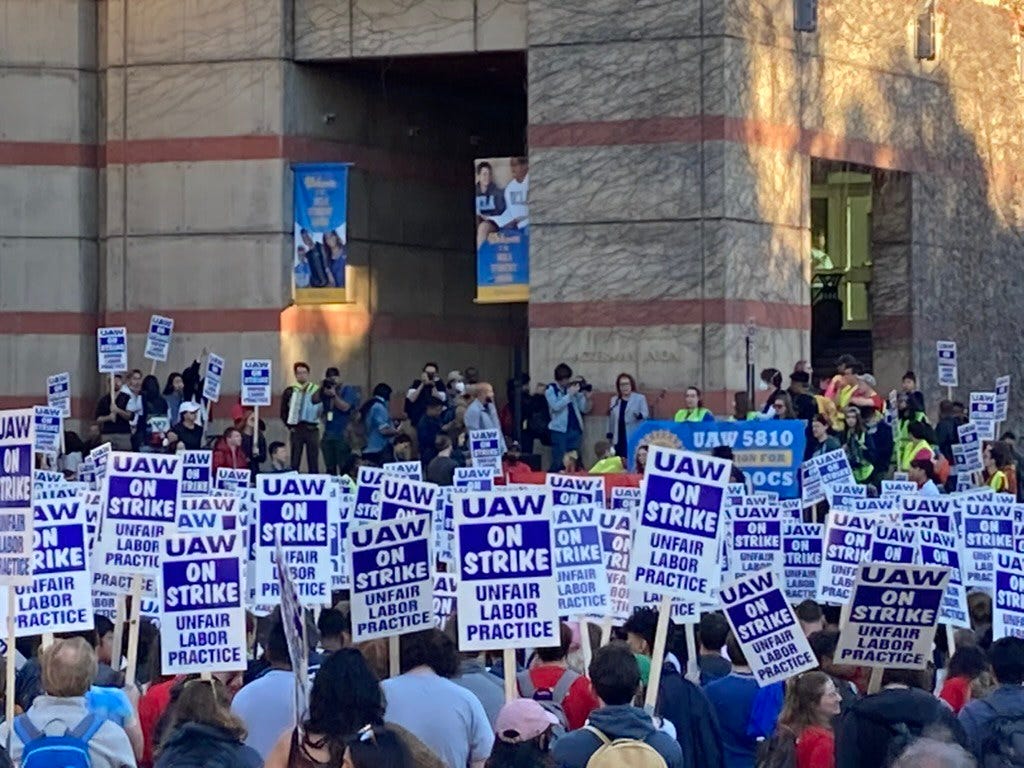
The last several years have seen a surge of worker militancy, renewed organizing, and growing popular support for unions. A new generation of organizers and leaders has emerged, animated by a class-consciousness shaped by racialized economic precarity, pandemic exposure, and political polarization. The resurgence of labor has been particularly visible among workers in education, logistics and delivery sectors, health care, and fast food. The labor movement is in motion—but not yet aligned, scaled, or consolidated enough to fully meet the moment.
The period from 2020 to 2024 produced more strikes than in any year since 2002, along with a series of highly visible labor actions that reshaped public discourse—from the UAW’s “Stand Up” strike against the Big Three automakers, to the mass organizing efforts at Amazon and Starbucks, to successful public sector campaigns across the South and Southwest. There has been a dramatic increase in NLRB petitions for union representation—up 35% between October 2023 and April 2024—reflecting a trend that has been growing for the past three years. Surveys suggest that 70% of the US people have a favorable view of unions, and national polling has found that nearly half of all nonunion workers (an additional 60 million) say they would join one if they could. The rising level of economic insecurity faced by younger workers, coupled with an improved legal environment for union organizing under Biden and several high-profile strikes, have led to organizing initiative coming largely from below.
Despite the headlines, union density (the percentage of the workforce that is unionized) has remained largely stagnant. Yet absolute membership has grown, and more importantly, labor’s strategic imagination has begun to expand. Efforts like Bargaining for the Common Good, rank-and-file-led strikes, and increasingly popular calls to organize the South show that sections of labor are experimenting with a more insurgent, social justice-oriented model of unionism. The UAW’s new leadership has launched an ambitious organizing drive targeting Southern auto and battery plants and is organizing for nationwide Mayday 2028 strikes. AFT and NEA’s alliance in the Fairfax Education Unions’ Virginia campaign led in 2024 to the largest public sector union victory in 25 years. CWA has expanded its “United Campus Workers” model into a Southeast mega-local. SEIU’s Union of Southern Service Workers is attempting to blend pre-majority organizing with worker center-style strategy. In the Twin Cities, SEIU Local 26 has anchored a community-labor front that combines political education, mutual aid, strike support, and multiracial coalition work in one of the most ambitious regional efforts to date. And SEIU, with its two million members and aggressive organizing program, rejoined the AFL-CIO. In addition, there is continuing organizing outside the framework of the National Labor Relations Act, especially among oppressed nationality and undocumented workers, through organizations such as the National Domestic Workers Alliance, the Coalition of Immokalee Workers, and the Pineros Y Campesinos Unidos del Noroeste (PCUN).
Labor’s role in responding to broader political crises has also begun to shift. In the wake of the Gaza genocide, unions including UE, UAW, APWU, NNU, IUPAT, AFA-CWA, and large SEIU and UFCW locals signed on to Labor for a Ceasefire—a major breakthrough in anti-imperialist labor organizing that would have been unthinkable a few years earlier.
Nevertheless, the labor movement will be seriously tested in the coming period. The National Labor Board’s Cemex decision, a major boon to organizing, may not survive Trump-friendly federal courts, and unions cannot expect the same kind of sympathetic treatment from an NLRB dominated by Trump appointees. More serious is the impact of the Trump/Musk regime’s drastic downsizing and headlong privatization of the federal government, at a cost of tens of thousands of union jobs along with the (attempted) elimination of collective bargaining rights for nearly a million federal workers. When coupled with cuts to health care and higher education and Republican-proposed cuts to Medicaid, these actions will have significant downstream effects on state and municipal public sector unions (especially in bargaining over health care costs), on the working class as a whole, and especially on Black workers (and Black women workers in particular), who are historically overrepresented in public sector jobs.
In response to the breathtakingly broad attack on federal workers, we’ve seen growing public support for them and their unions. There has been mounting labor resistance, including the rapid growth of the Federal Unionists Network and increasing militancy among some federal unions. Yet despite these strong reactions, some labor leaders have sought accommodation with the Trump administration, while others remain cautious or ambivalent about public confrontation. Many national unions remain risk-averse, bound by internal bureaucracies, legal constraints, or alignment with centrist political actors. Union organizing remains disproportionately centered in the public sector, with limited inroads in private industry. Coordination across states and locals is inconsistent. Few unions are investing deeply in cadre development or long-term political education. Labor's engagement with reproductive justice and queer and trans rights has remained uneven. And labor’s internationalism is being sorely tested by Trump’s tariffs. At the same time, we’ve seen a ramping up of immigrant worker defense by SEIU, UNITE HERE, UAW, and many other unions. And we’ve seen many unions rise to defend the civil rights of their LGBTQ members, even as some union leaders advise us to avoid so-called “cultural” issues.
To address these contradictions, we need to strengthen a left labor core. Within left labor, there are many, often competing strains: the Labor Notes/Kim Moody “rank and file strategy” caucus-building approach, the Jane McAlevey structure-tested deep organizing model, Eric Blanc’s “worker to worker” theory, the Emergency Workplace Organizing Committee’s (EWOC’s) “distributed grassroots organizing program,” the Bargaining for the Common Good labor-community framework, the social justice “political power unionism” model, and more. There are overlaps and tensions among all these tendencies, and each approach has something to contribute to the rebuilding of the labor movement and a viable left within it.
But for those who seek to build a Third Reconstruction bloc with an engaged, fighting labor movement at its core to contest for leadership of our multiracial pro-democratic front, the social justice “political power unionism” approach is essential. Social justice-minded forces critical to cohering such a bloc are organized and active within the CWA, the UAW, SEIU, the Painters (IUPAT), UNITE HERE, the UE, the USW, the APWU, NUHW, NNU, the AAUP, the AFT, the NEA, and others. In particular, advanced forces include (but are not limited to) SEIU 1199NE (healthcare, higher ed and nursing homes), the San Antonio Alliance of Teachers and Support Personnel, SEIU Local 26 and Twin Cities teachers unions, Chicago Teachers Union, United Teachers of Los Angeles, sections of UAW and UNITE HERE, United Campus Workers (CWA), North Carolina Association of Educators, the Massachusetts Teachers Association, and UFCW 3000. Since early 2024, we’ve also seen the emergence of labor-based efforts such as the National Labor Network for Ceasefire and Standing for Democracy.
Since mid-2023, there has been an ongoing attempt to pull many of these forces and others into a new labor left formation. It has worked on a number of projects, including Labor for Ceasefire, an anti-authoritarian education curriculum, activities at the Democratic Party Convention, and nationwide community-labor organizing for Mayday 2028. It is a promising effort which deserves support and participation and also requires much greater strategic direction and infrastructure.
Many on the left look to the labor movement to anchor the nationwide resistance to the ascendant authoritarian rule of the New Confederacy. Unions, by and large, are where many of the most progressive sections of the multinational working class are found. The labor movement alone—whatever its weaknesses—has the numbers, diverse membership, infrastructure, self-funding, and strategic capacity required to provide the kind of mass anchor necessary to defeat our enemy. The left must take seriously the need to deepen strategic clarity, infrastructure, and alignment within labor. Only then can labor move from symbolic resistance to strategic leadership in the fight against the New Confederacy. We must help build the connective tissue between organizing drives, develop shared political analysis, and advance union leaders and staff who can help cohere a democratic, militant, multiracial/multinational labor left capable of leading the front to defeat autocracy, deepen democracy, and win a Third Reconstruction.
6.4 Oppressed Gender Movements: Resilience and Retrenchment in a Revanchist Era
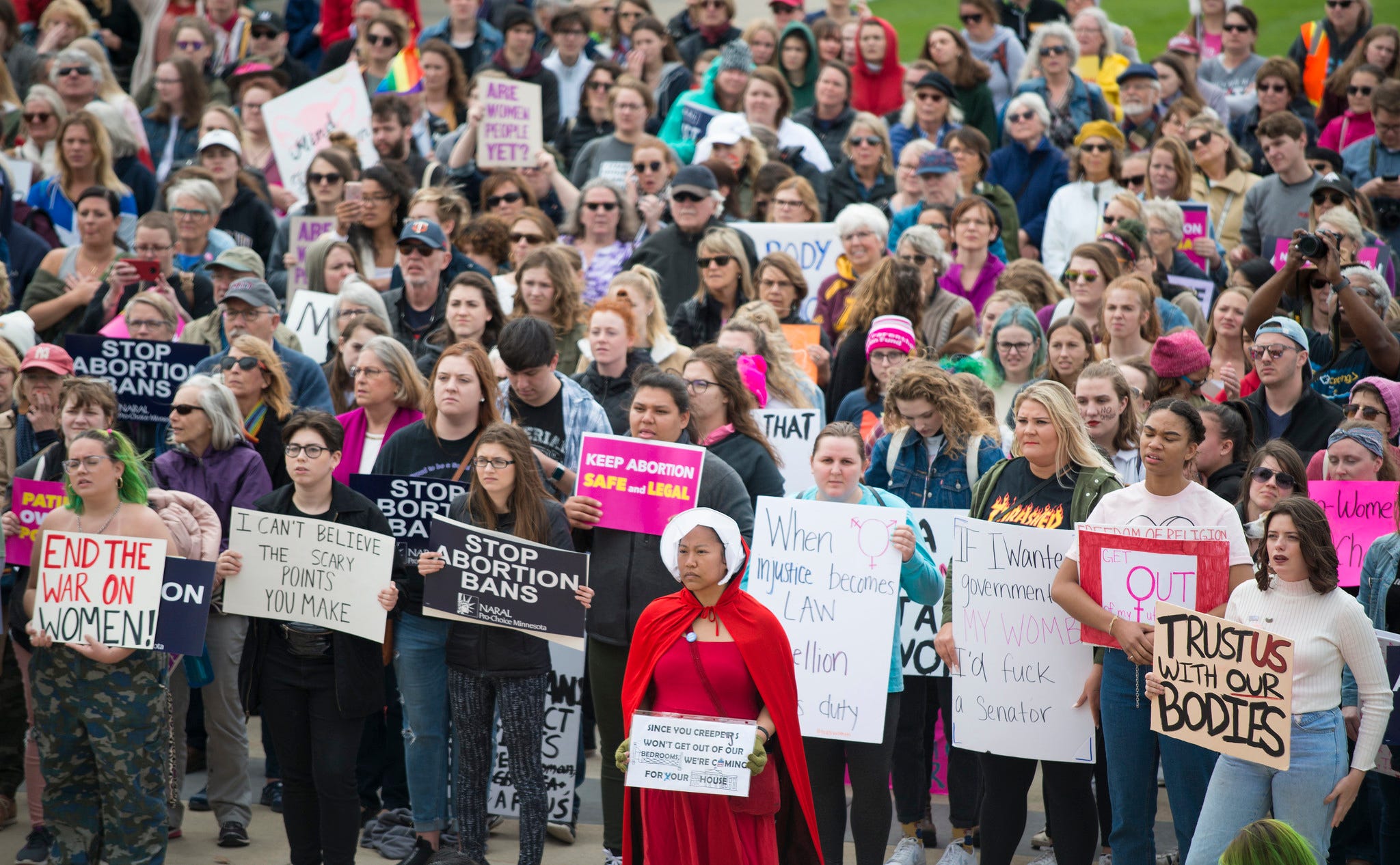
Over the past years, the terrain of gender has become one of the most active and contested sites in the authoritarian project of the New Confederacy—and one of the most important fields of resistance. Gender liberation struggles include a variety of movement sectors and a wide range of actors: from small, militant grassroots networks to large, well-funded nonprofits; from unions and mutual aid groups to legal organizations and electoral coalitions. This diversity reflects real reach and potential—but also significant fragmentation. Below we outline some specific developments by movement sector before attempting to generalize a few common themes and trends.
Queer and trans organizing. Few social groups have made as rapid a set of advances as LGBTQ+ Americans did in the 2010s, and few have faced as swift and relentless a backlash. Queer and trans movements are grappling with that reality. There is a deepening divide between large, grasstops LGBTQ+ organizations stuck in outdated advocacy frameworks and small but resilient grassroots networks primarily focused on care and community defense, Mainstream LGBTQ+ groups like the Human Rights Campaign (HRC) remain focused on lobbying and litigation strategies that—while successful at helping win major legal victories in the 2010s—are inadequate to combat the counter-assault on trans and queer communities today. These groups largely lack a power-building strategy and have been ineffective at organizing rallies, protests, mass mobilization, or effective communications. Legal groups like Lambda Legal and the ACLU are fighting important court battles against anti-trans laws and executive orders, but these defensive legal efforts are not accompanied by an organizing strategy. Meanwhile grassroots networks are practicing strong mutual aid work within trans and queer communities, with a focus on providing DIY medication, gender-affirming care, and material support. The scale of this grassroots organizing is all the more impressive given these networks typically lack mainstream institutional and financial support. But the focus of these efforts, too, is largely defensive. In an earlier era, radical groups like ACT UP connected advocacy efforts, grassroots community care, and militant direct action. Today, there is a deeper division between the advocacy and mutual aid “arms” of the queer and trans movements; even more notable, however, has been an overall decline of direct action, mass mobilization, and militant organizing across the entire sector, amid general demoralization.
Abortion access. Abortion funds exemplify how to build out infrastructure for mass mutual aid that is autonomous from the state. Almost every state in the US has one or more abortion funds, which have formed a strong network with a long history of inter-organizational connection, collaboration, and resource-sharing. In the aftermath of the Dobbs decision, these funds have responded creatively in navigating an increasingly oppressive legal landscape while working together to ensure continued medical and material support. However, funding challenges have intensified, as risk-averse foundations have divested from abortion care in general and from states under GOP control in particular, with devastating impacts, especially in the South. This was partly balanced by a surge in individual donations in the immediate aftermath of Dobbs; in the years since, however, that upswell has ebbed significantly. Long deprioritized by institutional funders, abortion funds have benefited from individual financial support from many middle class and wealthy white women; however, this has frequently caused mainstream abortion access organizations to shy away from more “radical” positions in favor of ones more palatable to the white liberal feminist mainstream.
Reproductive justice. In response to the limitations of such mainstream white liberal feminism, women of color-led organizations launched the “reproductive justice” (RJ) movement in the 1990s to combine struggles for reproductive rights with the fight for racial justice. Subsequently, younger generations of RJ activists have expanded the framework to incorporate a deeper understanding of gender and sexual diversity and a clearer anti-capitalist politics (although the movement has always included a class analysis). A strength of the RJ movement is its radical analysis and ideological clarity, connecting bodily autonomy to racial, social, and economic self-determination within frameworks that are analytically rich, yet popularly accessible. Notable RJ organizations like SisterSong, ARC Southeast, and SPARK are rooted in and/or prioritize the US South—a region home to more than half of the US Black population and one of the key frontlines of racial, gender, and social justice struggles. As other sectors of both the progressive and radical left tend to write off the South, RJ groups have often found themselves isolated. Historically underfunded and marginalized, RJ groups gained more prominence in the wake of Black Lives Matter. Their influence grew both relative to and within more mainstream, white-led reproductive nonprofits like Planned Parenthood, and benefited from increased funding—which has, however, operated on a boom-and-bust cycle, creating new challenges.
Gender and Housing justice. Another important sector of oppressed gender struggle is the small but growing housing justice movement. Like the reproductive justice movement, the housing justice movement is grounded in inclusive, intersectional feminist principles and led by those most impacted by US capitalist, white-supremacist, and patriarchal land and housing policies. Nationally, the Right to the City Alliance and its Homes for All campaign anchor a growing network of grassroots housing groups that engage in tenant organizing, eviction defense, and popular education. These groups often connect their work to broader movements for racial, environmental, and economic justice, and in some cities, partner with labor unions in the fight for housing for all. In some areas, RTTC has played an active role in left inside/outside organizing, through an affiliated 501c4 that can take advantage of electoral cycles to foreground housing justice issues and to elect allies to local and state office. However, in the face of compounding crises like COVID, soaring inflation, and rising evictions, housing justice groups are continually pushed towards mutual aid, eviction defense, and members’ other immediate survival needs, sometimes at the expense of longer-term organizing and power-building. Many groups lack formal structures, operate without nonprofit status, or struggle to sustain long-term organizing, and in some cases are resistant to adopting formal structures that could help them be more effective.
Gender and labor. Some of the most powerful but underappreciated organizations in the struggle for gender liberation are unions whose membership is majority women and gender-oppressed people. As MAGA attacks and undermines the social safety net, workers in care-related fields including teaching and healthcare are on the front lines facing the impacts of those attacks and defending against them. These workers have the potential to be among the largest and strongest organized forces fighting back against attacks on the social safety net and fighting for the society we envision. Key sectors of the workforce are highly segregated by gender, and national and local unions and workers’ centers in highly feminized sectors are among the most progressive and forceful in the labor movement. Among these are the AFA-CWA representing flight attendants, NNU and 1199SEIU representing nurses and other healthcare staff, NDWA representing domestic workers, and segments of the teachers unions, especially UTLA, CTU, and NCAE. These unions are increasingly embracing frameworks like social justice unionism and bargaining for the common good, which connect workplace demands to broader fights around care, education, housing, and public infrastructure. However, internal contradictions within labor remain: many unions still do not fully recognize gender struggle as central to their mission, and racism, misogyny, and transphobia continue to surface in many sectors of the labor movement within both leadership and rank-and-file culture.
The diversity of the oppressed gender movements renders it difficult to generalize across sectors. Still, surveying this heterogeneous terrain, a number of common trends begin to appear.
Many sectors of the gender liberation movements have developed increasingly sharp theoretical frameworks that understand race, class, gender, and sexuality not as identity claims, but as interlocking systems of power. At its best, this intersectionality is not just theoretical but practical, with many groups collaborating both within their own movement and across sectors. The intersection of gender with many other fronts of struggle—labor, housing, racial justice, education—creates organic opportunities for gender justice groups to build unity with other groups both strategically and practically. And as the New Confederacy ramps up its attacks on gender and sexuality, gender justice groups have an opportunity to assume a greater leadership role in the broader anti-fascist resistance. Amid a general societal decline of grassroots member-driven organizations, some of the most developed grassroots organizing is happening within oppressed gender movements—whether we think of networked abortion funds, trans and queer mutual aid networks, or militant nurses’ and teachers’ union locals.
At the same time, the oppressed gender movements face major challenges. Many of these sectors—especially trans, abortion access, and RJ organizations—are among the most targeted by the far right, facing doxxing, criminalization, divestment, and demoralization. Notably, there is a sharp disconnect between small, underfunded grassroots groups with deep ties to impacted communities and large, well-resourced nonprofits that often lack accountability to a mass base, yet set the narrative and policy agenda. The larger groups frequently make pragmatist errors and often focus on legislative, lobbying, and advocacy efforts incapable of meeting this political moment. Many of the smaller groups have a more radical power analysis, but are often ambivalent about power-building: divided on the need for long-term base-building that can contest for governing power, and prone to left sectarianism. Decades after Jo Freeman wrote her critique of the “tyranny of structurelessness,” many oppressed gender groups also remain ambivalent about structure itself, at times impeding their ability to scale effectively. An exception to this is some of the more militant unions with a majority oppressed-gender membership; at their best, these groups combine a structural power analysis with clear structure-based organizing models to build power and lead the resistance.
6.5 Climate and Ecological Justice: Strategic Gains, Strategic Uncertainty
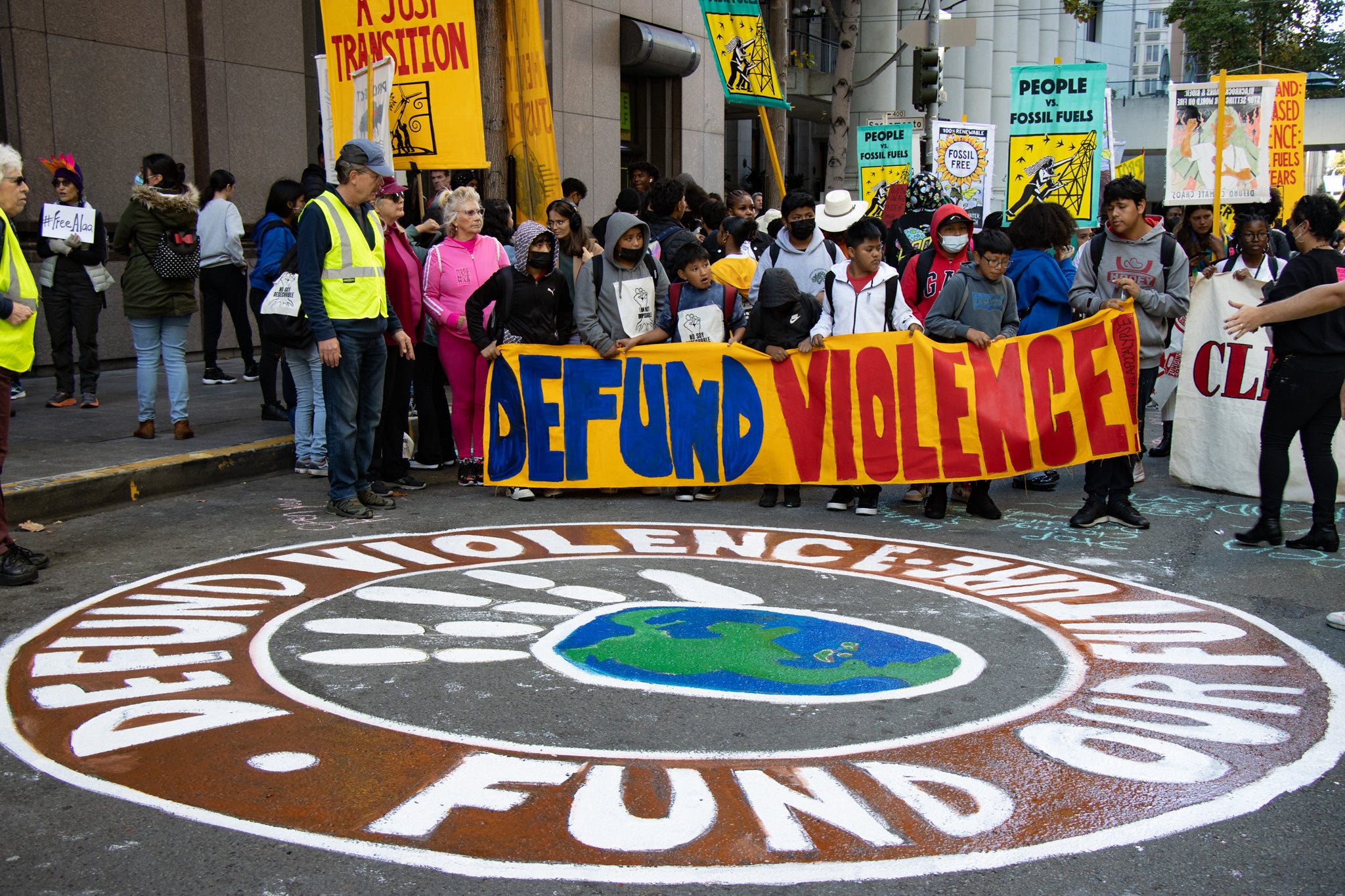
After nearly three decades of growing mass movements for climate and ecological justice (CJ/EJ), which succeeded in establishing carbon emissions reduction as a central global policy goal and won major environmental justice reforms in the US, the CJ/EJ movement today faces serious challenges. These challenges not only limit the possibility of further ecological progress, but also threaten to unravel years of hard-won gains.
Beginning in the mid-2010s, the CJ/EJ movement in the US experienced a major surge in activity. The resistance to the Dakota Access Pipeline at Standing Rock catalyzed national attention, while groups like Sunrise Movement and Climate Justice Alliance were able to mobilize many thousands to demand sweeping reforms to climate and energy policy. Movement forces shifted from leading local resistance efforts to converging around a shared vision of structural transformation. Their demands ranged from land reform and protections for disenfranchised farmers to electrification, renewable energy deployment, and public control of energy infrastructure. This vision coalesced into what became known as the Green New Deal (GND). While CJ/EJ groups articulated different variations of the program, the vast majority aligned with the GND framework. Though it originated in the US, the GND gained international resonance, influencing environmental platforms among center-left parties and movements in Europe and South America.
In the US, the GND gained enough traction to become a leading political and policy framework within the Pro-Democracy United Front. It offered a more ambitious and justice-centered alternative to the "Environmental, Social, and Governance" (ESG) framework promoted by centrist forces—who acknowledged the climate crisis but remained committed to market-centered approaches. Following the 2020 election, the Biden-Harris administration attempted to integrate elements of both programs into its legislative agenda. The result was the Inflation Reduction Act (IRA), passed in 2022. The IRA included major climate and energy provisions: tax credits for green industries, subsidies for renewable energy and electric vehicles, and the creation of a “green bank” to support decarbonization. Additionally, in an earnest attempt to meet CJ/EJ demands and consolidate movement support for the Biden-Harris administration, the IRA embraced the Justice40 initiatives put forward by movement forces to address energy burdens and environmental injustices faced by oppressed nationality peoples within the US.
Overall, the IRA was seen as a major victory for and as the culmination of decades of campaigning by the CJ/EJ movement alongside other green forces, despite its limitations. It represented the largest climate investment in US history and reflected years of sustained organizing. By the end of the Biden-Harris administration, the IRA program was still being rolled out and there were many factors delaying the investments provisioned in the bill. Kamala Harris embraced the IRA as a central part of her 2024 campaign platform.
Since Trump has been reelected, all the IRA and Justice40 initiatives are being targeted for destruction, in line with the program of “Project 2025” embraced by the New Confederacy. The undoing of "Bidenomics" and climate policy reflects a sharp rightward turn in federal governance and a crisis for CJ/EJ strategy. The vision of the GND (and even ESG) was focused on addressing climate change at a global scale through decarbonization of the largest carbon-emitting economies. But explosive geopolitical conflicts over the past few years have thrown the international liberal world order—the framework on which mutual decarbonization via the Paris Accords stands—into crisis, putting efforts towards decarbonization at major risk. With Trump back in power, it is unlikely that CJ/EJ movements will bear much influence over federal policy in the US.
Climate and ecological justice movements now find themselves in a difficult conjuncture. So, these movements are forced to rethink their strategy in conjunction with those forces rising to the defense of anti-racist democracy against growing authoritarianism. Changing from momentum to intense friction at whiplash pace has put CJ/EJ movements on their back foot, figuring out where to regroup and how to move forward.
Amid this uncertainty, some patterns are emerging. Disruptive actions targeting fossil fuel companies and polluters are likely to continue. Pipeline resistance, anti-deforestation campaigns, and struggles over local environmental regulation will remain flashpoints—especially as MAGA forces move to eliminate oversight and governance. Many CJ/EJ groups may shift toward more localized fights, given the inaccessibility of national or international levers in the short term. These local struggles could become training grounds for developing advanced forces, surfacing contradictions within the MAGA bloc, and anchoring new coalitional possibilities for the Third Reconstruction.
In Memphis, for example, Black-led environmental justice groups are resisting a newly opened data center tied to Elon Musk’s xAI project. The facility relies on methane-spewing natural gas generators and subsidized power from the Tennessee Valley Authority, polluting a majority-Black community. In more favorable terrains, like New York, reform remains possible: the 2023 Build Public Renewables Act committed all state-owned buildings to run on renewables by 2030, guaranteed union jobs, and offered retraining for displaced fossil fuel workers. Such examples offer a glimpse of what’s still possible at the state and local levels.
Looking ahead, the CJ/EJ movements may play a critical role in reorienting the democratic front. If they can regroup and align with other sectors—particularly organized labor, oppressed nationality movements and oppressed gender organizations—climate and environmental justice movements could play a major role in cohering a progressive bloc capable of challenging MAGA and shaping a post-neoliberal political agenda rooted in a Third Reconstruction. The next phase of climate justice organizing will depend on whether these movements can weather the current storm—and rise to meet the next one.
6.6 The Inside/Outside Trend and the Development of Independent Political Infrastructure
Over the past decade, many of the most grounded and strategic sectors of the US left have come to embrace an inside/outside orientation rooted in independent political organizations (IPOs): primarily local and state-level vehicles that combine base-building and issue organizing with a coherent electoral strategy. These formations are not simply campaign engines—they aim to serve as strategic vehicles for the political aspirations of the oppressed nationalities, oppressed-gender people and the multiracial/multinational working class. Early innovators of this strategy like New Virginia Majority, Florida New Majority and the Ohio Organizing Collaborative have helped inspire the formation of many state-wide IPOs, especially since 2016, including the Carolina Federation, Down Home NC, Tennessee For All, Florida Rising, and many more. At a local level, there has likewise been a proliferation of experiments with IPO formations such as the Knoxville City Council Movement, New Haven Rising, New Lynn Coalition, Reclaim Philadelphia, and the Richmond Progressive Alliance, to name only a very few. In some areas—most notably, New York—DSA has functioned like an IPO; however, this has been highly uneven within DSA nationally due to internal organizational contradictions discussed below. There has also been a critical thickening of the infrastructure within the Third Reconstruction wing of the pro-democratic front, through the growth of organizations not themselves IPOs but which support IPOs and the broader movement, such as Movement Voter Project, We Make The Future, Local Progress, and others.
At the local level, IPO projects have taken a number of different forms: from formal (often 501c4) organizations to informal collectives, to chartered chapters of larger state or national groups. At the state level, IPO-type projects have typically gravitated towards one of two poles (with a range of intermediary approaches). In some cases, IPOs have formed as new stand-alone organizations that seek to directly integrate base-building, issue organizing, and electoral work. In other cases, IPO-type projects have emerged as an umbrella for a coalition of labor and social movement organizations that seek to work together on a joint electoral strategy and policy program. In Minnesota, for example, exciting IPO work has been led by a coalition of community organizations, workers’ centers, labor unions, and faith-based groups.
Each of these models has strengths and weaknesses. The coalitional approach has the advantage of breadth and buy-in, uniting multiple organized constituencies. But because a coalitional political vehicle is one step removed from direct base-building, there is a risk that it becomes disconnected from and unaccountable to a mass membership—particularly when participating coalition partners often struggle themselves to do effective base-building. The “stand-alone” IPO model bypasses this challenge by directly building and engaging a base, but sometimes at the cost of perceived insularity or friction with other longstanding organized forces. These variations reflect a key strategic tension: we need IPOs that have a broad and diverse enough social base to contend for political power, but that are disciplined and structured enough to move strategically and maintain accountability to an organized membership.
Both models have had challenges getting to scale. If existing organizations do not yet have a base that is broad and deep enough to lead a majority of popular forces in the state, then even the strongest coalition will be insufficient. At the same time, no "stand-alone" IPO has yet succeeded at building a base of the breadth and depth necessary to lead a new political majority at the state level.
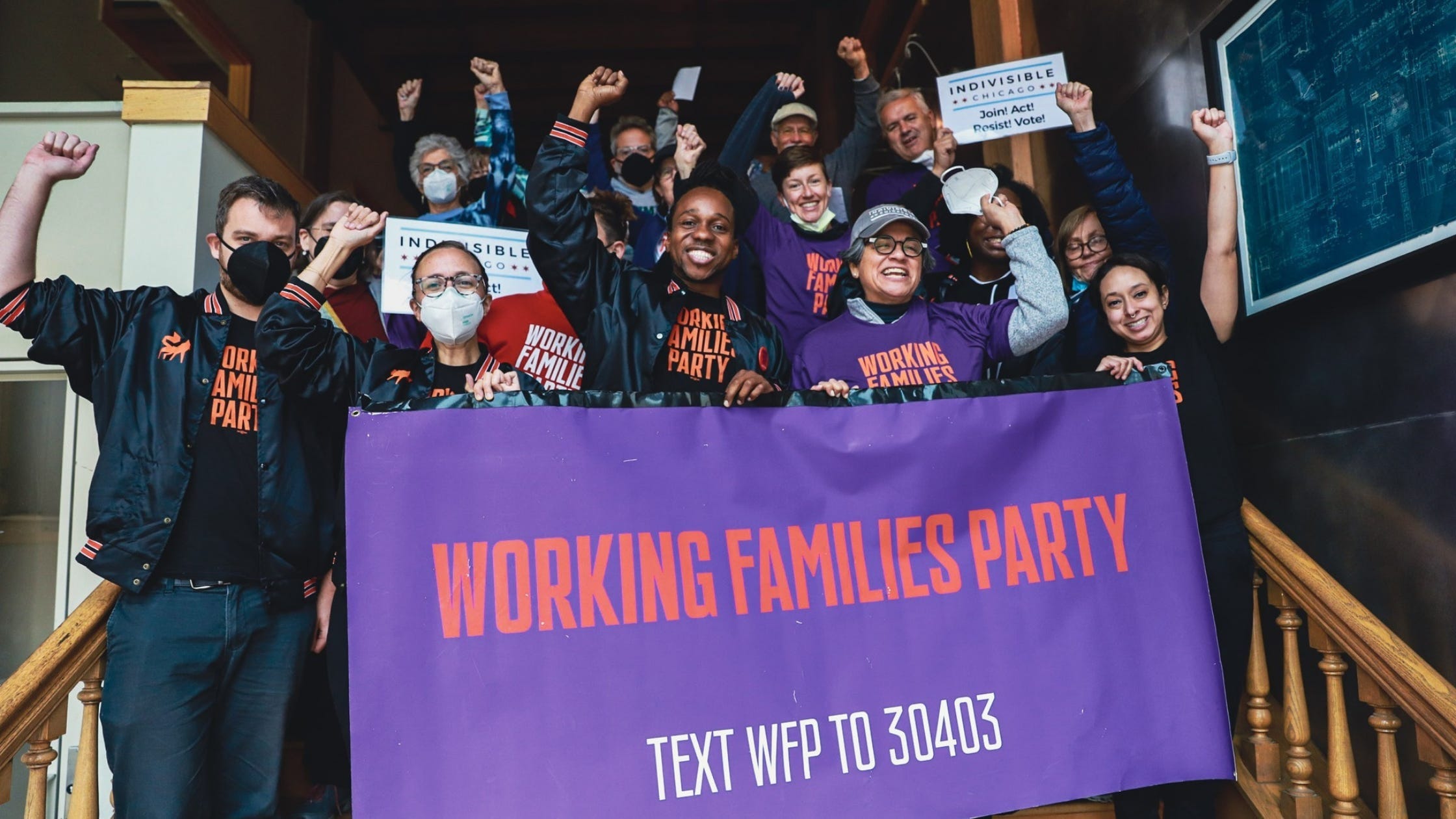
Parallel to this state-based work, the Working Families Party (WFP) has expanded to new states and played an increasingly prominent national role, especially in battleground electoral efforts. WFP’s dual character—as both an electoral vehicle and a broader front of progressive forces—has made it a contested but strategically important space. For significant sections of the inside/outside trend, WFP has functioned as both a nucleus and an umbrella for the nascent Third Reconstruction “party” we need to build. Its ability to win primaries, hold electeds accountable, and project a popular alternative to neoliberalism has outpaced most other attempts at national electoral alignment.
But these advances are not without contradictions. While WFP has offered important resources—especially in electoral infrastructure and expertise—the relationship between WFP and place-based IPO, labor, and social movement organizations remains underdeveloped. Proposals to use WFP as the electoral arm of social movements have sparked serious debate. Many see the idea as promising, but under-specified and overly focused on national branding rather than grounded organizing. Others worry that aligning too closely with an organization seen as embedded within the Democratic Party will compromise their politics and vision. To some extent, this reflects strategic confusion about the nature of the Democratic “party,” which is less a coherent entity than a dynamic terrain of struggle (as discussed in Section 5). But it also reflects the reality that WFP and many of our state-based IPO projects, while scaling up their electoral organizing, have not kept pace with deep base-building, leadership development, and building out of co-governance structures.
When Liberation Road adopted independent political organization as a core component of our strategy in 2016, we pointed to the example of the “Jackson Plan” spearheaded by the Malcolm X. Grassroots Movement (MXGM) in Jackson, Mississippi. As we wrote then, “the Jackson Plan articulates a clear, left view of the question of political power and the state: it is necessary to contest within the existing state through issue/policy fights and the capture of government offices and at the same time to be building institutions of participatory (what Harnecker would call protagonist) democracy.” However, the connection of struggles “inside” the state and “outside” in civil society has proven fraught for most groups that have sought to emulate the Jackson model. While a variety of grassroots groups continue to experiment with people’s assemblies and solidarity economies, few have managed to connect these efforts to a sophisticated electoral strategy. Meanwhile, many of the IPO projects with which our members have been involved have made great strides around electoral strategy—and some have won important policy fights at the level of local and state government—but the parallel process of building organs of direct democracy has generally remained underdeveloped.
As a result, our most sophisticated electoral work has outpaced the development of organization and democratization at the level of civil society. In cases where IPOs have managed to elect left candidates, this has often produced contradictions, as these elected officials became accountable to a mass base much broader than even our most successful base-building organizations, but with much more underdeveloped, confused, and contradictory politics. At times this has resulted in left-progressive electeds taking bolder stances than their electorate was ready to support, contributing to losing subsequent elections; at other times, to these electeds adopting more moderate stances than IPOs wished to advance, contributing to disillusionment among our base. There have been increasing efforts towards co-governance at a local level as well as in some states, like Minnesota. In New York, DSA’s “Socialists in Office” program provides support to elected socialists, and WFP often supports endorsed electeds with regular meetings, contributing to the gradual emergence of something like a progressive caucus structure at the state level. Overall, however, our IPOs have struggled to develop the collective capacity and strategic competencies to consistently support elected allies in navigating the complexities of office, contributing to the isolation of movement candidates once elected.
Meanwhile, as the establishment wing of our united front has lost coherence and legitimacy, our IPOs have found themselves playing an increasing role in waging general election struggles—but without control of the “commanding heights” where strategic decisions are made. The 2024 election made this contradiction more visible. In key swing states like North Carolina and Pennsylvania, IPOs and aligned grassroots organizations anchored the ground game—often more effectively than the Democratic Party itself. With support from national efforts like Seed the Vote, movement-led place-based efforts increased coordination, scaled infrastructure, and helped hold the line in terms of turnout. In contrast to the sharp Democratic drop-offs in other parts of the country, these states saw either stable or increased turnout. Yet the contradiction was stark: while progressive IPOs led the voter engagement strategy on the ground, they had little influence over the public narrative, media ecosystem, or campaign messaging—what some described as “owning the doors, but not the air.”
Across all these fronts, the IPO front remains among the most promising, if underdeveloped, experiments of this period. Yet IPOs still suffer from a lack of shared infrastructure, national narrative coordination, and consistent investment. IPOs have shown they can recruit and train candidates, mobilize tens of thousands of voters, and coordinate with labor and movement allies. But too often, these projects operate in isolation—without the connective tissue needed to scale into something greater.
If we are serious about building a Third Reconstruction, we must treat the electoral front not as an accessory, but as a core site of struggle—where we contest for ideas, for legitimacy, and for material control. The road to power will not run through the Democratic Party as it currently exists—but it will run through the terrain the party occupies. The Democratic Party is not a coherent political organization, but rather a coalition of forces—some progressive, some regressive, some simply opportunistic. To navigate that terrain effectively, we will need independent political formations that function like a party for our side: organizations that are rooted in deep base-building, capable of long-term strategy, and clear about their role in contesting both within and beyond electoral politics. Simultaneously, we need to engage in a parallel process of democratization at the level of civil society: building people’s assemblies, workplace democracy, and other mechanisms of direct democratic decision-making. IPOs, at their best, are the embryos of such formations—vehicles capable of organizing our forces across terrains, shaping popular consciousness and public policy, and building the power of the oppressed nationality and oppressed gender movements and the multiracial/multinational working class.
6.7 The Socialist Left and the Need for a Socialist Core
Surveying the developments outlined above, three key challenges for our movements emerge. Across our movements:
There are too few organized mass membership organizations working at the size and scale we need.
There is too little coordination, collaboration and connective tissue.
There is too little strategic consolidation, with many “left errors” (sectarianism, ultra-left politics) and “right errors” (tailism, pragmatism).
To address these challenges, Liberation Road has argued that we need a stronger, more coherent socialist “core.” By that we do not mean anyone who self-identifies as “socialist.” Unfortunately, many sectors of the US socialist left are only weakly connected to effective mass base-building, organizationally insular, and strategically prone to ultra-leftism. Instead, the core we need to build must be rooted within and helping to lead effective mass movement organizations, working across movement sectors to increase alignment, and strategically clear.
Throughout this period, one of the central strategic tasks taken up by Liberation Road has been to help cohere such a socialist core. The need for this has only grown clearer in recent years, as authoritarian threats have escalated and the limitations of fragmented and siloed left formations have become more visible. Our 2022 Strategic Orientation named the consolidation of this socialist core—strategically, programmatically, and organizationally—as our central responsibility for the period.
Efforts to cohere this trend have made some significant advances, even if they have not yet yielded a shared organizational form. Across a number of formations—Liberation Road, North Star Socialist Organization (NSSO), DSA’s Socialist Majority Caucus and Groundwork, the Communist Party USA, Convergence, and sections of the Rising Majority coalition and State Power Caucus—there is growing strategic convergence around key elements: the centrality of racial capitalism and white supremacy as structural targets, the need for a broad united front to block authoritarianism, and the strategic necessity of contesting for governing power. That convergence was visible in the widespread adoption of the “Block and Build” framework for the 2024 elections, adopted by many of the formations named above as well as by larger mass organizations like the Working Families Party and the Black Lives Matter PAC. This reflects a broader reality: while no single formation has succeeded in consolidating the Left programmatically or organizationally, many of us are now operating with shared strategic assumptions and in overlapping movement projects.
Other developments point to a trend in motion, even if not yet coherent. The 2024 Rising Majority Congress marked an important moment of attempted alignment for social movements. While the gathering did not resolve major questions of organizational unity or shared program, it nonetheless reflected a deeper political coherence than any comparable space in recent years. In a different lane, Grassroots Power Project (GPP) has functioned as the closest thing our “trend” has to a think tank—supporting ideological alignment at the national level, and playing a key behind-the-scenes role in organizational alignment efforts in states like Florida, Colorado, Wisconsin, and Minnesota. The labor left project has the potential to play a similar role within the labor movement—developing a left “pole” within key unions and experimenting with coordination around Mayday and other moments—although its lack of clear leadership structure has meant the space has often been shaped by what some have called a “tyranny of structurelessness.” Meanwhile Convergence has become an important outlet to reflect on and connect these diverse terrains of struggle.
Liberation Road has played an active and consistent role in this process. Our Left Relations team has led bilateral work with most of these key organizations and helped initiate moments of collective strategic intervention. One example came during the 2024 Socialism Conference, where we co-led a session with SMC and North Star on the urgent need to block MAGA and defeat Trump. That session helped push clarity around the stakes of the election at a time when parts of the left were still unsure and vacillating. We followed that by hosting a national online version of the event with Convergence, and then joined Convergence in organizing a post-election call for socialist, labor, and movement leaders across the trend. We are now helping organize follow-up calls to build that into a regular space for coordination.
At a local, state, and sectoral level, many of Liberation Road’s cadre members have worked to help cohere aligned leadership both with the self-identified socialist left and, especially, within and across IPOs, unions, and social movement organizations. We have seen some success in organized labor—an area where our cadre are heavily concentrated—and in the US South—a strategic priority for our organization. We have been excited to continue deepening relationships with aligned caucuses and forces within DSA, at both a national and local level. We also explored organizational unification with North Star Socialist Organization, a new cadre formation which emerged out of the Socialist Organization and Strategy (SOS) process, which we had helped to facilitate. While we were disappointed that NSSO opted not to pursue organizational unity at this time, we were excited to collaborate with many of their new members around 2024 electoral deployments, and have continued to coordinate with their leadership, with whom we share deep strategic alignment.
But none of this has yet added up to the kind of durable, mass-based, strategically aligned movement infrastructure required to wield greater influence within our broad front. At best, we have increased coordination within movement "galaxies"—but those galaxies remain largely isolated from each other. Many of these spaces of coordination also remain far too distant from on-the-ground base-building. At the same time, our forces leading the most grounded and effective base-building are often so focused on maintaining their own operations that they struggle to step into broader alignment work and political leadership roles.
Across multiple fronts, we remain caught between the scale of the authoritarian threat and the insufficiency of our current infrastructure. Left and progressive forces continue to respond to crises with new tables and coalitions—Fightback, Frontline, Time to Act—but despite good intentions these often duplicate existing efforts without consolidating or cohering them. Meanwhile, the far right is consolidating. The New Confederacy is running a coherent play. They are building a political vehicle to govern. We are still trying to figure out who we are and how we relate to one another.
The socialist left, in particular, faces a stark choice. We can either remain a collection of loosely affiliated networks and tendencies, each doing important but partial work. Or we can take seriously the need to cohere—not in name alone, but through shared structure, practice, and accountability. The “Block and Build” framework developed in 2024 was an important step, as were other developments outlined above. But those foundations are not yet stable. And they will not become so through summits or slogans alone. They will become stable only through ongoing shared work, strategic coordination, and ultimately, organizational unification.
This is not a time to retreat or hunker down. Nor is it a time for either self-congratulation or despair. It is a time for honest assessment, strategic courage, and disciplined collective work. The raw materials for a major political realignment are here. The question is whether we can forge them into something that doesn’t just resist, but builds the power to lead a process of structural transformation, both inside the terrain of the state and across civil society. The Third Reconstruction will not build itself. But it can be built—if we do the work to build it.