


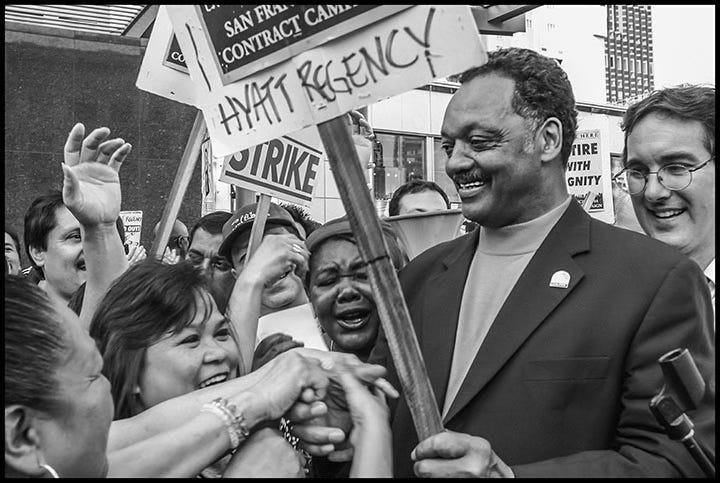
Jesse Jackson’s passing has engendered many articles about his life, work, and place in history—including Bill Fletcher’s piece here in the New Liberator. In this post we give space to personal memories and reflections by organizers who worked directly with Jackson or were significantly influenced by him and the Rainbow Coalition.
We invite New Liberator readers to contribute their own personal reflections about Jackson and his work in the comments.
Bill Gallegos— veteran activist in the Chican@ Liberation Struggle and the environmental justice movement:
One of my fondest political memories is going to San Antonio in 1988 with a delegation of Los Angeles “Latinos for Jesse Jackson.” We worked with some wonderful gentes from San Anto, and we focused on the public housing development on West Side, right across from the incredible Guadalupe Cultural Arts Center. We received an overwhelmingly positive response from the Chicanada living in the development. The co-chair of the Texas Jackson campaign was “Little Joe” of “La Familia” fame. He called for a rally for Jesse at a west side park and 48 hours later 5,000 people showed up. Little Joe welcomed the crowd and did a nice baile with Jaqueline Jackson—the Reverend’s spouse—and she gave a rousing speech. When introducing her, Little Joe reminded the Chicano crowd about the importance of Black-Brown unity with the phrase “we are only a shade away.” What an evening and what a memory.
Jeff Crosby—worker at General Electric in Lynn, Massachusetts, for 33 years; president of his local union and the area Labor Council:
What I remember specifically about Jackson and learned from him is the way he could make very complicated arguments into a simple powerful educational statement. I was forever trying to figure how to build a movement against free trade which was killing my union local and community, without contributing to xenophobia and potentially war. What I took from Jackson I used again and again: “China didn’t take your jobs. GE took your jobs to China.”
The other phrase I remember and used a lot is “the people who take the early bus.” There is a whole world of working class life that starts at 4:30 to 6:00 in the morning as people take public transportation for a half hour or an hour and a half to get to their jobs, or even the people who deliver your newspaper with their kids asleep in the back seat at 3:30 in the morning on freezing unplowed winter roads (for those of us who still get papers delivered). Middle class people don’t even know that world exists. But Jackson spoke of and for them.
I will miss that.
Meizhu Lui—former president of an AFSCME local; community health and economic justice organizer:
Jesse Jackson’s passing made me remember others too, who were, unlike the Barack Obamas, willing to name racism and turn inclusion into a unifying message.
Let’s not forget that wonderfully scrappy black woman, “Unbought and Unbossed” Shirley Chisholm, who in 1968 became the first black woman to be elected to the US Congress. Racism and sexism didn’t quiet her down, they pepped her up. She ran in the Democratic party primary for the US Presidential candidate in 1972, promising to bring marginalized peoples into places of power, and winning 152 delegate votes.
And there’s Mel King, who formed the first Rainbow Coalition — before Jesse — when he ran for the Mayor of Boston in 1983. I was working in the kitchen at Boston City Hospital, and was president of our AFSMCE local; we always tried to get our members, the majority African American, to go vote. But it wasn’t until Mel and then Jesse that they did. Having candidates who they knew shared their lived experiences and who would not abandon them after the election finally lit them on fire. We campaigned like our lives depended on it. Which they did.
David Bacon—California writer, documentary photographer, and former union organizer. See davidbaconrealitycheck.blogspot.com:
For a while it seemed like Jesse was everywhere. In the last years I worked as an organizer he ran for President, and the first picture I took of him was speaking at a Labor Day picnic - all the big labor leaders behind him - Jimmy Herman, then president of the ILWU, Jack Henning, our rebellious leader of the state labor federation, and others. We organized our labor committee of the Rainbow Coalition, and it was not hard to convince our unions that he was the one. The idea of running for president by bringing in the excluded, enfranchising the disenfranchised, was our touchstone from then on.
But I remember him best because he came out for workers again and again, long after he wasn’t running for anything anymore. I’m sure it’s the workers who remember him best, because the photographs show it. The nurses with Rose Ann De Moro at Summit Hospital, the members of my own union, the then-Northern California Newspaper Guild and the other unions of our conference facing the Chronicle, and the farmworkers in that huge march in Watsonville. You can see the way the hotel workers look at him, during the lockout of Local 2. Barbara Lee, then Congresswoman (the only one with the courage to vote against the Iraq war) and now Oakland Mayor, is there with him fighting for the workers in the nursing homes.
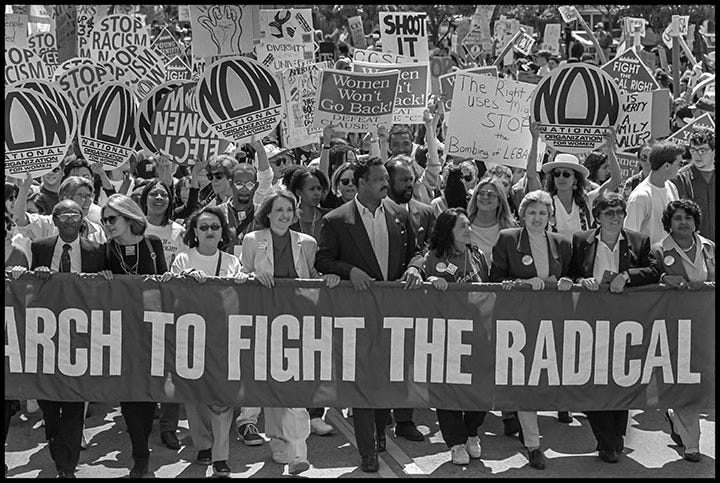
He didn’t come just for labor, of course. He came for the students, battling the University of California to keep affirmative action. He walked with the women at the head of the National March to Fight the Radical Right. And amidst it all, I sometimes found a man lost in his thoughts, perhaps grateful for a moment out of the crowd.You were there for us, Jesse.
Jamala Rogers—long-time organizer, feminist, and political strategist with deep roots in the Black Liberation Movement
Rev. Jesse Jackson was undeniably a transformative civil rights figure. He was charismatic, strategic, and analytical. For those of us who were in organizing spaces with the reverend, we also saw another dimension of the iconic leader.
Rev. Jackson’s ambition for recognition and influence matched his dedication to racial equity and economic justice. He maintained a healthy balance between the two and for the most part, avoided being labeled a “movement opportunist.” Sometimes the label was inescapable, like when he came to Ferguson, Missouri, during the uprising after the murder of young Mike Brown. However, during the Ferguson uprising after Mike Brown’s murder, some young activists criticized his visit as self-serving. Actually, Jackson had been asked to lead the fundraising effort at a particular event. Jackson was pretty adept with the ole Baptist church practice of raising monies by denominations: If you have $1000, come forward. If you have $500, and on down to $5. I saw him raise thousands of dollars using this method.
Jackson understood how to motivate people and move them in a strategic direction. He was an eloquent speaker and astute at taking complex concepts and rolling them into language that the masses could understand. Jesse already knew what he would say, how to say it, and what its impact would be.
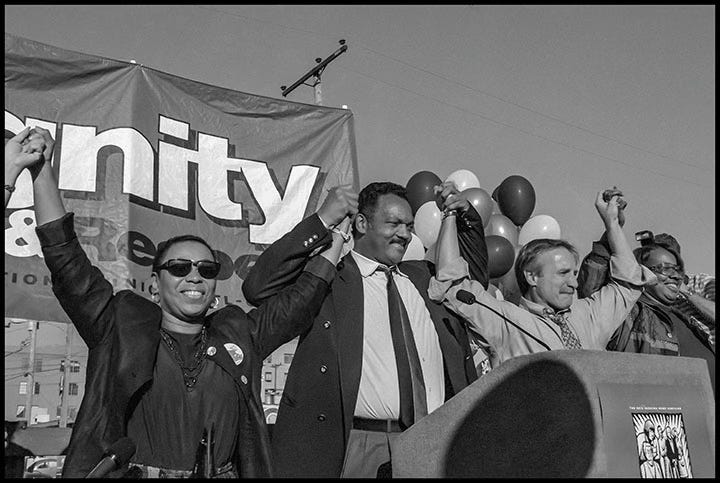
My fondest memories of Jesse Jackson are from his 1988 presidential run on Super Tuesday. As a member of the League of Revolutionary Struggle (LRS) and a contributor to its newspaper Unity, I spent six weeks with a fellow LRS member, a professional photographer, traveling through the southern region as part of the campaign’s advance team. The LRS was heavily invested and involved in both Jackson’s presidential campaigns and the Rainbow Coalition.
As a journalist/organizer, I embedded myself in communities to capture the vital work of dedicated volunteers who tirelessly registered voters, educated the public on critical issues, planned fundraisers, and implemented security-conscious Get Out The Vote efforts (GOTV).
Two key organizing lessons I learned during that Super Tuesday stint. I recall asking Ms. Mabel, one of the team leaders, why they were not wearing Jackson buttons. Anyone who knows me knows that I proudly wear my political T-shirts and buttons to raise awareness. She explained that they needed to be able to move freely through the community without being targeted by the local white power structure. After all, it was the South, with its ugly history of racial terrorism against Black voters. I witnessed firsthand what true organizing looks like in oppressive political conditions and the unspoken realities of second-class citizenship that persistently shape these communities. Lesson (re)learned: Understand the material conditions you face in a given situation so that you use the appropriate organizing tactics.
It was fascinating to watch Jesse Jackson in his element. I saw volunteers puff up with pride when he thanked them for their efforts. He convinced them that they were part of something bigger. When there were multiracial teams, especially if there was going to be a photo opportunity, I watched him literally rearrange bodies so that the image would reflect a visual rainbow, not just a hodge-podge of people grouped together by race and gender. Lesson learned: A rainbow coalition is about both image and substance.
A significant part of Jesse Jackson’s legacy is the acknowledgment that organizing the multiracial working class was critical to winning political power under U.S. capitalism. The need for a national strategy that embraces the principles of a rainbow coalition is still relevant. Radicals and progressive reformists have been given the groundwork and the framework for achieving multinational unity through the electoral arena. Now it’s time to intensify the work—and keep hope alive.
Also see reflections by:
Gene Bruskin in The Stansbury Forum, Jesse Jackson was a Labor Leader
Carl Davidson in LeftLinks, Jesse Opened a Rainbow Path Forward, Now We Must Build and Walk a New Road
Thank you for these powerful reflections on Rev. Jackson from inspiring movement leaders. You give us a lot to reflect on.