


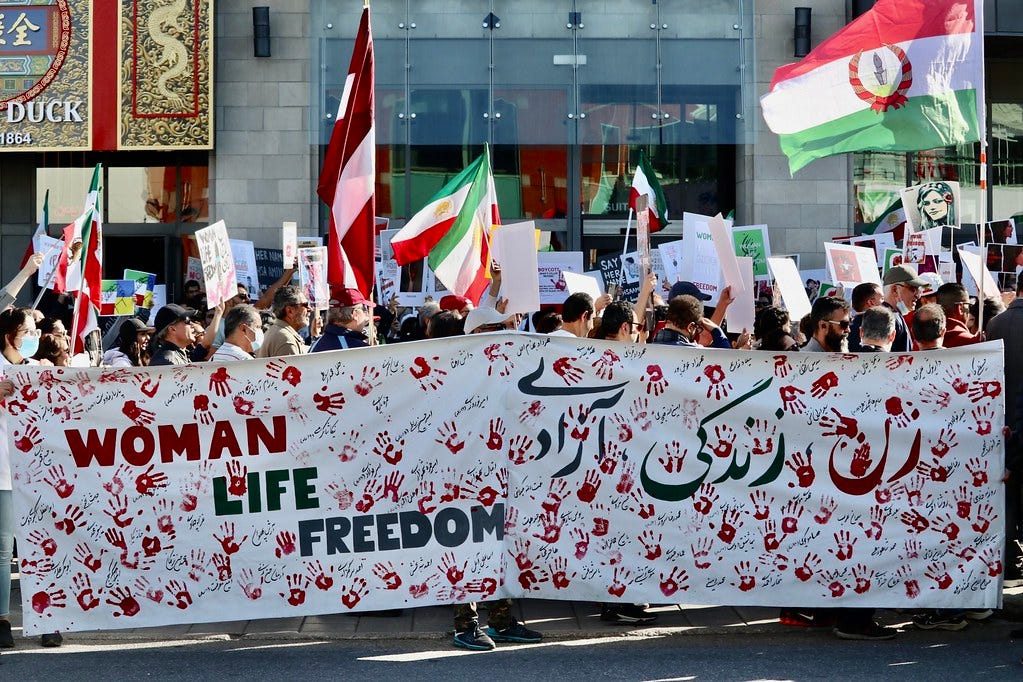
As of February 28, Donald Trump has launched an unprovoked, illegal and unjustified war on Iran. Liberation Road condemns this act of imperial aggression and urges our members, allies and all peace loving peoples to take action to demand that the US stops this war now.
Take action:
Join emergency protests in cities across the country
Organize a protest in your area and register it here
Call and email your Senators and Representative to say No War on Iran
Even as we seek to work with all those opposed to war with Iran, we note a critical difference with some other sections of the US anti-war left. Opposition to US imperialism does not require silence about—or support for—the authoritarian Iranian regime. Liberation Road unequivocally condemns US intervention and aggression, and we also stand in solidarity with the Iranian people as they struggle to determine their own future free from both foreign domination and domestic tyranny.
Below we reprint Liberation Road’s February 10th statement on Iran.
Iran and the Global Fight Against Authoritarianism
By the International Work Team of Liberation Road
Liberation Road stands in solidarity with the Iranian people as they resist authoritarian rule and fight for material survival, dignity, and democratic rights. We condemn the criminal slaughter carried out by the Iranian regime against peaceful protesters and its ongoing repression of political dissidents, women, LGBTQ+ people, Kurds and ethnic minorities, workers, and other oppressed groups. At the same time, we unequivocally condemn US interference in Iran—past and present—which has brought war, sanctions, and collective punishment, not freedom. We call on the United States government to end its threats of military attack, lift sanctions that devastate working-class people, and respect Iran’s national sovereignty.
Opposition to imperialism and solidarity with the oppressed are not competing principles, but dual imperatives that all leftists and internationalists must consistently uphold. We affirm the inalienable right to self-determination of the Iranian people, and we stand in solidarity with them in their struggles against their own despotic regime. In alignment with these two principles, we call on US leftists and all peace-loving peoples to do everything we can to:
Prevent US aggression and interference against Iran. There are several Congressional bills that can blunt Trump’s military aggression against Iran, including S.J.Res.104 and S.2087 in the Senate, and H.Con.Res.38, and H.Con.Res.40 in the US House. US leftists must push Congress to use the War Powers Act to force votes and accountability when Trump threatens military action, while being ready to disrupt business as usual should the US regime attack Iran.
Support democratic and progressive struggles in Iran. One concrete, material step people in the US can take is to help Iranians bypass internet censorship. Iranian activists have called on supporters to download and run tools such as the Conduit app, developed by researchers affiliated with the University of Toronto’s Citizen Lab, which enables decentralized VPN access. Individually this is a small, low-effort action—but when thousands do so together, it can make a real and material difference for Iranian activists on the ground facing internet blackouts and surveillance.
Background and Context
The Iranian people have contended with many forms of authoritarian rule since the Second World War. In 1951, the Iranian people selected the progressive nationalist Mohammad Mossadegh as prime minister. In a coup backed by the UK and US, Mossadegh was overthrown and Shah Pahlavi installed. Then in 1979, a broad and multi-tendency movement overthrew the despotic regime of the US-backed Shah. Many left and democratic forces within Iran participated in the Iranian Revolution, and tens of thousands of Iranians returned from exile, hoping to rebuild a democratic Iran.
After the shah’s ouster, a fierce struggle for political leadership erupted between the most progressive and the most reactionary forces within the revolutionary camp. Though severely weakened by repression, left forces mounted a serious challenge. Ultimately however, Islamic fundamentalist forces consolidated power through massive state violence, crushing organized opposition and extinguishing hopes that the new order would evolve toward democracy. Throughout the 1980s, the Islamic Republic executed tens of thousands of leftists, imprisoned and tortured many more, drove hundreds of thousands into exile, imposed compulsory hijab on women, and extinguished basic civil liberties across society.
Since at least the turn of the millennium, Iranians have repeatedly risen up against the regime, each wave broadening resistance, but also hardening repression. The 1999 and 2003 Iranian student protests gave way to the 2009 Green Movement, which brought millions into the streets to contest electoral fraud, demanding free elections and constitutional reform. Subsequent protest cycles in 2011-12, 2017-18 and 2019-20 expanded the movement’s social base as well as its demands—with economic, social, and political grievances intermixing in heterogeneous protests that remained largely leaderless, due both to their spontaneous character and to ongoing repression of political opposition.
Then in 2022 the state’s killing of a young Kurdish woman, Mahsa Jina Amini, set off the “Woman, Life, Freedom” uprising. Drawing on the lineage of the Kurdish Women’s Movement, the mass revolt situated demands for women’s rights, bodily autonomy, and ethno-national liberation at the center of a broader project of social, political, economic, and ecological emancipation. Though each of these movement cycles was beaten back, they form a living tradition of resistance that, despite its uneven and non-linear development, has seen an overall radicalization of rhetoric and tactics from reformist demands toward more open challenges to the regime.
The Current Wave of Protest and Repression
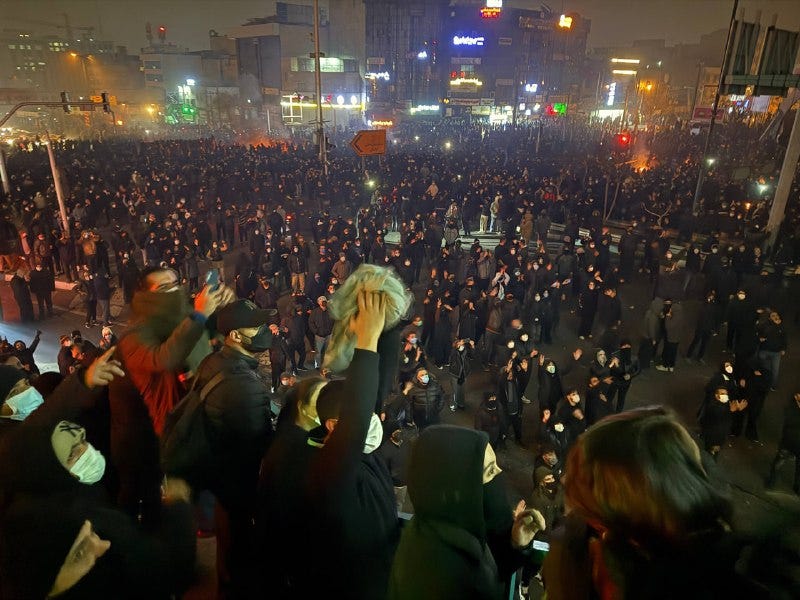
The most recent wave of protests began in late December 2025, amid a deepening social, political, and economic crisis. Years of sanctions, political corruption, state mismanagement, and ecological breakdown have all contributed to sharp inflation, currency devaluation, and widespread shortages of food, fuel, electricity, and water. Meanwhile the regime continued to pour billions into the military apparatus while neglecting to meet people’s basic needs, causing growing discontent. Notably, the protests were initially sparked by widespread shop closures among Iran’s bazaari—merchants and shopkeepers who have historically formed an important support base of the regime. The participation of these petty bourgeois strata signaled the depth of the crisis and the erosion of support for the Islamic Republic.
The movement soon spread beyond urban centers to smaller cities and rural communities, uniting diverse social forces. By early January, boycotts, closures, and walkouts had intensified into something approaching a general strike, which increasingly included explicit political demands. Claims of widespread monarchist sentiment—often amplified by Western media in ways that serve Israeli and American propaganda interests—should be treated with caution. Where such currents appeared, they often reflected political despair and the absence of credible alternatives after decades of repression more than a coherent project of restoration. What unified the protests’ multi-faceted political currents was a common repudiation of the Islamic Republic, rooted in a deepening rupture between Iranian society and the state.
The government’s response has been brutal and systematic. Although precise figures are difficult to verify, multiple human-rights organizations report death tolls in the tens of thousands, with Time, The Guardian and other media sources suggesting more than 30,000 people may have been killed. These are staggering numbers, dwarfing the death tolls from prior protests and likely even exceeding the 1988 mass executions, which the UN found to be a crime against humanity and a genocide of Iranian political and religious minorities.
The Bloody History of US Intervention
Trump has attempted to exploit the Iranian regime’s brutal despotism to justify his own despotic ambitions. Shedding crocodile tears for the thousands murdered in Iran, he has repeatedly threatened military intervention while attempting to negotiate a “deal.”
But US intervention has never served the interests of the Iranian people and has repeatedly strengthened authoritarian forces while inflicting immense suffering on civilians. From the CIA-backed coup in 1953, to the US government’s support for the Shah’s repressive regime, to military strikes, sanctions, and covert operations in the post-revolutionary period, US involvement has consistently undermined popular self-determination.
Today, US policy toward Iran continues this destructive pattern. Crushing economic sanctions function as a form of collective punishment, deepening poverty, accelerating inflation, and restricting access to food, medicine, and basic infrastructure. These measures disproportionately harm ordinary people, while political and military elites find ways to shield themselves from the worst effects. Meanwhile the repeated use or threat of naval deployments, air strikes, and proxy warfare increases the risk of catastrophic conflict while narrowing political space inside Iran.
Rejecting the False Choice of Interventionism and Campism
One response to the Iranian regime’s atrocities begins from a genuine moral horror at the scale of repression and bloodshed, but arrives at a disastrous conclusion: that US power must intervene to “save” the Iranian people. This view treats imperial intervention as a humanitarian instrument, ignoring its actual historical record. US military threats and economic sanctions do not protect protesters—they isolate them, discredit them as foreign agents, and provide the regime with justification for intensified repression. There is no imperial shortcut to liberation.
An opposing error begins from a justified revulsion toward US imperialism, but resolves that revulsion by excusing—or even celebrating—the crimes of the Iranian state. In this framework, any regime opposed to Washington is treated as progressive by definition, and popular uprisings against it are dismissed as foreign plots. This position abandons the Iranian people to their executioners in the name of “anti-imperialism.” Anti-imperialism that requires silence about mass repression is not anti-imperialism at all.
We reject the false dichotomy that forces us to choose between support for self-determination and solidarity with the oppressed. We agree with the position put forward in a statement signed by the Zapatistas and many other left forces around the world. As these groups note, this false choice is the product of people looking at the situation from outside, and above. “Up above against up above. Power against power.” Like them, we look below:
“Down below, the Iranian people struggle for life.
Down below are the women who challenge patriarchal control every day.
Down below are the workers impoverished by neoliberal policies.
Down below are sexual minorities, religious minorities, oppressed peoples, and those who live in the peripheries beaten by the water, housing, and employment crises.”
As we in the US resist state violence, political repression, and attacks on the rights and lives of immigrants, people of color, women, LGBTQ+ people, and the multiracial working class, we recognize that our fight against fascism is inseparable from the struggles of the Iranian people and of all peoples around the world confronting authoritarianism under different conditions. We stand in solidarity with them.