

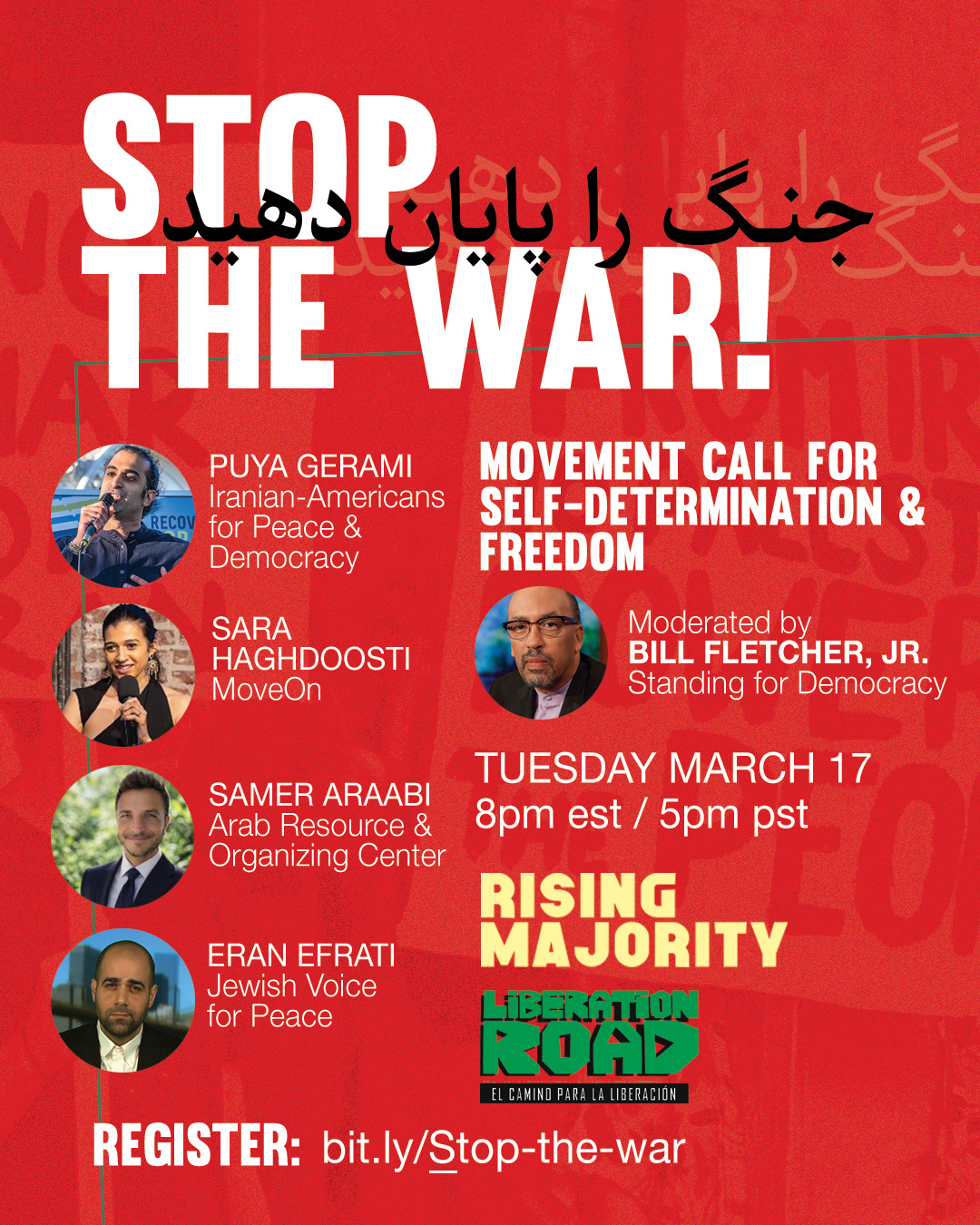
Tomorrow, Liberation Road is co-hosting a movement call we hope you can join:
Stop the War: A Movement Call for Self-Determination and Freedom
📅 Tuesday, March 17
🕗 8:00pm et / 7:00 pm ct / 5:00pm pt
In preparation for that conversation, Liberation Road is sharing a short strategy memo outlining four commitments that guide our approach to the war on Iran and the broader crisis unfolding across the region.
Here are four core commitments—shaped in dialogue with key movement partners—that we think can help anchor a principled internationalist response to the US/Israeli war on Iran.
1. We defend Iranian self-determination and unequivocally oppose the US/Israel war of aggression.
We demand an end to violence and a return to diplomacy, the rule of international law, and political solutions, beginning with the immediate cessation of attacks by the US and Israeli governments.
We affirm Iran’s right to self-determination against US, Israeli and all foreign military aggression, sanctions, and regime change — without endorsing the Iranian regime.
We recognize the United States and Israel as the initiating aggressors in this conflict, wielding dominant military and economic power as part of a broader imperialist project.
We acknowledge Iran’s own regional imperialist ambitions and reactionary alliances are real—but they do not justify this war.
2. We stand in solidarity with the Iranian people in their struggles against domestic repression.
We center the Iranian people—not the state—and their long history of resistance to both domestic tyranny and foreign domination.
We stand with workers, women, LGBTQ+ people, Kurds, and other oppressed nationalities, groups, and movements in Iran.
We reject campism and “enemy of my enemy” logic. We oppose US imperial aggression and condemn the Iranian regime’s domestic oppression at the same time.
3. We stand for Palestinian liberation as part of the same struggle.
We understand the war on Iran in the context of Israel’s war on Gaza and the broader US and Israeli imperialist projects.
We affirm the Palestinian people’s right to national self-determination as a stateless and oppressed nation.
We stand in solidarity with progressive forces in Palestine and Israel, while recognizing that questions of resistance strategy and political leadership for the Palestinian people belong to the Palestinian people themselves.
We recognize that decades of US and Israeli intervention have weakened secular, leftist and democratic forces across the region, strengthening reactionary currents.
4. We organize to defeat authoritarianism and empire at home and abroad.
We affirm that our primary responsibility to the peoples of Iran, Palestine, and the world is to restrain and weaken our own government’s capacity for war and imperialism.
We understand that imperialism abroad strengthens authoritarianism at home—especially against Black, Brown, immigrant, LGBQT+, feminist and working-class communities.
We commit to building a broad anti-war movement that rejects both imperial aggression and authoritarian apologism, wherever they occur.
We organize to defeat the forces of war and repression and to shift the balance of power toward principled internationalism and democratic renewal.
Tensions and contradictions in our movements
Our approach should aim for the broadest possible anti-war front while clearly articulating our position on those points—and strengthening a left current aligned with them. As we do so, here are some tensions and contradictions to navigate within our movements:
Campism vs. principled internationalism
Some sectors of the anti-war movement frame global conflicts through a “campist” lens, treating any state opposed to the US as objectively progressive. This can lead to apologism for authoritarian regimes such as the Islamic Republic. We reject this logic: opposition to US imperialism must go hand-in-hand with solidarity with oppressed peoples around the world resisting repression by their own governments.Liberal anti-war politics vs. structural critique of empire
Another tendency limits opposition to Trump’s war to procedural arguments (Congressional authorization, constitutional violations, lack of defined war goals) without confronting the deeper imperial structures driving US policy in the region. While these arguments can help broaden opposition, they do not by themselves challenge the regional order shaped by US and Israeli military dominance.
Iranian diaspora divides around war and regime change
Within Iranian diaspora communities there are deep and understandable divisions: some currents support US/Israeli intervention in hopes of toppling the regime, while others defend the Islamic Republic as a bulwark against Western imperialism. These divisions can spill into movement spaces. Our aim should be to align with forces that oppose both US war and regime tyranny, and that center the self-determination of the Iranian people.
Breaking the false divide Between Iranian and Palestinian liberation
Some forces opposing the war on Iran hesitate to foreground its connection to Israel’s war on Gaza and the broader regional project of US and Israeli power, fearing that Palestine remains polarizing in US politics. At the same time, in some movement spaces solidarity with Palestine becomes conflated with uncritical support for states that claim to back the Palestinian cause, such as Iran. Our task is to connect the dots between the struggles of the Iranian and Palestinian people.
Narrow anti-war framing vs. broader anti-authoritarian struggle
Some US anti-war organizing focuses exclusively on stopping the immediate military escalation without connecting it to the domestic political terrain. In reality, imperial war abroad strengthens authoritarian politics and repression at home. The fight against war and US imperialism is inseparable from struggles against racism, sexism, repression, and oligarchic power inside the United States.
Implications for our Work
Build the broadest possible anti-war front against escalation with Iran, including forces whose analysis differs from ours, while maintaining political clarity about imperialism, self-determination, and democracy.
Deepen the political analysis of the anti-war movement from procedural anti-war arguments toward a structural critique of empire, situating this conflict within the wider imperial structures shaping US and Israeli power in the region.
Strengthen a principled internationalist pole within the anti-war movement—one that rejects both imperial aggression and authoritarian apologism, wherever it occurs.
Clearly link opposition to the war on Iran with the struggle for Palestinian liberation, situating both within the broader regional project of US and Israeli military dominance.
Stand in solidarity with the Iranian people’s struggles against repression, emphasizing that democratic change in Iran must come from internal mass movements rather than foreign intervention.
Connect opposition to war abroad with struggles against authoritarianism, racism, and repression inside the United States, particularly as militarism strengthens attacks on Black, Brown, immigrant, LGBTQ+, feminist and working-class communities.
Center movements and peoples rather than states and regimes in our political analysis, strategy, and solidarity.
If these questions are on your mind, we hope you’ll join us for tomorrow’s movement call. Stop the War: A Movement Call for Self-Determination and Freedom.