


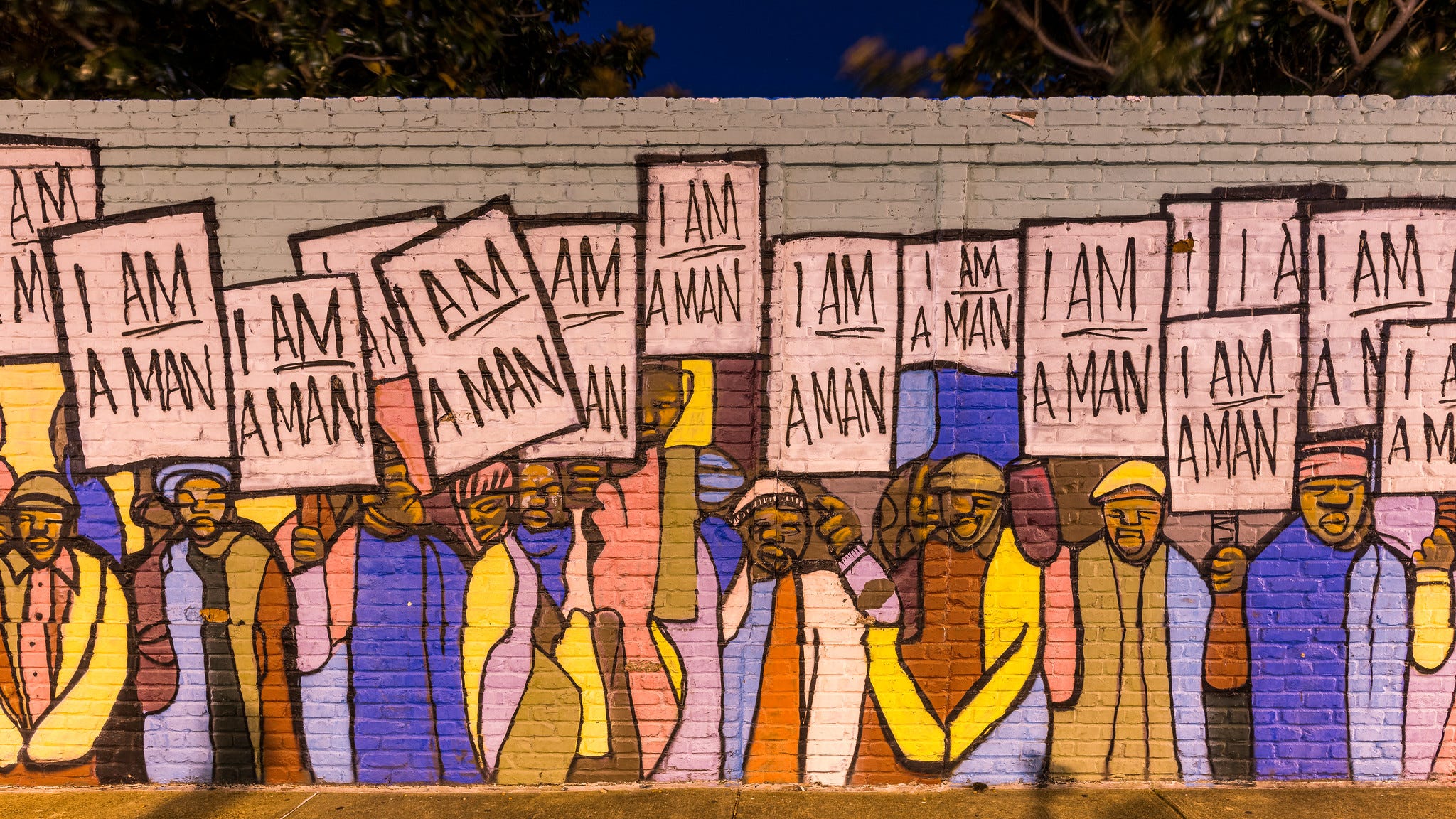
MLK was murdered 57 years ago today...and many of us have still not come to grips with the fact that there is no one leader of the Black Freedom Movement (or, for that matter, any movement!).
King represented a symbolic unity within the Black Freedom Movement—and its allies—that was not quite accurate. Due to the way history has been written, one can erroneously conclude that the Black Freedom Movement was lined up behind Dr. King and that it fell apart (plateaued, declined, etc.) due to his murder.
While Dr. King was a very significant leader of the Black Freedom Movement, he was far from the only one and his leadership was constantly contested. He began as a 26-year-old minister who found himself in the middle of a struggle in Montgomery, Alabama, that he had never anticipated. Who would have expected a 26-year-old leader at that point in time? Yet, there he was, and his age became one of the issues he had to struggle around, particularly with older veterans of the Black Freedom struggle.
The absence of a broader context has led most people to draw erroneous conclusions about the March on Washington. Though King's speech is most well known, the march started as a Black labor march, initiated by the Negro American Labor Council under the leadership of A. Philip Randolph. The NALC effort merged with that of the SCLC and, presto: August 1963.
Tensions within the liberal-to-progressive wing of the Black Freedom struggle were very intense. Roy Wilkins, of the NAACP, was not at all pleased with King and his efforts at mass action. He resented the attention King received. There were others in that camp, but they had to handle these differences carefully due to the support that King was getting at a mass level. But to King's left, new issues emerged with Malcolm X, SNCC, the Revolutionary Action Movement, and the explosion of Black Power. The entire question of the relationship of non-violent protest vs. armed self-defense, as well as desegregation vs. community control, not to mention matters of national self-determination, tore at the Black Freedom Movement. Though King managed many of these differences astutely—for instance, retaining a comradely, if not friendly, relationship with Kwame Ture despite their political differences—it was becoming clear that “one was dividing into two,” so to speak.
The last two years of King's life pointed to not only a challenge to his leadership—on multiple levels—but also a strategic quandary for the Black Freedom Movement. In the aftermath of major legislative victories, such as the Civil Rights Act and the Voting Rights Act, what next? And, of course, how to link the domestic struggles for civil and human rights with the global struggles against colonialism, imperialism, and white minority rule? These were questions King was grappling with until the moment of his death, and these issues divided the movement, a division that became more than apparent in the aftermath of King's death.
Martin Luther King was a unique revolutionary figure who was, in a very fundamental way, grappling with the challenges facing a freedom struggle, something that was in many respects an anti-colonial struggle, in a context where the victims of racist and national oppression were not the numerical majority. This led him to different conclusions than those advanced by many Black cultural and revolutionary nationalists. The differences were sometimes tactical, often strategic, but rarely about the overall objectives (i.e., the end to Jim Crow, the expansion of democracy, peace). What King's tactical approach masked was his actual conclusion that his objectives could not be fully won within the context of capitalism. This conclusion has been suppressed in the popular imagination and media ever since April 1968. And Richard Nixon, as shrewd a politician as any, understood this perfectly well when he launched a double barrel assault on the Black Freedom Movement with both his so-called "Southern Strategy," as well as his call for "Black Capitalism."
We come not to mythologize Dr. King; we come to honor him, and to emulate his revolutionary essence.

Excellent. Good work. It may come as a surprise to some younger folks, but MLK only had solid support from about 35% of the population when he was alive. It ebbed and flowed. SDS/SNCC saw ourselves to his left, and we were, but most of us had the good sense to still support him as part of a wider front and to defend him against Hoover and the FBI, who hated Dr. King more than they did us. We were shaken by the assassination. SDS offices were on Chicago's West Side, which was in flames and turmoil, and a tank was stationed outside our office door. All we could think to do was to hit the streets all night, talking to the National Guard, who were much like us, young guys, but who went into the NG to avoid Vietnam. 'Don't shoot for the Slumlords! If you have to shoot, shoot in the air!' was one popular and effective slogan we raised when talking to them. I would agree with BillF that King was wrestling deeply with the questions around socialism. Unfortunately, many of us never thought of him doing so until we read his works after he was killed.