

by M.L.
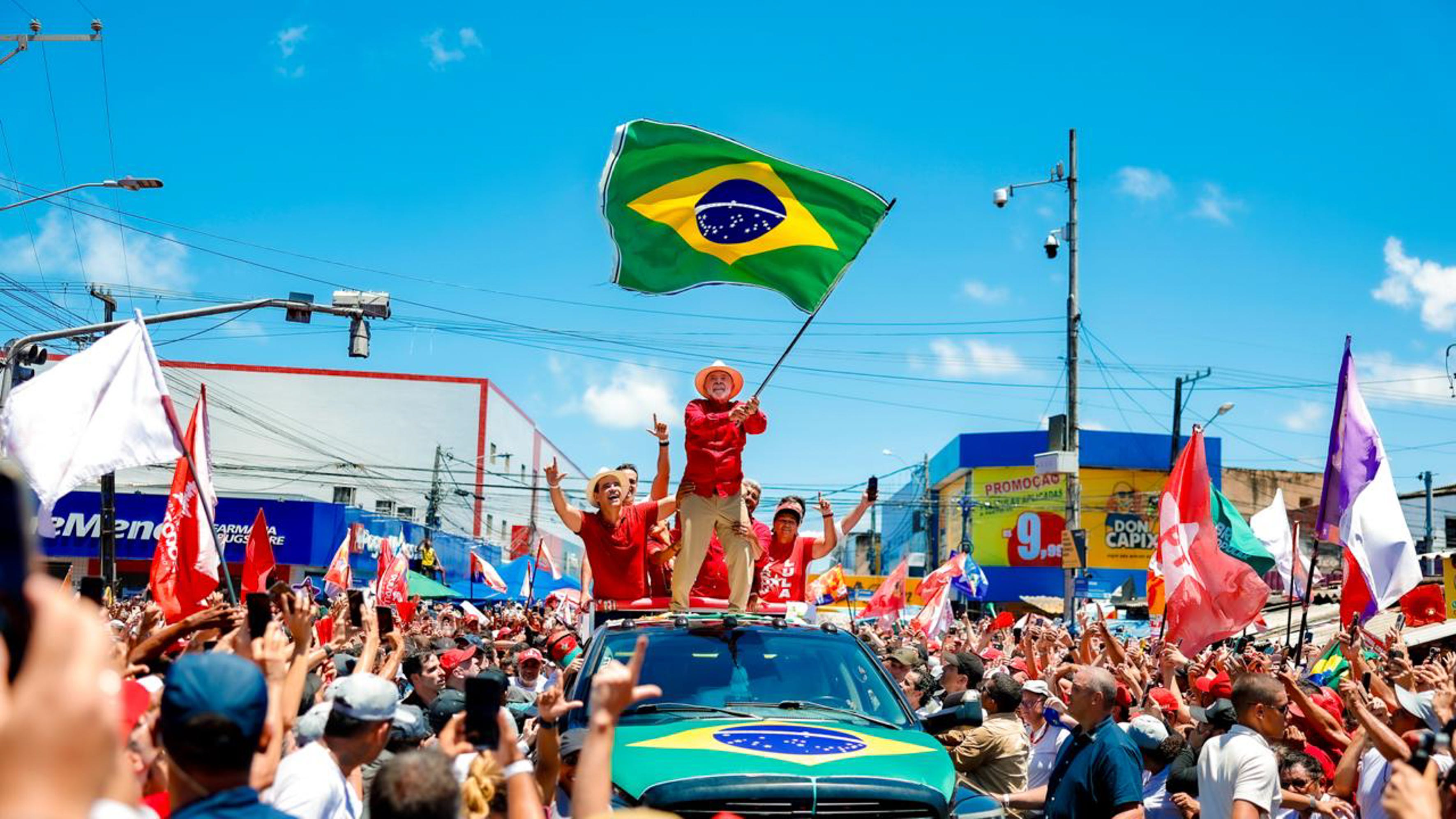
The New Liberator is pleased to share the following account we received from an organizer in Brazil on the historic October 25, 2026, electoral victory by Lula, Brazil’s left-wing Workers’ Party incumbent. This was a victory for people in Latin America and throughout the world fighting for democracy and against authoritarianism—in the words of Mexican President Claudia Sheinbaum, “a breath of fresh air.”
See the original article in Portuguese here.
In the second round of the elections, Brazil had a second chance to save democracy—and it succeeded. Lula finished the first round behind the far-right candidate, Flávio Bolsonaro, defying the polls. Relying on the numbers that favored Lula, there was practically no campaign. Furthermore, in Congress, the far right gained greater influence in both the Senate and the Chamber of Deputies. The new president would also have the power to remove Supreme Court justices and appoint four new ones, thereby securing a majority on the bench. A victory for the far right would have granted it absolute power, as it would control the executive, legislative, and judicial branches.
The day after the first-round results were tallied, the mood was one of mourning and fear. Never in Brazil’s history had there been a turnaround in the second round, and organized crime and fascism were knocking at our door.
Confident of victory, the far right openly announced its intentions: to copy the Argentine economic model, amend the constitution, and thereby seize power and strip the elderly and the poorest of their rights—with significant impacts on Brazil’s environment, healthcare, social security, and education. Our sovereignty was also at risk, as Flávio Bolsonaro had made deals with the U.S., through Marco Rubio, to hand over our natural resources in exchange for support to win the election. He was a candidate embroiled in various corruption scandals and linked to armed militias.
Hope came from the streets and spread across social media. College and high school students started a movement that spread through cities and entire neighborhoods. Workers soon joined them. In just a few days, the defense of democracy and Brazilian sovereignty took in public spaces and social media, uniting people across the political spectrum. The elderly also mobilized. It wasn’t just the left that took to the streets. There were those who wanted a country where everyone could exist and live. These were joyful, musical acts celebrating life! Everything the far right abhors.
We understood that to win this battle, we needed to unite our efforts on the streets and online. A Brazilian congressman, André Janones, created a WhatsApp channel that reached 10.8 million followers in just a few days. “Lula’s Army” became a unique channel for spreading information and providing guidance on how to navigate social media. We understood that, to win, we had to dominate both the streets and social media. We understood how the algorithms worked and took action to outsmart the Big Tech system. It didn’t take long to realize that Big Tech was restricting our posts, making it difficult to share content, and failing to deliver our messages. People then began producing short videos, discussing the loss of rights, sovereignty, the risk of dictatorship, Milei’s economic plans, and warning the public about the dangers we faced. The strategy to circumvent the algorithm was: Never like, comment on, or post on any far-right social media. Never defend yourself on opponents’ social media platforms. Internet users were urged to like, comment on, repost, share, and save every post from the democratic camp on every progressive post. The mobilization of 10 million people in the “Lula Army” and its private networks secured dominance on social media within a few days. The main campaign was for each person to seek out one more vote. Lula needed around 2 million votes to win. We secured about 10 million votes, which put him ahead by a margin of around 4 million.
This was no ordinary victory. We overcame the boycott by companies that shut down public transportation in the Northeast region. Flights were canceled to the Northeast, where Lula had the most votes. At the TSE (Superior Electoral Court), the president had been appointed by the Bolsonaro administration and acted in favor of Flávio’s campaign.
We overcame the control and power of the Big Tech companies that were favoring the far-right campaign. We defeated Donald Trump, who, as allegations have already indicated, was secretly financing the campaign behind the scenes. We defeated the Brazilian media, which was biased in favor of Flávio. We defeated the Brazilian elite, which had already taken a side.
We won the election, but we face significant challenges: unifying a country divided by the influence of fake news and hate speech; reclaiming an understanding of the class struggle that lies at the heart of this perverse game played by the far right; and ensuring that not only Brazil but the world understands that this is about more than Lula or elections against the far right. It is about understanding that there is a new wave of imperialist conflict which, to achieve its goals, divides us, dehumanizes us, and exploits us. Our challenge, regardless of elections, is to broaden the debate and reflect on the kind of society we want.
M.L. is a Brazilian trade unionist who started in the orange sector warehouse and became union president. She now works as an organizer and trainer for Transnational Information Exchange (TIE Global). She has worked throughout Latin American and Africa.