


Global elites have been a favorite target for right-wing populists in Europe and the US. In fact, listening to politicians we might think globalization is not only in decline, but has been replaced with national competition, tariffs, and delinking. Verbal attacks on globalization are common for Trump, but Biden has also extended tariffs, attacked China’s development, and promoted policies to protect and subsidize the national economy.
So it may come as a surprise that in 2023 foreign direct investments for new manufacturing and infrastructure projects almost surpassed their previous peak. Transnational capitalists invested in 16,447 cross-border projects worth over $1.3 trillion dollars, and created 2.8 million jobs. As usual, the US was in the number one spot as a source for outbound investments.
How about the number two economic power, China? It turns out all the tariff and protectionist maneuvers hardly slowed China’s foreign expansion. Its foreign direct investments hit an all-time high at $163 billion, but changed direction to focus on the Global South. China was joined by skyrocketing investments from Saudi Arabia, the UAE and Qatar, with Abu Dhabi’s sovereign wealth fund becoming the world’s biggest single foreign investor. The Asian Pacific attracted the most cross border capital with $450 billion flooding through the region.
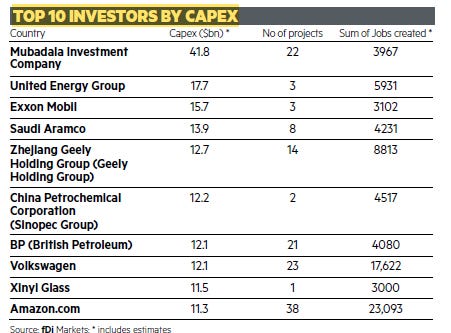
Among the top ten global corporate investors by capital expenditures (CAPEX) were four Chinese companies, three from the US, two from the Arabian Gulf and one from Europe. Of the top five, Exxon was the only US corporation (at number three, with $15.7 billion invested) while number two was United Energy Group from China at $17.7 billion. Looming above all was Mubadala Investment Group from Abu Dhabi (UAE) with $41.8 billion in capital expenditures in 22 projects.
The good news is renewable energy had the highest rate of investments for the fourth year in a row. The sector attracted $348 billion with 856 new projects. Renewable investments led in four of the five global regions, and registered second in North America (Canada and the US). Coal, oil and gas drew $94 billion—still way too much, but far behind renewable investments. This is an indication that significant sectors of the transnational capitalist class are committed to the green modernization of the means of production. Unfortunately, the needed transformation is sorely undercut by market competition and bankruptcies, rather than carried out as a common planetary project.
Considering how often and loud Republicans holler about the evils of globalization it's ironic that they welcome foreign investments into red-dominated states. In terms of the number of projects with foreign investment, the top ten states in 2023 included: California, New York, Illinois, and Massachusetts (all blue states) as well as Texas, Ohio, Florida, North Carolina and Georgia (all red states, though the latter two are purplish). The total for blue states was 517 projects, and for red states 568. Since 2019 Texas has led in gaining foreign investments, with some $90.5 billion. So, while Texas Governor Greg Abbott viciously attacks working class immigrants, his arms are wide open for foreign capital1.
As we see globalization continues, even as protectionists and competitive strains increase between countries. One last note: although projects and capital are reported with national identities, it’s important to remember that transnational corporations, no matter their national origin, have investors and stock owners from the world’s rich no matter where they live.
Jerry Harris is the national secretary of the Global Studies Association of North America, and on the international board of the Network for Critical Studies of Global Capitalism. His articles have often appeared in Race & Class (London), Science & Society (New York) and International Critical Thought (Beijing). His last book was Global Capitalism and the Crisis of Democracy. His work has been translated to Chinese, Spanish, Portuguese, German, Czech, and Slovak.
All data is from “The fDi REPORT 2024: Global greenfield investment trends.” fDi Intelligence, www.fDiIntelligence.com, 2024. Editors Jacopo Dettoni & Geraldine Ewing. Note, the report only cover greenfield investments—that is, new investments in physical assets. It excludes the trillions of dollars invested in stocks, bonds, futures, money markets, derivatives and reinvestments in old structures.
i am finding the newsletters from Lib road worth reading even w the blizzard of other emails i get- clear, not too long and substantive
Thanks