


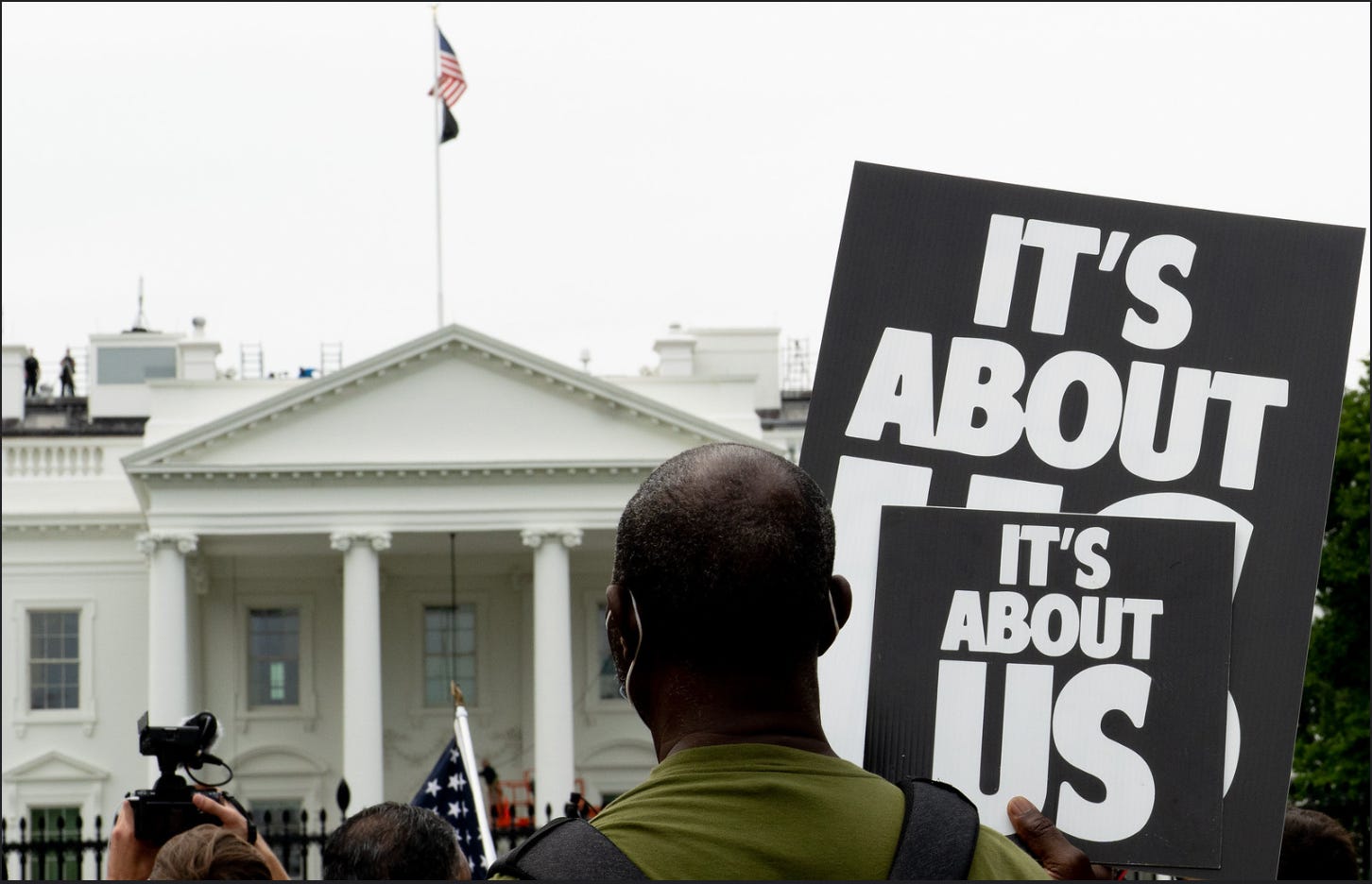
On April 29th, 2026, the rogue Supreme Court again attacked the 1965 Voting Rights Act, and in a 6-3 decision (Louisiana v. Callais) struck down section 2 of the VRA as unconstitutional. Callais has immediately led a collection of Republican-dominated state legislatures to redraw Congressional districts to favor right-wing rule. The Callais ruling risks leading to a historic collapse in Black representation in the US Congress. And with the pulverization of section 2 in 2013, the enforcement mechanisms for the VRA have been rendered hollow and empty.
This attack on the VRA is part of the strategy of the reigning regime of the New Confederacy to roll back the revolutionary victories of the post-Civil War First Reconstruction and the civil rights-era Second Reconstruction. The brutal backlash against the First Reconstruction was carried out by so-called “redeemers,” who strove to restore elite white minority rule. As Michael Podhorzer and Thomas Zimmer have recently argued, we have now reached the apotheosis of America’s “Second Redemption”—a swift, brutal backlash against our fragile progress towards real multiracial democracy.
The restriction of the right to vote is one of the ways the New Confederate regime intends to breed pessimism among our organizations, within our movements, and in the communities of the oppressed. Pessimism is the general orientation to the development of history as being a site of unending defeat and suffering. Pessimism is a form of philosophical cowardice that does not allow us to turn and face history for what it is: a struggle of and by the oppressed and exploited that is at once both horrendous and victorious, depending on what we do.
Those of us who believe in freedom cannot afford to succumb to despair because that is precisely what our enemies want us to do. Yet the reaction to the Supreme Court ruling from left activists and social justice organizations has too often been one of stubborn pessimism. This kind of pessimism has the potential to lead to a self-fulfilling prophecy of defeat: if we take massive attacks on the democratic rights of the people as a sign that the political situation is hopeless, we risk tacitly supporting the regime’s endeavors through our political non-response.
We need sobering analysis like Zimmer’s and Podhorzer’s to keep our eyes on the catastrophic situation we find ourselves in. But we also need to muster the courage to look at the future as a place of potential promise. That is the purpose of hope. Hope is the courage to have a generative expectation of whatever is on the horizon. Hope is not optimism, because those of us who hope also must be students of history, and there is no assurance of a victorious future because the future remains open. Hope is a social ethic and a political principle that gives us grounding and encouragement in the face of the unrelenting storms we find ourselves in.
What does it mean to approach this moment from a place of grounded hope? It means combining sober analysis with strategic audacity. For the New Confederacy’s aggressive gerrymandering, as devastating as it is, simultaneously offers us potential new openings and strategic possibilities.
Take the case of Tennessee. After the Callais decision, the assumption in many movement spaces is that we have irrevocably lost the state’s sole majority-Black Congressional district and with it the possibility of securing a single House seat. A more hopeful perspective might look at these new districts as a strategic opportunity. By dividing the state’s Black, Brown and progressive white voters across multiple districts, the Tennessee GOP has actually expanded the map of potentially winnable seats.
Below is the partisan lean of the state’s redrawn Congressional districts. This is how the new districts voted in the 2024 presidential, 2020 presidential, and 2018 Senate race:
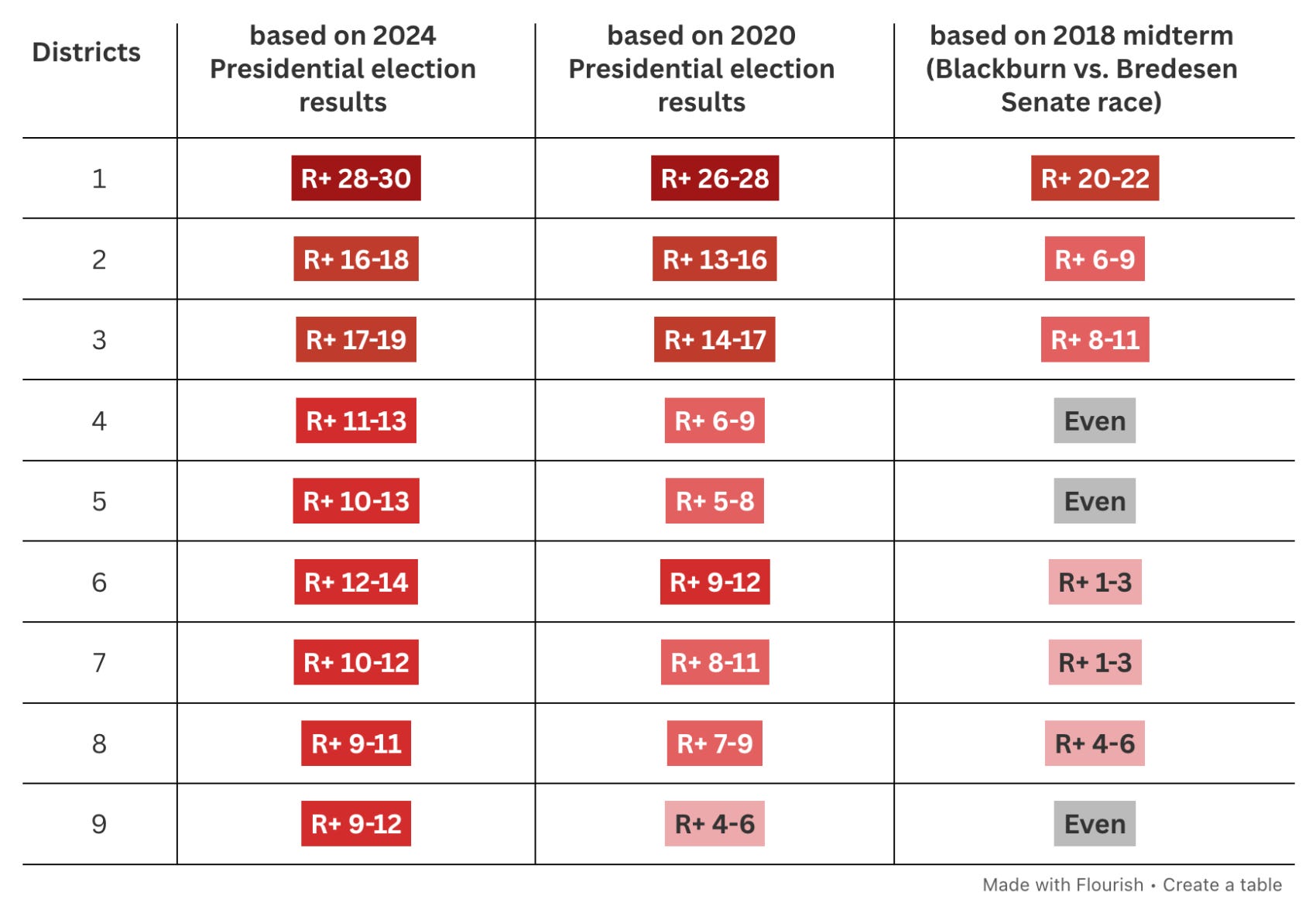
Table source: the Tennessee Lookout, based on data from Dave’s Redistricting
While the 2024 results certainly look terrible, the 2018 midterm election is actually a much closer parallel to the political situation in 2026. Trump’s strength is that he brings out MAGA voters who only come out for him. But this coalition contracts when his name is not on the ballot. Meanwhile, midterm elections see gains for the opposition party in inverse proportion to the popularity of the sitting president.
The Tennessee GOP’s mistake is that they seem to have drawn the new districts on the basis of Trump turnout, not accounting for these changed conditions. Their error is an opportunity for us. In the place of one sure win (but eight certain defeats) they have offered us five or six contestable seats, and three that are solidly winnable.
Our historically unpopular president is shedding support left and right, while pro-democracy voters are galvanized, and this latest assault on voting rights will only add fuel to the fire. In other words, the political conditions of this year’s midterm elections could hardly be more favorable to the pro-democracy, anti-Confederate majority. In these conditions, the very gerrymandered districts that might otherwise hamstring us open up new strategic opportunities. There is every reason to be aiming to do as well or better than 2018. Which means districts like TN 4, 5, 9, and possibly 7 should be within reach.
The potential for a New Confederate overreach has ground elsewhere as well. It is significant that the New Confederate government in South Carolina, even with pressure from Trump and even given the momentum of Callais, has been conflicted about a potential “dummymander“—redistricting intended to help Republicans that could actually lose them seats.
The courageous defiance of the movements for liberation in Memphis and the leadership of people like Justin Pearson remind us that we need as much hope and courage within the institutions of electoral and political power as we do beyond them. The Callais decision, rather than sending us into a death spiral of pessimism, must serve as an opportunity for us to become even more clear about this moment: the New Confederacy is the enemy, the state legislature was and remains the principal staging ground for the full-frontal assault on the First and Second Reconstruction victories, and it is incumbent on our organizations to view the battle for control of these state governments as the key strategic and political intervention we must make in this period of struggle.
The power and promise of an abolition democracy rooted in a socialist politic is that hope can and must become both the ground that anchors us and the principle that sustains us.
Aaron Jamal is an organizer in North Carolina and is committed to the socialist transformation of the United States. Aaron writes regularly on his Substack, BLACKUNBOUND.

Excellent example of dialectical and all-sided analysis on your part, Aaron. Keep on keepin' on!