


The mark left on the New World, or Turtle Island, by Hernan Cortez also left Ponce de Leon in the dust. Born a lesser noble with dim prospects at home, he headed to Hispaniola and then Cuba as a young man. Bogarting and elbowing his way upward, he received an encomienda, a designated land area with the command of all the non-Christian labor upon it. This was typical of all the nobility and many of the military who had migrated, and they used it to make their fortunes. Cortez used his allotment to work himself into a position to make a military invasion of what was then the Aztec empire against the orders of Cuba’s governor.
We all know the next part reasonably well. Cortez impressed the first two native peoples with his horses and guns, and they thought they might use him against their local rivals. So Cortez defeated one group after another with this divisive policy until he had gathered a considerable force. He next fought his way into Tenochtitlan, got Montezuma to agree to meet him, and then put the Aztec ruler under house arrest. Cortez took over the region and killed Montezuma and his two chief underlings. This made Cortez head honcho, more or less, of what he called “New Spain” with many subordinate states. But the Spanish king made Diego Velázquez de Cuéllar the governor of New Spain, with Cortez in a secondary position.
No matter—Cortez maneuvered his way back to the top. But how, apart from looting Aztec royalty, did Cortez and others like him make their money? The answer is silver, much more so than gold. Central Mexico had lots of it in the hills—ore seams that reached the surface. Unlike gold, silver ore had to be treated and processed several times to leach out the silver. Moreover, the seams went downwards, requiring long shafts up to 600 feet to dig and gather the ore.
Thus, silver mining required a lot of labor. The hand tools needed were simple enough: wooden ladders, ropes, and headbands. But it required a class of miners made up of drafted Indians and enslaved Africans, and when they weren’t enough, more Indians were recruited and paid a wage. Cortez himself owned dozens of mines, and other Spaniard settler-colonizers owned hundreds more. Up to 5,000 miners forged the mixed enslaved and waged proletariat of New Spain. And as workers often do, they waged battles and strikes to improve their conditions. Sometimes they were killed and replaced. But since the work required some skill, sometimes they won concessions. This is one good starting point for writing our labor history in the New World.
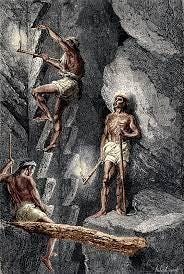
The key point? There was constant pressure to find more slaves. This was difficult because the successors of King Ferdinand and Queen Isabella, the young King Charles II, and Marianna, his regent mother, were trying to outlaw slavery in the Caribbean and New Spain. They also aimed to make new ‘Catholic vassals’ of the Native peoples. Only about 10% were freed. But excuses had to be concocted to enslave new workers.
To do so, we find one Juan de Oñate y Salazar, a young conquistador of the late 1500s who married Cortez’s granddaughter. He gathered up a small army and headed northward to subdue a new area, the “New Kingdom of León y Castilla,” later known as New Mexico, in what is now the United States. In 1598, he crossed the Rio Grande and pressed on until he ran into a relatively large collection of Pueblos, the adobe cities of the Acoma peoples. Oñate raided them for food and tried to capture slaves but met resistance. It became a full-scale war, and ultimately the Acoma fighters surrendered with only 500 left. To punish those who wouldn’t submit to enslavement and refused to work, Oñate gathered dozens of young men and chopped off one foot (some reports say he chopped off their toes).
Oñate took his troops far beyond Santa Fe, exploring and capturing native peoples into what is now Oklahoma and Texas. Eventually, news of his cruelties caught up with him, and in 1608, he returned to Mexico.
But he’s still remembered. When Hispanic New Mexicans recently tried to commemorate him with a statue, indigenous New Mexicans wanted it removed. Someone cut off one foot of the statue’s horse where he was seated. Some memories stick around.
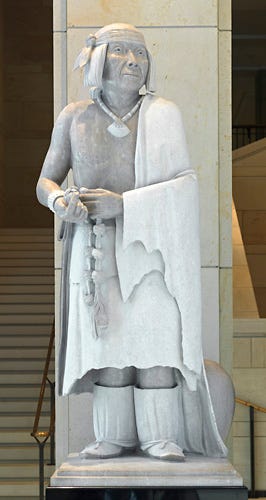
Some 80 years later, the Pueblo people organized a general uprising. Their leader was named Po’pay, and the revolt is often named after him. Through extraordinary coordination, the Pueblo people managed to drive the Spanish out. Although this hard-won independence lasted only 12 years, the episode proved instrumental in challenging the slave labor system, forcing the Spanish to alter their policies towards the Pueblo, and allowing the Pueblo people to preserve their language, culture and heritage to this day. Today, New Mexicans honor this history with a statue Po’pay in the US Congress.
Carl Davidson is a former student leader of the New Left of the 1960s, serving as a Vice President and National Secretary of Students for a Democratic Society. From 1968 to 1976, he worked on the Guardian newsweekly as a writer and news editor. He continues to write prolifically.
Some things must be remembered. The past is present in our reality. Honor the struggles of the people and never forget the cruelty of the colonizers, in Mexico and in the USA. And now in Gaza.
Over a decade ago, my husband and I took a leisurely road trip from Texas to California, stopping frequently along the way. I had read up on places we might want to visit, and I told the stories to my husband. In Santa Fe, we went to see an old adobe church. As we stopped in the gift shop full of tourists, my husband announced loudly, "You know, this church was burned down during the Pueblo Revolt in 1680!" The proprietors didn't appear really happy to have him there.