

by Jerry Harris
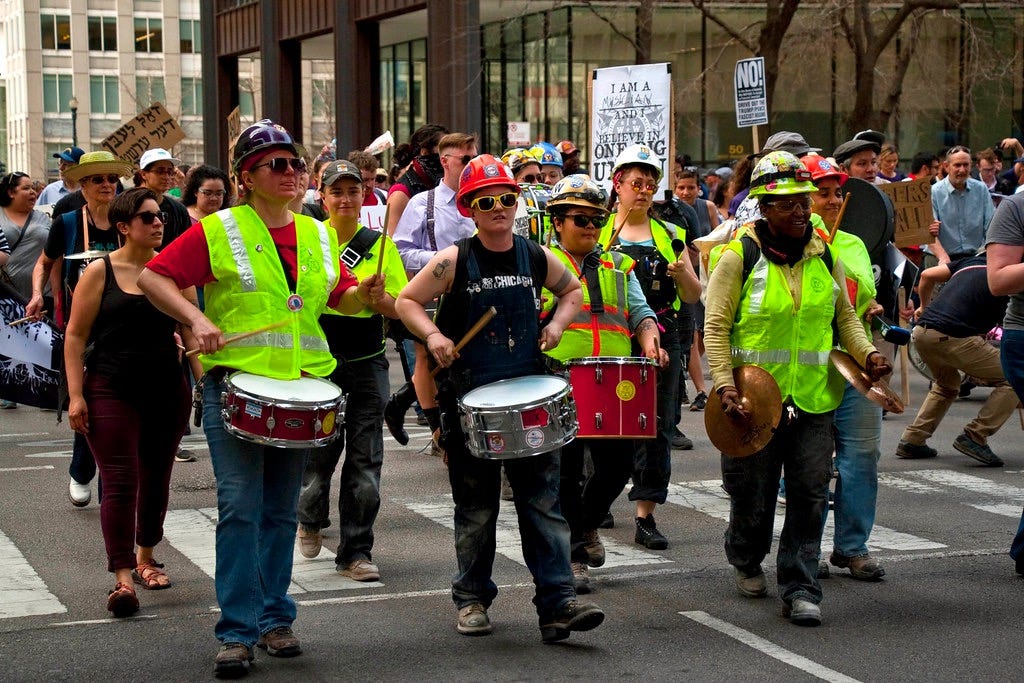
The Democratic Socialists of America (DSA) has had a string of spectacular electoral victories. With success comes greater media attention, growing membership, and new challenges. One of the most important questions is how to build broad unity that can achieve transformative policies. And how do we criticize each other and political allies without falling into sectarian left purism where differences overshadow what we hold in common and disrupt working together?
The specter haunting DSA seems to be the possibility of socialist Congresswoman Alexandria Ocasio-Cortez (AOC) joining the presidential primary. Positions within DSA range from enthusiastic support, to begrudging inevitability, to outright opposition. But the debate over AOC is just the tip of the iceberg. As DSA grows and fields more and more candidates, whom to support will turn into a constant question.
In this article, I want to draw on personal organizing experience that helped develop my ideas on coalition building. This is from my years as a labor activist, first as a steelworker, then as a teacher.
Politics in the Steelworkers Union
I worked at the US Steel South Works mill in Chicago in the late 1970s and early 1980s until deindustrialization hit with full force. At the time I belonged to the October League, a Maoist formation with cadre concentrations in five major mills in the Chicago and Indiana region, and other mills throughout the country.
Ed Sadlowski, a militant leader and head of United Steelworkers Midwest District 31, was running an insurgent campaign for union president. The national union leadership were typical conservative and corrupt bureaucrats. Sadlowski had created a lot of energy and excitement, although he eventually lost the election. But the October League had refused to support him because he wasn’t a “true revolutionary leader.” We defined him as a social democrat, and social democrats had to be exposed and removed so communist leadership could emerge. This type of sectarian and ultra-left purism led to our isolation within the entire militant wing of the union. At the time I was working in a tobacco factory in Louisville, but a year later when I got a job at South Works I saw our organizing efforts were in shambles. Cadre had even stopped going to union meetings, which they called a “circus of opportunists.”
There were about eight different communist organizations at South Works, but only one militant left caucus, which was led by Alice Puerala. Alice was widely respected throughout the mill where she had been working for about 25 years, first as a Socialist Workers Party cadre, and now as an independent leftist. For sectarian reasons none of the eight communist groups were part of her caucus. I joined with her shortly after going to work. We won the next election and she became union president–the only woman president of a basic mill with more than 7,000 workers. I became editor of the union paper, got a fellow cadre to join, and Alice served two terms as president. None of the other groups joined in.
I had some differences with Alice, most practically with her rocky relationship with a new militant Black caucus, with whom we had forged an alliance. And of course we had our feet in different historic left camps, Trotsky and Mao. But we built a solid and warm working relationship based in the fight for better working conditions, a broader anti-corporate militancy, and the need for multi-racial solidarity. These same conditions were present in the Sadlowski campaign, if not for our purism and making red lines over issues that prevented unity. Each of the other communist groups had their own red lines that kept them at arm’s length from Alice, resulting in little to no influence in the union for most of those organizations.
When I look at DSA today with its many caucuses, some with their own red lines when it comes to AOC, I think back to the mill and the difference between being isolated and being effective mass organizers. The key to this was understanding how the majority of steelworkers viewed Alice as a militant leader as opposed to our own narrow view based on categories and issues dear to the Left. Today I see the same disconnect between how millions see AOC and the complaints held dear by some in the DSA. As for the October League, the persistence of ultra-leftism in other areas of organizing eventually led to its demise.
The Faculty Association at DeVry University
After a stint in the Harold Washington administration, I along with others were quickly purged when Daley became mayor. I went on to be a teacher at DeVry University. There had been a faculty association at DeVry that had fallen into hibernation but was being revived, and I decided to run for chair. There were only 50 faculty members and I lost the election by four votes. But the count found our ballot box had been stuffed with more ballots than there were faculty. So, we held the election again and it ended in a 25-to-25 tie.
The humanities department teachers were solidly progressive/Left, while majorities in the other departments were conservative, male, and white. Instead of fighting for Left dominance and splitting the faculty, I went to my opponent (Lowell) and suggested we act as co-chairs. Lowell was an older white engineer living in a small town 40 miles west of Chicago, at the top of the seniority list, and probably a Republican. But we both wanted the faculty to have a stronger organized voice, and we had different goals that didn’t conflict. Lowell wanted by-laws and a more structured faculty association; I was interested in putting out a newsletter focused on working conditions and school issues. We agreed to work together, thereby uniting the faculty.
Unity resulted in a number of important victories. We reduced class sizes, reduced the number of classes faculty had to teach each semester, won sabbaticals, got the administration to expand the library by letting teachers order thousands of new books, and equalized wages between departments, which meant a raise for humanities teachers by thousands of dollars. When the administration met with the faculty, we were able to present a united front and coordinate demands between departments. DeVry Chicago quickly gained a reputation as the most militant campus in the DeVry network, and one that national administrators dreaded to visit.
I was openly known as a leftist and to many a Marxist. An administrator told me they knew I was a communist. But they never succeeded in isolating me or other Left faculty members because we stayed grounded in the concrete demands of teachers and the concerns of students. Left leadership successfully set a tone of confrontation and militancy based on achievable demands that benefited all teachers.
We could have taken the path of defining conservative teachers as our opponents, creating red lines and purity tests, and emphasizing differences. Instead, we built a solid coalition and won significant changes, respect for the Left, and room to bring innovative programs to the school. These included faculty workshops on Freire pedagogy, bringing in Left academics for guest lectures, and engaging anti-war Iraq veterans to speak to students. Among the guest speakers were an expert on LBGTQ history who taught at the University of Chicago, a Black scholar from Lawrence University who had been an important figure in Amiri Baraka’s revolutionary organization in New Jersey, and Bill Ayers, the former SDS and Weatherman leader who now was a respected academic reformer at the University of Illinois.
Coalitions Will Help Us Win
The challenge for the Left is to unite broadly and aim our main blow at the principal enemy. The Left has a sad history of sectarianism towards each other and towards our progressive and liberal allies. We are coming to a period in which the DSA may have the possibility to grow into a mass party of the working class. To do so I believe we must broaden our politics, build our coalitions, avoid abstract slogans, and welcome all friends and allies in the struggle to transform our country.
This is the best manner to popularize our political vision, win people to a socialist platform, and expand our membership. Coalitions don’t undercut our message, they magnify it. We thrive in the soil of mass mobilization and movement building when we stay rooted to the urgent demands of the working class and consciously build our organization.
A version of this article appeared in the Midwest Socialist, September 2, 2026.
Jerry Harris is the national secretary of the Global Studies Association of North America, and on the international board of the Network for Critical Studies of Global Capitalism. His articles have often appeared in Race & Class (London), Science & Society (New York) and International Critical Thought (Beijing). His last book was Global Capitalism and the Crisis of Democracy. His work has been translated to Chinese, Spanish, Portuguese, German, Czech, and Slovak.
Well done, Jerry. Early in the OL, when we posed ultraleftism as the main danger, we had a decent approach to union reformers and others in civil society. But when the line flipped, it was as you describe. Kudos to your work with Alice in steel and the DeYry faculty. Your experiences helped in founding a lasting organization, the GSA, which is much needed.
Jerry, accurate and important analysis. Keep fighting. Larry Miller