


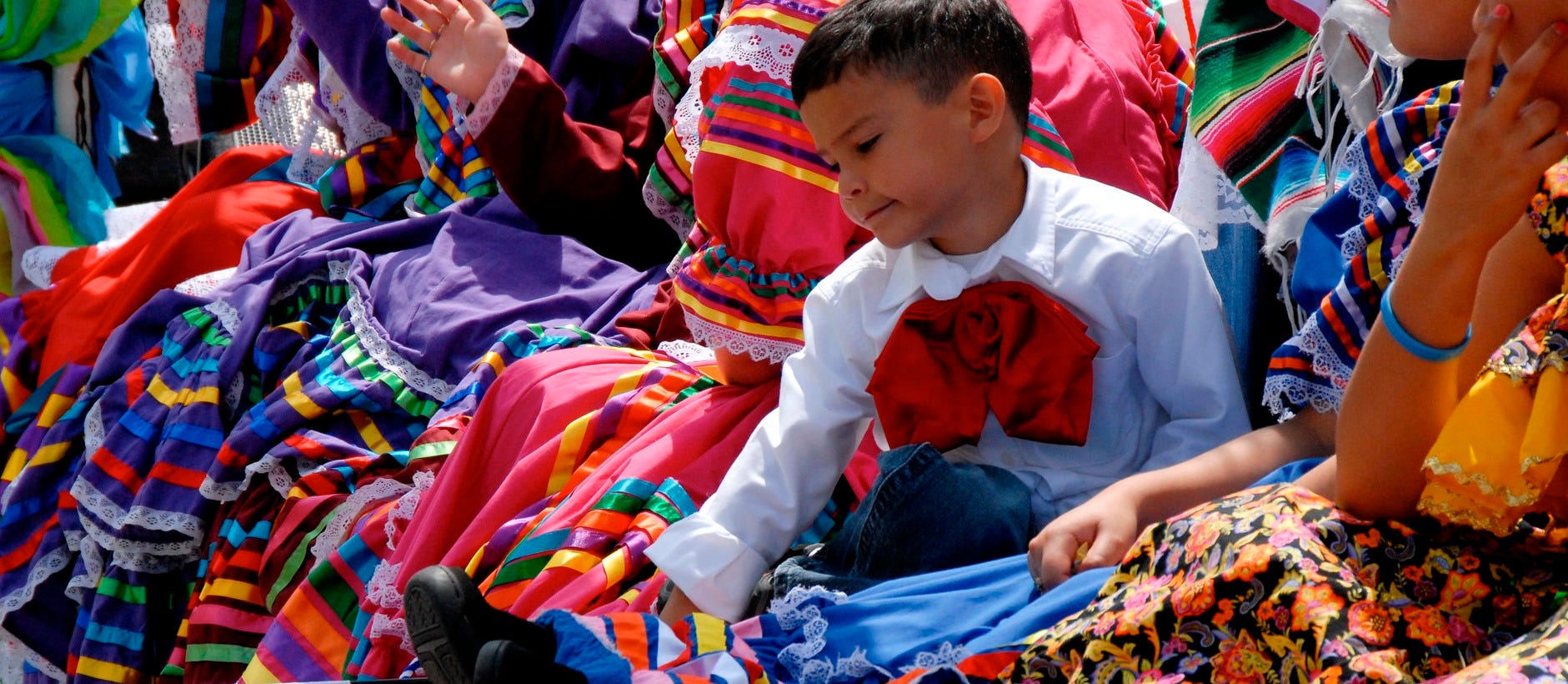
The celebration of Cinco de Mayo in the US was a product of the Chicano demand for the teaching of the true history of this country. The celebration of this holiday was a reluctant concession of the white power structure, especially in the Southwestern US. But of course, like racial capitalism always does, the power structure has since done all it can to deform the holiday’s true meaning, to commercialize it, and to strip the holiday of the very historical significance it was meant to commemorate.
Despite this, its celebration remains a victory of the Chicano Freedom struggle, with deep significance for the Black freedom struggle and for the fights of all oppressed peoples in the US. As leftists, we must lift up and share the revolutionary significance of Cinco de Mayo.
In that spirit, we publish two poems by comrades Bill Gallegos and Joe Navarro and a reflection by Bill Fletcher on the significance of this holiday to the Black freedom struggle.
Our Hearts Sing Freedom: La Gloria de Cinco de Mayo
By Bill Gallegos
Cada Cinco de Mayo … Brown hands hurriedly cutting/backs bent/skin scorched/dignity resting lightly on shovel.

         El Aguila/flowing in an arc de Resistencia —
piercing the seamless skies of Aztlan.

         We are not the spoils of conquest/not meant to be chained/our bodies broken for CoolRay tycoons, drinking our life’s blood/on the fringes of ClubMed.

           We are the children of Cuahtemoc/
creators of awe and wonder/visionaries/life givers …
desert artists singing sacred song.

You cannot defeat us — racists with bibles and guns!

         También, we are the children of Puebla/souls fired like
diamonds struck hard by the oppressive hands of decay/and a greed
         untouched by the tender stroke of humanity.

You cannot defeat us/our veins run with the blood
of struggle/and a blessed fire. Our hearts sing
a freedom song/even in the deathly cold and silence of your prisons.

         Simón!! We are the children of Zaragoza, of Juarez, and Villa,
of Zapata, Flores-Magón and Tennyuca/… soldadadas valientes de Cortina/

         We are Mano Negra and Brown Berets/Mothers of East LA Streets.
We are your worst nightmare — the true Calawala cabrónes.

For reals — we are the true Sueño de Las Américas
Cinco de Mayo and the Black Freedom Struggle
By Bill Fletcher
For Black America, Cinco de Mayo needs to be seen as a day to celebrate a war of resistance against a colonial power that was, de facto, allied with the Confederacy and a day to celebrate an abolitionist state which welcomed many of our ancestors and "blood."
Much of the Black Left embraces Cinco de Mayo as an important revolutionary holiday. Much of Black America, however, while increasingly recognizing the holiday, does not necessarily see its significance for the Black American experience.
We need to change the narrative, and there is a particular and timely reason to do so: the rise of the New Confederacy in the US.
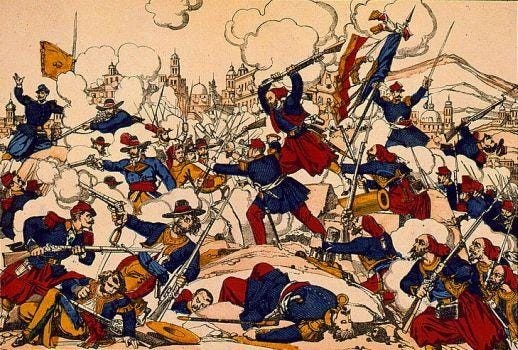
Cinco de Mayo celebrates the Mexican defeat of French colonial forces in the battle of Puebla. The French, under Napoleon III, chose to take advantage of the US Civil War in order to re-establish a Western Hemispheric empire through invading Mexico and establishing a puppet state. Though French forces were routed at Puebla—a rout interestingly commemorated by the French Foreign Legion—they ultimately defeated the republican government of Benito Juarez. This began a five-year guerrilla war of the "Juaristas" against the French and their Mexican collaborators, a war resulting in the defeat of the French and their puppet government of "Emperor" Maximilian.
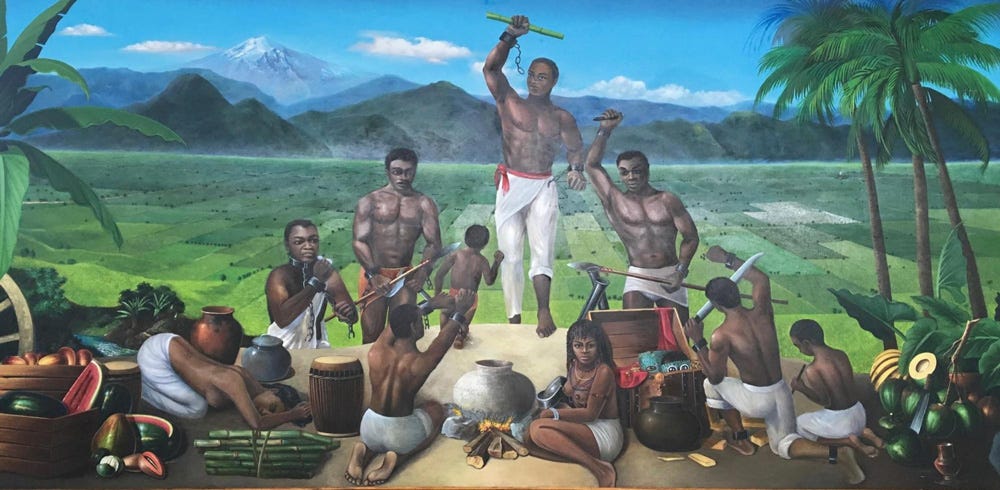
Thus, Cinco de Mayo is about resistance, celebrating the efforts to re-establish a sovereign, democratic, republican government in Mexico. But In a moment where nativism has even affected portions of Black America, It has an additional significance. Iit is noteworthy that when Mexico broke free of Spanish colonial rule, in1821, efforts to eliminate slavery were undertaken, ultimately taking the form of the Guerrero Decree, named after then president of Mexico, Vicente Guerrero. Guerrero, by the way, was a Mexican of African descent.
The end of slavery in Mexico had a critical place in the future of the US. Africans began escaping from slavery and crossing into Mexico, where they were welcomed. Some of those runaways had been part of the Seminole Nation in Florida who, after having been expelled by the US from Florida, sought refuge in Mexico. Other Africans were those who were able to break free from various forms of bondage and make it to safety. An excellent exhibit currently showing at Denver’s Museo de las Americas speaks to some of the African experience in Mexico: titled “AfroMexican Journey: Yanga, Slavery, and Freedom,” it is open until Juneteenth.
The fact that Mexico abolished slavery created a problem for white US settlers who had been generously permitted to relocate to what we today know as the state of Texas (Tejas). The desire to ensure slavery in Texas became one of the causes around which white settlers united leading to an uprising in 1836 against the Mexican government. This uprising resulted in the proclamation of the Texas Republic and, ultimately, the US war of aggression against Mexico.
The symbolic significance of freedom for Africans in Mexico has been largely lost from African American history, let alone the history of US/Mexican relations. The fact that Mexico welcomed Africans should never be forgotten.
This said, the African experience in Mexico has, at least until recent times, been complicated. Although more than 200,000 Africans were brought to Mexico during the Spanish colonial period as slaves, the African experience was largely ignored in the Mexican narrative until only the last few decades. Benito Juarez, himself of both European and Indigenous ancestry, took the lead in identifying the significance of the Indigenous heritage of Mexico, and identifying Mexico as a "mestizo" nation-state. The problem was that his recognition of “mestizaje” failed to acknowledge the African blood flowing through the veins of Mexico. This resulted in an entire heritage appearing to be nonexistent. In the recent past, there have been significant efforts within Mexico to reclaim its African heritage, including that which resulted from those who escaped slavery in the US.
Despite the unevenness of the African experience in post-1867 Mexico (after the expulsion of the French), the reality that Mexico was an abolitionist state which welcomed African refugees—what some people would call immigrants—should not be lost on Black America. The African runaways/refugees were not going to Mexico to displace anyone. They were seeking freedom from the vicious racist oppression found in slavery.
Today more than ever, it is important to reclaim this history. As Trump works to stoke anti-immigrant sentiment, including within the Black community, Cinco de Mayo points to the deep interconnection of the Mexicano, Chicano, and Black freedom struggles. Indeed, there are deep parallels between that historical period and today, when right-wing forces in the United States seek to replace multiracial democracy with a New Confederacy, while across the border Mexican President Claudia Sheinbaum deepens a process of social transformation begun under her predecessor, Andrés Manuel López Obrador.
Cinco de Mayo should not be viewed merely as a "Mexican holiday," or a cute cultural affair. For Black America, Cinco de Mayo needs to be seen as a day to celebrate a war of resistance against a colonial power that was, de facto, allied with the Confederacy and a day to celebrate an abolitionist state which welcomed many of our ancestors and "blood."
When Did Cinco de Mayo Become Cinco de Money Or Cerveza de Mayo?
By Joe Navarro
When did Cinco de Mayo
Become
Cinco de Money?…
Or
Cerveza de Mayo?
Cinco de Mayo,
La Batalla de Puebla
The defeat of French
Colonialism in Mexico
To celebrate Mexico’s
First full-blooded Zapotec Indian
President, Benito Juárez
And popular uprizing
Of humble
Campesinos and obreros
Rising up against
The imperial army
Of Napoleon

When did Cinco de Mayo
Become
Cinco de Money
Or
Cerveza de Mayo?
Instead of a time
To celebrate the
Revolutionary achievements
Of Mexicanas y Mexicanos
And their glorious
Tradiciones de resistencia
And their ambitions
For libertad, autodeterminación
Y liberación

When did Cinco de Mayo
Become
Cinco de Money
Or
Cerveza de Mayo?
A drunk fest
A Green, white and red
Corporate day to
Get America drunk enough
To forget injustice,
Inequality and national oppression
A day of belligerence
Chile, beans, encheritos,
And Chihuahuas
Muchos stereotypes and
Fiestas de ignorancia

When did Cinco de Mayo
Become
Cinco de Money
Or
Cerveza de Mayo?
When did the connection
Between Mexico’s lucha
Por la independencia
Become severed from
La Raza, viviendo en el ábdomen
Of U.S. Imperialism
Luchando por la justicia
Igualdad y autodeterminación?
When did it stop being
A celebration of la gente
To honor activists and martyrs
For the cause of social justice?
When did it cease to be
Una celebración de la lucha,
Las tradiciones y la cultura
De nuestra gente?

When did Cinco de Mayo
Become
Cinco de Money
or
Cerveza de Mayo?
When corporations poured
Milliones de dólores y
Milliones de cervezas
To intoxicate La Raza
Y toda la gente enough
To forget what’s important
Pero los ideales del
Cinco de Mayo siguen
The ideals continue
To thrive in the hearts
And minds of la gente,
The people who remain
Politically sober, unaffected
By the flow of money and beer
As they celebrate
Cinco de Mayo,
A celebration of independence,
Self-determination and pride

¡Qué viva el Cinco de Mayo!
¡Qué viva Benito Juárez!
¡Qué viva la independencia de México!
¡Qué viva la autodeterminación de La Raza!
Joe Navarro is a longtime Chicano Liberation activist, a poet and creative writer, and a former public school educator.

