

by Peter Shapiro
I first visited New York back in the early 1970s. A native Californian, I was astonished at the extremes of wealth and poverty in the Big Apple. Rich people flaunted their wealth in a way that would be considered bad taste on the Pacific coast: women in mink being helped out of limousines by uniformed chauffeurs and escorted into lavish apartment buildings by uniformed doormen. Half a block away, people were getting their meals out of dumpsters.
Returning home, I reached out to a friend who had grown up in New York. “I don’t get it,” I said. “You’ve got people who are ostentatiously rich and people who are destitute, jammed together cheek to jowl on that tiny little island. Why don‘t they kill each other?”
My friend looked at me in surprise. “They do kill each other,” she said.
Today New York has a socialist mayor who rode into office on a wave of anger over income inequality. And “egalitarian” California is home to gentlemen whose fortunes make those Park Avenue dowagers of yesteryear look like paupers.
At last count California had 246 billionaires, about a third of the nation’s total. Their collective worth was over $2 trillion—roughly half the state’s gross domestic product. Over the last three years, their wealth has increased by an average of 158 percent.
Last year, their share of the income tax revenue collected by the state was two and a half percent.
Much of their assets are beyond the reach of the tax collector—investments, stocks and bonds, private equity. Such things don’t count as income unless they’re liquidated or sold. Other sources of revenue for the state, sales and excise taxes, fall most heavily on those least able to pay.
Local property taxes are supposed to fund public schools, but Proposition 13, an ill-considered “tax reform” that passed back in 1978, sharply limits how much can be collected, so the state assumes much of the burden.
So it is that California, which boasts the world’s fourth largest economy, still struggles to pay for its public schools, charges exorbitant tuition at its public universities, and sees hospitals and community clinics closing or drastically curtailing services as federal funding dries up. One way or another, legislative debates and campaigns for public office boil down to arguments over how to divide up a pie that never seems quite big enough to feed everyone.
Propositions 3 and 40: Putting the Brakes on Cutbacks
The electoral arena can be tough to navigate. There are tactical alliances to negotiate, struggles to define the key issues and keep them front and center, debates about candidates’ “electability,” honest questions about how they’d function once in office. If your strategic goals aren’t completely clear, it’s easy to lose your bearings.
When the issue is taxes, though, it’s a lot easier to size up the terrain. Competing interests break down neatly along class lines, much as they would in a shop floor struggle. It may take expertise to draft tax laws or even just understand how they work. But you don’t have to be an economist or a policy wonk to see how they play out in real life—any more than you need to study company balance sheets to know they’re not paying you enough to live on.
After nearly half a century, California is still feeling the effects of Proposition 13. Placed on the ballot when the state legislature couldn’t agree on needed tax relief for homeowners, it was written to benefit mainly business, whose overall share of property tax revenue shrank by nearly half. For public schools, it was a catastrophe: an education system that was once the pride of the nation sank to the bottom in state rankings.
Proposition 13 also barred the state legislature from tapping new sources of revenue without a two-thirds vote. It thus fell to the voters, through the ballot initiative process, to do damage control. A constitutional amendment was passed that required a minimum level of state funding for K-12 education and community colleges; it helped, but it wasn’t enough. A subsequent ballot measure, pushed through by the California Teachers Association, imposed a temporary tax on the top 2% of income tax brackets. That tax, earmarked mainly for schools, is due to expire in two years; a new measure on the November ballot, Proposition 3, would make it permanent. If it fails, public education will confront yet another funding crisis.
On top of California’s ongoing struggle to pay for its kids’ education, Donald Trump’s Big Bad Budget bill, HR-1, now threatens to play havoc with its health care. When HR-1 kicks in next year, the state will lose $100 billion in federal subsidies for health insurance premiums, the Children’s Health Insurance Program, and matching funds for MediCal (California’s version of Medicaid). In anticipation of the lost revenue, health insurers have dramatically increased their premiums and half the community clinics in Los Angeles County have closed their doors. Hospitals that rely on federal Medicaid dollars to keep operating are threatening to shut down or drastically curtail services. One hospital in the Sacramento Valley has already closed, forcing local residents to drive 40 minutes to the nearest emergency room.
One in five Californians, and fully half the state’s children, are on MediCal, but the cuts will fall most heavily on California’s 11 million immigrants. Two years ago, California became the first state in the nation to grant MediCal eligibility without regard to immigration status. This was a major victory, and it did not happen overnight: it took a protracted, step-by-step struggle to extend state funds to cover those denied access by the feds—first immigrant children, then Dreamers, finally all state residents, whether “legal” or not.
With the passage of HR-1, the state started walking back its commitment. California now bars any new enrollment in MediCal for undocumented adults. Those already enrolled must pay a $30 monthly premium. Even one missed payment gets you dropped from the program, with no opportunity to reenroll. In fact, leaving the program for any reason, even temporary, means you can’t get back in. Those who remain enrolled must now pay out of pocket for dental care.
All told, once HR-1 takes effect, as many as 3 million Californians could be kicked off MediCal, another half million will lose their Obamacare subsidies, and an estimated 145,000 health care workers will lose their jobs. The California Medical Association calls it a catastrophe in the making.
The situation confirms something health care activists have known for a while: our jerry-built, market-driven health care system requires major infusions of our tax dollars to keep it afloat. Unfortunately, when the bulk of a state’s wealth is tied up in the hands of a few people and is largely exempt from taxation, there is constant pressure to throw more people overboard.
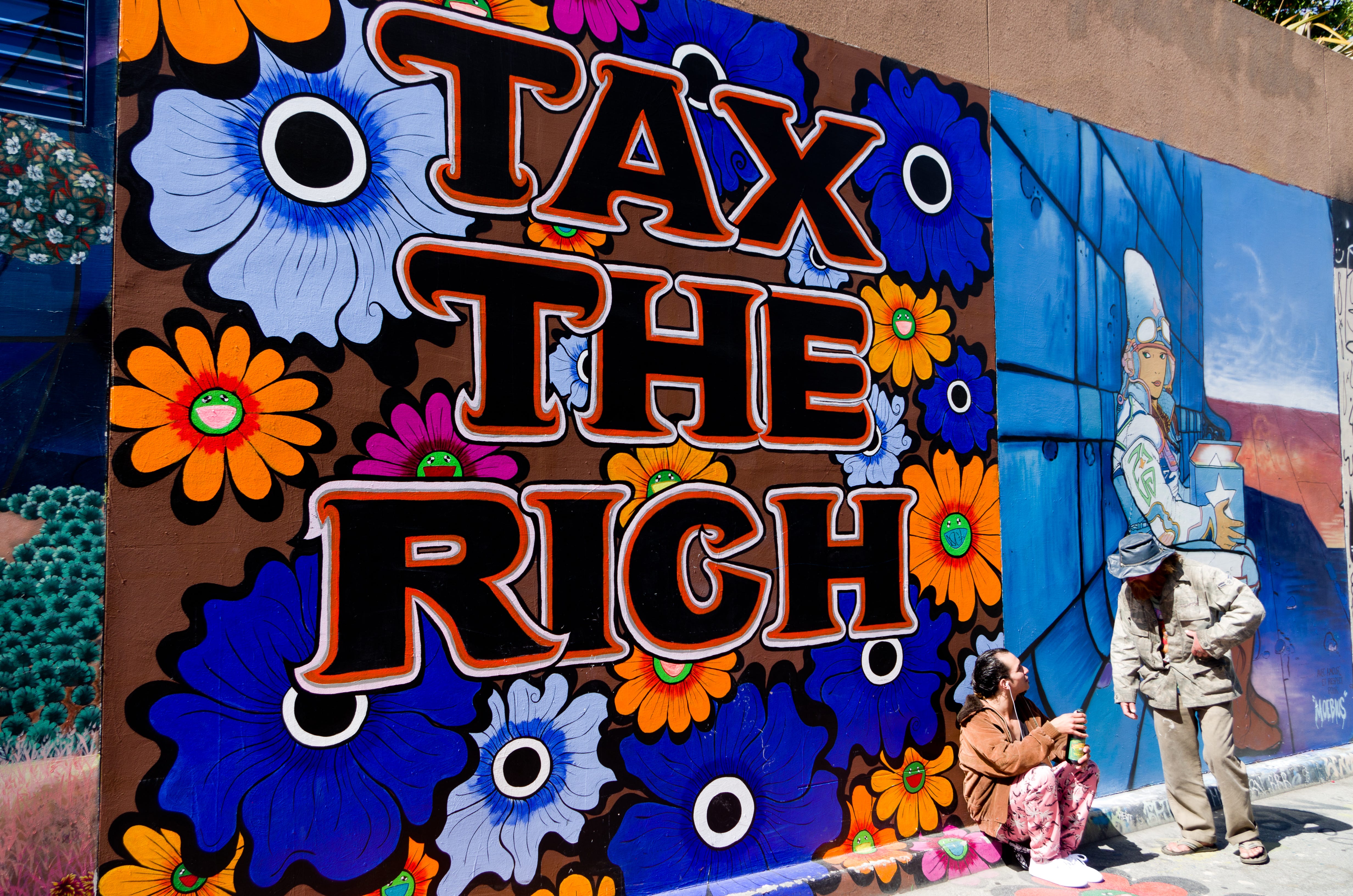
Besides Proposition 3, there is a second “tax the rich measure” on California’s November ballot. Proposition 40, drafted by a UC Berkeley economist who is an expert on inequality, is a one-time 5% wealth tax on the state’s billionaires, calculated to raise just enough money to make up for federal cuts to MediCal. Note that it is a tax on wealth, rather than income—meaning that Mark Zuckerberg, whose paycheck as CEO of Facebook is exactly one dollar, would have to make a one-time payment of $10 billion on his estimated net worth of $200 billion.
Proposition 40 has attracted some extraordinarily well-funded opposition. Google CEO Sergey Brin has already spent over $100 million to defeat it. California voters have been bombarded for weeks with TV ads, online messaging, and mailers warning them that their home equity, savings, and retirement accounts are in jeopardy, and the government will have “sweeping new audit power over every taxpayer” if the measure passes. In short, says the opposition, a tax on a handful of uber-rich is really targeting everybody.
The implicit message here is that there’s an identity of interests between the billionaires and the rest of us. Made explicit, this message would be a very tough sell. The truth is that, while tax laws have always tended to privilege the haves over the have-nots, this tendency has become so pronounced since Ronald Reagan occupied the White House that it amounts to outright class robbery. One way or another over the years, every tax cut for the rich has come out of the hides of everybody else.
The Challenge of Public Disinvestment
Back in the 1930s, when US capitalism seemed on the verge of collapse, the federal government embraced the idea that the best way to get the economy back on its feet was to put more purchasing power in the hands of ordinary people. One way to accomplish this was to make it easier for workers to join unions—which they did, through what amounted to one of the great social movements in our country’s history.
The other was through public investment—government spending on programs that put more money in the hands of consumers, thereby generating more business for capital. Though this approach is no longer in favor, there’s at least one recent example. When the Affordable Care Act passed, health insurance had become so expensive that many people could no longer afford it. It was a vicious circle: the more people who lost their coverage, the higher the premiums for those who kept theirs—until many of them could no longer afford it either.
Obamacare addressed the problem with premium subsidies for people who were struggling to pay for their health insurance. It provided access to care for millions who would have otherwise gone without. But it also served as a $12 billion handout to an industry whose drive to sustain its profits was actually destroying its market.
In our indignation over corporate greed, we sometimes forget that capitalism is fundamentally irrational. However calculating and ruthless its behavior, big business often requires some form of government intervention to curb its self-destructive tendencies or at least compensate for them. That’s why even the most enlightened and necessary public investments often involve a sizable payoff to capital.
By and large, though, the name of the game today is public disinvestment. From your local city council to the state house and all the way up to the White House, everything from Medicare to prisons is being handed over to private investors, turning public functions into sources of private profit.
Instead of bolstering the economy with public subsidies, the government uses generous tax breaks to encourage investment, on the theory that the benefits will eventually trickle down to the rest of us. What actually happens: needed services are cut back because “we can’t afford them,” while the tax burden increasingly falls on those less able to pay. Politicians’ promises of tax relief are often accompanied by attacks on public employees, whose unions are blamed for the budget crunch plaguing state and local governments.
During World War II and even more so during the Cold War, California benefitted enormously from federal largesse. Much of it went for military spending—aerospace, shipyards, and, increasingly, national defense-related research and development grants for solid-state electronics, aeronautics and space, computers and systems analysis. Stanford University became the hub of a huge defense-electronics juggernaut that embodied President Eisenhower’s oft-quoted warning about the “military industrial complex.”
Today, the surrounding region—Silicon Valley—is generating the kind of profits that no government handouts could possibly match. Still, the tax dollars keep rolling in. During Trump’s second term, Palantir’s surveillance technology has attracted close to $1 billion in contracts from the Defense Department and Homeland Security. NASA subsidizes Elon Musk’s forays into outer space. Musk and Palantir founder Peter Thiel, who mentored Vice President J.D. Vance and jump-started his political career, are among the loudest voices against Proposition 40.
An earlier generation of defense industry entrepreneurs was willing to tolerate high marginal income tax rates to keep the federal gravy train running. Today’s high-tech moguls treat their federal handouts almost as an entitlement. Their libertarian rhetoric, with its fulminations against “big government,” sounds strangely incongruous in the face of their undiminished appetite for government subsidies and their increasingly chummy relationship with the most authoritarian administration ever to occupy the Oval Office.
More often than not, decisions about public finance and government spending are made in ways that benefit the rich. But at least they provide an arena where working people can fight for government policies that address their needs and curb the power of business. When the government downsizes, they lose not only needed services but also political leverage needed to effectively defend their own interests. Budget constraints are used against every attempt to win concessions from the state, and popular movements that need to work together to win are reduced to fighting over crumbs.
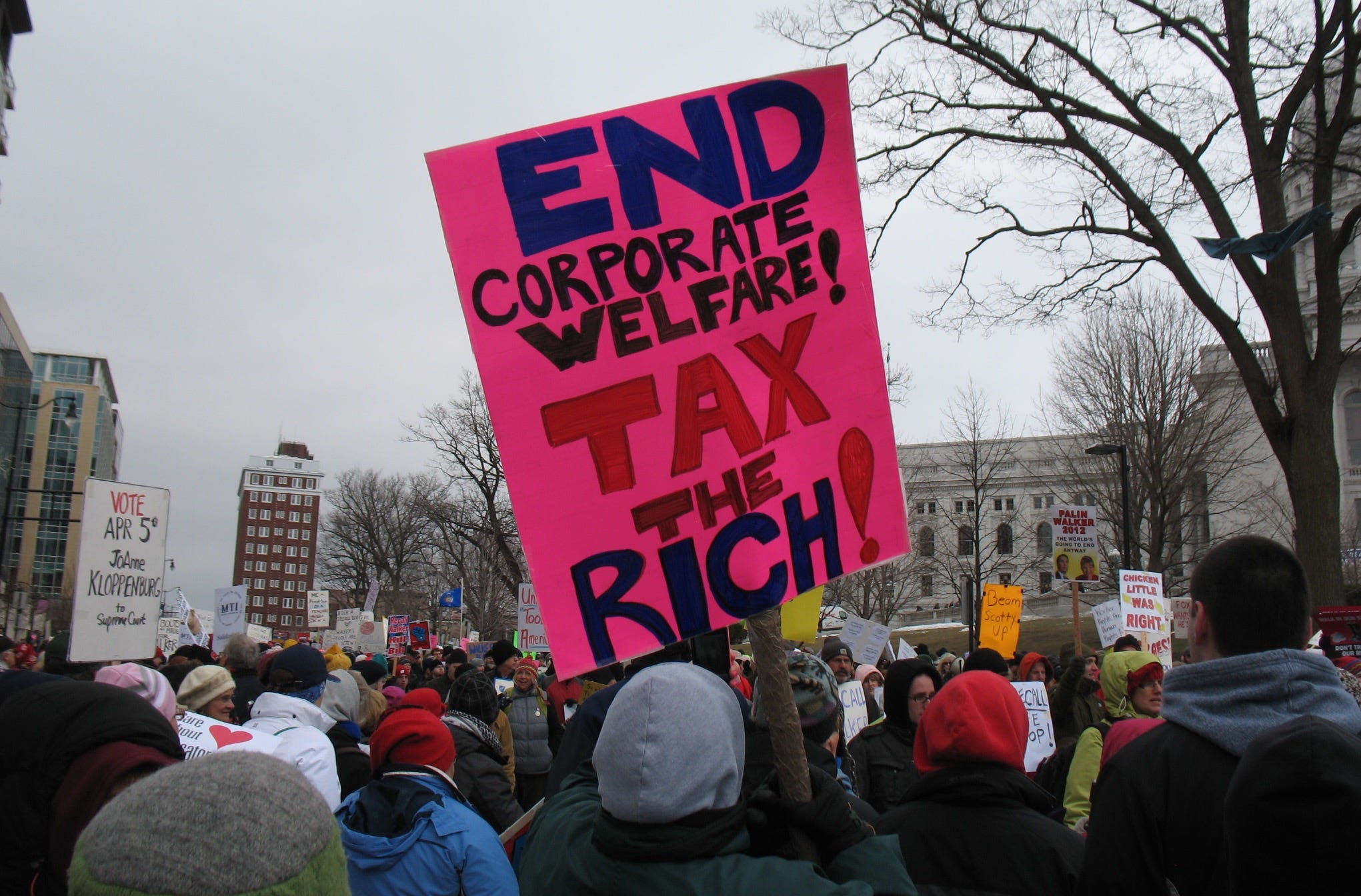
Forty years of neoliberal “small government” policies have given us the kind of extreme economic inequality that has no precedent in this country’s history. Right now, demands to “tax the rich” are perhaps the best way to challenge it. If the California measures fail, the social costs will be enormous. If they succeed, they should raise the struggle to a higher level.
Peter Shapiro has been a health care activist ever since 2009, when he represented his union at the founding conference of the Labor Campaign for Single Payer. He is active in the California DSA Tax the Rich Working Group.
Outstanding piece, Peter! Thank you for doing such a great job grounding the class struggle in clear language.