


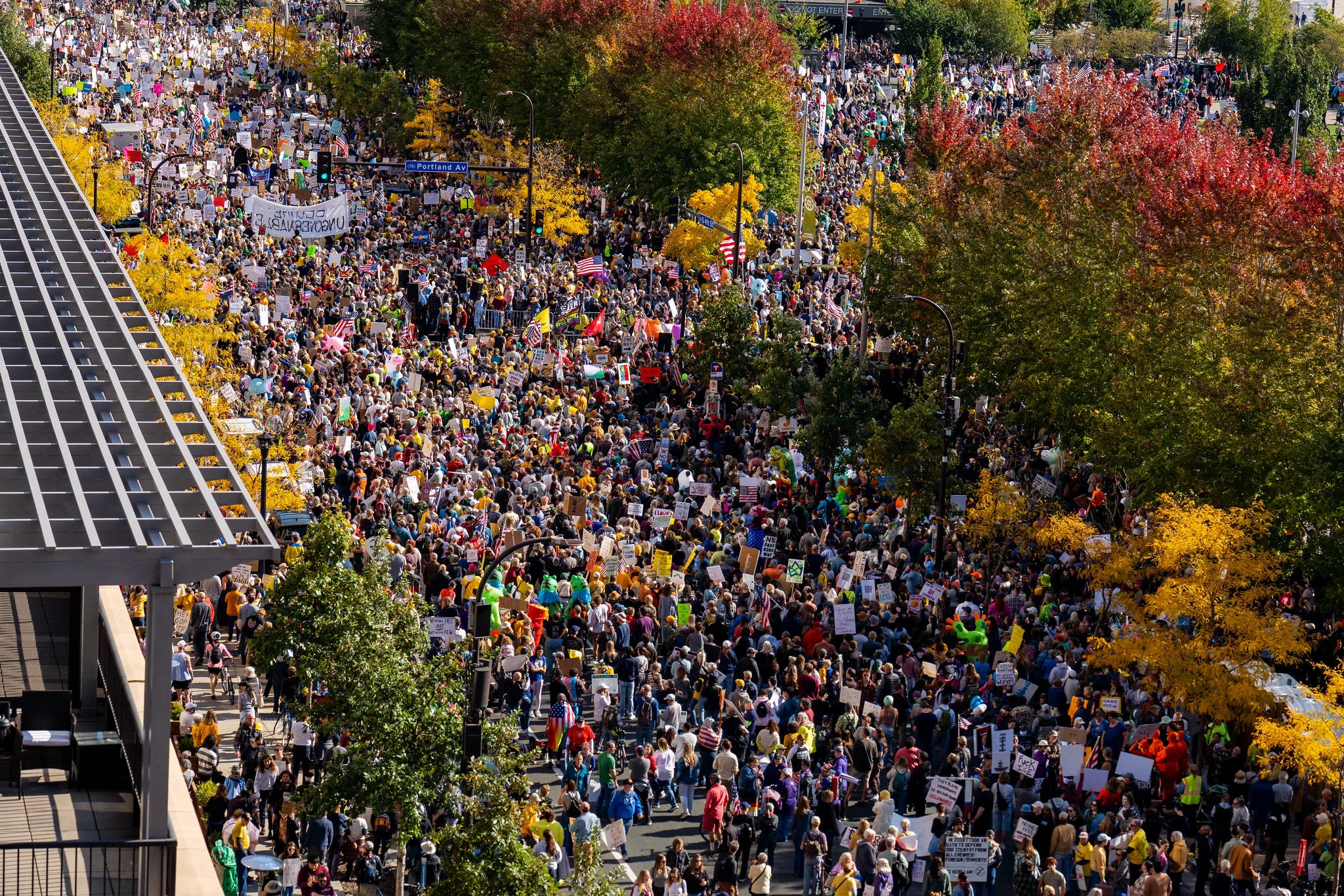
It appears that the citizen outpouring of rage and discontent over Trump’s autocratic actions resulted in over 2,500 No Kings protests and assemblies on October 18th. Estimates place the total attendance at 7 million, much higher than the previous No Kings day in June. Turnout amounted to about 2% of the US population, nothing to scoff at, but certainly not the 3.5% that Harvard professor Erica Chenoweth says is the boiling point indicator of overwhelming civic dissent.
While the American “No Kings” actions had some participation by US labor councils in areas like the Bay Area and New York City, from a national perspective union participation was anemic. Labor has not been in leadership of the anti-authoritarian front, despite the Trump administration’s aggressive union-busting and dismantling of labor-regulating agencies.
Contrast US labor’s anemic presence to the historic role played by Italian labor in recent uprisings and national actions there for Palestine. On Friday, October 3rd—a workday, in contrast to the weekend protests in the US—an estimated 2 million Italians flooded the streets up and down the Mediterranean boot. This is about 3% of the population—more than the US number, though still not surpassing the Chenoweth threshold.
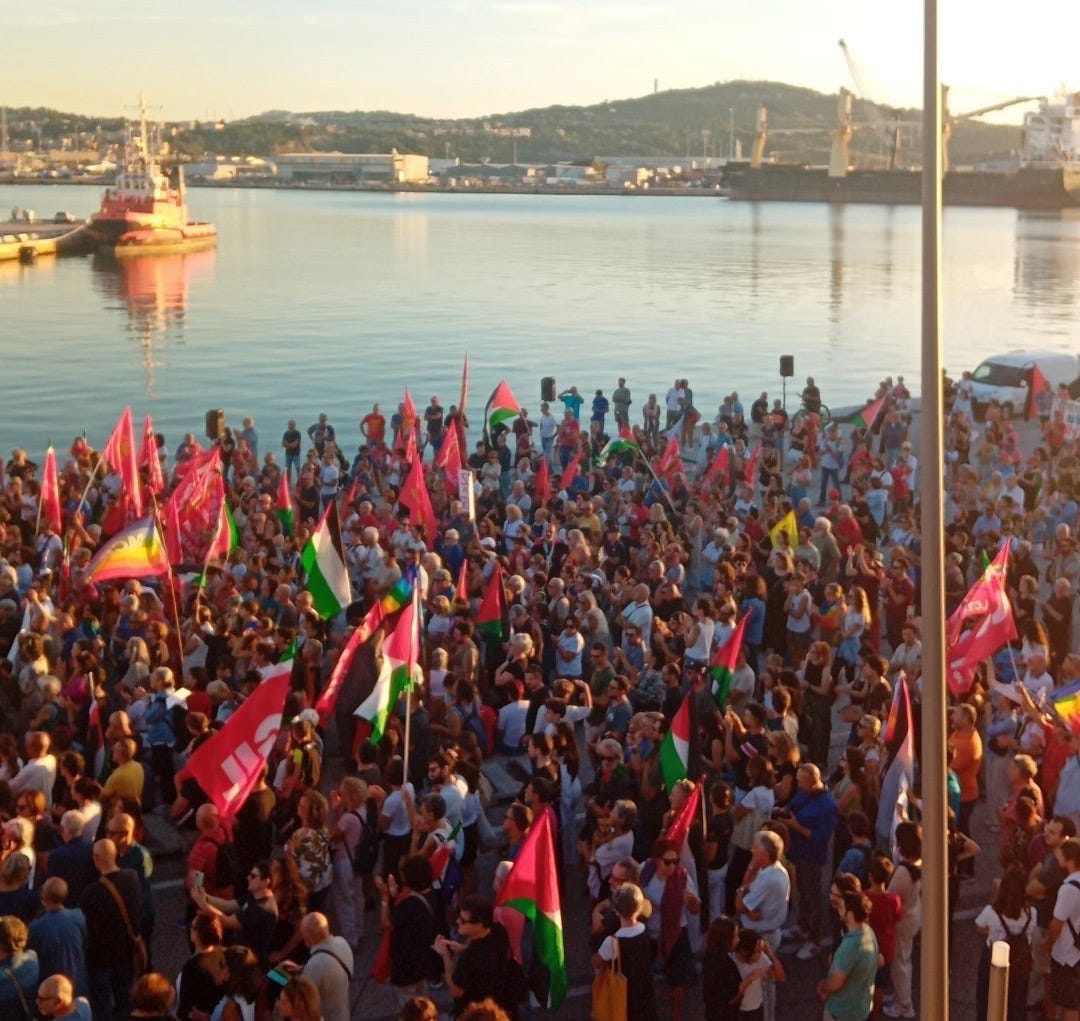
However, the cardinal difference between the two countries is that the Friday, October 3rd action included a national strike called by the largest union confederation in Italy, the Confederazione Generale Italiana di Lavoratori (CGIL). There was also important participation by the Unioni Sindicati di Base (UBS), which have particular strength in the Port of Genova, the largest Italian port. Their agitation and constant action over Gaza and their intermittent protests helped to fuel the profile of the struggle and exerted pressure on the larger national confederation to act.
The immediate impetus for the strike was the attack on and arrest of Italian participants in the freedom flotilla seeking to deliver humanitarian aid to Gaza, some of whom were members of the Italian parliament. This outrageous act fueled the call by CGIL for a general strike.
As a result of the national strike call, Italy’s two-million strong street mobilization was combined with coordinated work stoppages in key sectors including shipping, transportation, and education. The fusion of union-led efforts with widespread street mobilization catalyzed a disruptive capacity beyond what any single group could have achieved in isolation. As one participant noted: “There was enormous and truly diverse participation: teachers bringing entire classes, high school students, people of all ages. All sectors joined the strike, including freelancers—psychologists, architects, etc.—and not just unionized workers.”
The Italian legacy of the political strike
It is helpful to take a dive into Italian history to understand the phenomenon and tradition of political strikes. Therein may lie some important lessons for US left-wing organizers inside and outside the labor movement.
Under fascism in Italy, from 1923 until liberation and Mussolini’s execution in 1945, there was one labor federation, with compulsory membership for all workers under their national agreements. In fact when I explain our labor law in the US that provides for unitary representation in a corporation or workplace, my Italian comrades exclaim, “Ma Pietro questi sono sindacati fascisti (But Peter, these are fascist unions!)” And herein lies a great difference.
Soon after Italy emerged from fascism the labor world saw the formation of three major national confederations representing workers in sectoral national agreements covering 13 major sectors of the economy. Membership in any one workplace was voluntary but each of the national federations was tied to one of the three major postwar parties. The CGILthe largest then and today)was tied to the Italian Communist Party; theUnione Italiana del Lavoro (UIL) to the Socialist Party; and the Confederazione Italiana Sindacati Lavoratori (CISL) to the Christian Democrats.1 In individual workplaces there was—and is—the opportunity to elect members to the Rappresentanze Sindacali Unitarie (RSU), which has responsibility for dealing with local issues not dealt with in national agreements. Today none of the iconic Italian political parties remain, but the labor confederations do, and while they often bargain together, they sometimes sign separate sectoral deals. The bottom line is that workers join unions voluntarily and participate often in RSUs. National union density or level of membership is 25%, more than double that in the US, but Italian labor agreements cover 83% of the workforce!
The structure of post-war Italy’s labor confederations gave birth to a long tradition of national strikes over political issues. For instance in 1960, Italy’s ruling Christian Democrats formed a center right government allying with fascists in parliament. The left-led labor movement engaged in massive strikes that toppled the “Tambroni” government in five months. In the Italian “hot autumn” of 1969, a series of workplace actions ultimately led to a general strike involving more than half of the Italian workforce, alongside students, housewives, migrant workers and other social sectors, which secured big new government investments in pensions, education, and affordable housing.
Italy’s October 3rd strike for Gaza, while of a size and scale not seen in years, thus draws on a long legacy of political strikes, organized by large coalitions that both include and extend beyond organized labor, that articulate social and political demands for the class as a whole.
US Labor’s “Bella Ciao” moment?
In contrast to Italy, the United States does not have a tradition of political strikes in the post-war period. While such strikes on the municipal level were part of the militant labor movement of the 1930s (San Francisco and Minneapolis for example), the 1947 Taft-Hartley Act explicitly outlawed “solidarity” strikes, as part of a broader process of both repression and appeasement.
In recent years, the concept of the general strike has seen a resurgence in US discourse. Many have been inspired by the call from United Auto Workers’ President Shaun Fain for US unions to align their labor contracts to expire in May of 2028 to coincide with the expiration of the UAW’s master agreement. The concept is that this would enable a national strike against the billionaires.
This is certainly a laudable goal—and kudos to Fain—but 2028 is a long way off and the urgency of blocking Trump’s authoritarianism is a task that must happen now. Fain has had less to say about that task, presumably for fear of alienating the significant portion of the UAW’s membership who voted for Trump. But general strikes, by their very nature, must be willing to step beyond an ostensibly “apolitical” focus on contracts to articulate a broader set of demands for the class as a whole that are, by their very nature, political. With millions of members under attack, unions have a big role to play in nurturing and supporting militant action and puncturing the narrative that Trump’s actions are supported by working people.
By shouldering the fight against 1930s fascism, the Italian left was able to win broad legitimacy in the working class—a legitimacy that persists to this day in the legacy of the political strike. As we face a new threat of rising fascism, US labor must learn this lesson.
Could this be labor’s “Bella Ciao” moment in the US? The anthem of the anti-fascist fight celebrates the role of partisan fighters in defeating Nazi fascism. The active participation of unions in No Kings and the defense of immigrant workers would heighten their power and build a stronger left union presence in the US. Bella Ciao/Block and Build!
1 The CGIL was the sole national union federation that emerged in 1944 as the replacement and opposition for the fascist corporatist unions. As part of the cold war both UIL and CISL were chartered in 1950.
Peter Olney is the retired Organizing Director of the International Longshore and Warehouse Union (ILWU). He has been a labor organizer for 50 years in Massachusetts and California, and worked for multiple unions before landing at the ILWU in 1997. For three years he was the Associate Director of the Institute for Labor and Employment at the University of California. He co-edited (with Glenn Perušek) John Womack’s Labor Power and Strategy (PM Press, 2023).
Addendum: Response from Leopoldo Tartaglia
After publication, The New Liberator received the following clarifications from Italian trade unionist Leopoldo Tartaglia, which we are appending at the request of the article’s author.
The article “Block Build and Bella Ciao” is a generally accurate description of the Italian situation. I would however add the following:
Since the mid ‘80s—as result of the relative weakness of the unions—there has been a law in effect governing strikes, with many limitations on the sectors involved, time limits, and nature and scope of the strikes, especially when it involves a national industrial action and/or a national general strike.
In fact the National Commission for Strike Regulation is now opening a case against CGIL arguing that the general strike of October 3 was unlawful.
The relationship among the 3 main Confederations—CGIL, CISL, UIL—is at a very low level, maybe worse than at the beginning of the century (when Silvio Berlusconi was in charge). CISL is clearly linked to the right wing Fratelli d’Italia Meloni government—the previous CISL Secretary General G Sbarra became a member of the government, in charge of policy for Southern Italy. The UIL in the last two or three years stood with CGIL in calling general strikes in 2023 and 2024 against the budgetary law, but this time refused to mobilize and call a strike on Gaza and Palestine and gave a different response to the new budgetary law, while CGIL organized the October 25th national demonstration in Roma (about 200.000 participants) against it.
Although there is not the same level of repression as that of the Trump administration, nevertheless in Italy the right wing government, lead by the neofascist Giorgia Meloni, is approving bills and rules that increase penalties and repression against the social movements and immigrants.
On that front, while clearly denouncing these kind of policies, until now the reaction of the CGIL has been very weak in terms of national mobilizations and strikes (So far no general strikes to defend immigrant workers. ).
—Leopoldo Tartaglia

Fantastic food for thought — it’s both simple and complex. Unfortunately, the U.S. labor movement has a limited recent
history of direct action. Some key unions, such as the ILWU and UAW, have carried that tradition, but overall, it’s been the exception rather than the rule. In contrast, European unions have maintained a stronger culture of direct action. That said, we in the labor movement need to return to our roots — to the spirit and foundations that built these movements in the first place.
Thanks for the much needed history lesson.