

by the International Developments Work Team, Liberation Road
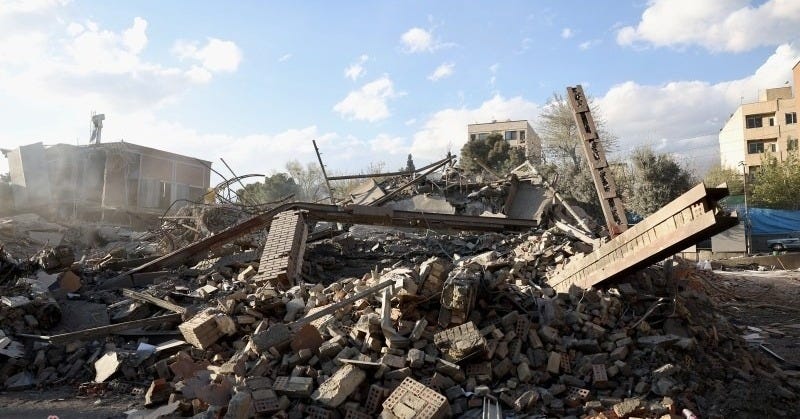
Now past the five-month mark, the US/Israel-Iran war has no end in sight, with some reasonable fear of escalation (Saudi Arabia has joined in, and Red Sea traffic has been targeted). A July Reuters survey found that 79% of people in the US believe the war will last for the foreseeable future. And the war is mostly at a standstill with neither side making a strategic military breakthrough, and diplomatic talks failing repeatedly. What was supposed to be a rapid assertion of US power has instead become a costly war of attrition—and an increasing political liability for Trump and MAGA.
Trump and Netanyahu started this war on the mistaken belief that a decapitation strike, taking out the leadership of Iran, would create favorable conditions for a rapid political takeover. If Hegseth hadn’t forced out a vast swath of the senior military leadership, perhaps he would have advised Trump against such a fool’s errand. Yes, Iran has been an official enemy of the US since 1979, but no other president was dumb enough to test Iran’s ability to block the Strait of Hormuz. And the Islamic Revolutionary Guard Corps, the main military/political force in Iran, has enough redundancy and decentralization to withstand leadership changes.
Now the conflict has become a war of depleting armaments and the resolve to withstand the damage being done. The US is rapidly running out of interceptor missiles—enough so that missiles are being pulled from other areas around the globe. Iran is also slowly running out of long-range missiles as well, although drones are cheap and easily replenished.
This war won’t be ended on the battlefield. Trump does not have the domestic support to launch a ground invasion, and bombardment and missile strikes have never won a war. All of the threats to destroy Iran will just cause more pain and suffering. So far over 2,000 Iranians have been killed, 26,000 have been wounded, and 3.2 million have been internally displaced. This is not enough to move a regime that just last year violently put down the latest surge of unrest and killed thousands of unarmed protesters in its streets.
For Trump and the MAGA forces, the suffering has been political. It is time-honored wisdom in the US: When gas prices go up, incumbents lose elections. But it is not just gas prices; the vast majority of the country do not support this war, and feel the US is being hurt by it. Naked imperialist intervention has clearly become a constitutive element of Trump’s governing agenda, despite his former bogus claims to isolationism. This has angered a section of the MAGA base, presenting opportunities to split and erode support for the Trump regime.
With the mid-terms in less than 100 days, Trump’s choices are narrowing quickly. Perhaps the only way out is to accept Iranian demands—giving up any dream of US control of the Strait, dropping demands to curb Iran’s nuclear activity or dismantle its ICBMs—call it a victory, and pull US forces back from the Gulf. Barring that, the elections may be a disaster for the MAGA leadership.
The broad anti-war front in the US has struggled to gain momentum. There has not been enough time or focus to build broad anti-war movements at the base. Movements take time to build, and we are in a period where many other important fightback initiatives compete for attention.
The antiwar strategy initially focused on pushing for a war powers resolution to reassert Congressional authority. In June, the passage of a war powers resolution by both chambers of Congress marked a historic breakthrough—the first such congressional rebuke of an ongoing war under the War Powers Act—even if the non-binding resolution did not by itself force Trump to end the war. The next fight, which is happening right now and for the next few months, is to block funding for the war. And unprecedentedly, anti-war Democrats, centrist DNC leadership, and anti-war Republicans have been solidly united into a real bloc.
While no one can be sure exactly how the war will end, it has accelerated the decline of US hegemonic power in the region. The Gulf states, seeing that the US has broken the compact to be their protector, are beginning to look to an independent future of common defense and to the possibility of working with multiple great powers—China in particular. Whatever the precise terms of a settlement, Iran and the Gulf states may increasingly take responsibility for negotiating the security and operation of the Strait themselves. The US will have lost a large amount of international standing, and there may be a cascading effect of other allies planning for an independent future to protect their interests.
While Trump and Netanyahu tried to use “regime change” to justify this unjustifiable war, the Iranian regime is more powerful than it was before. Domestically, the Iranian regime has used the war as an excuse to ramp up internal repression, months after the massacres of January, and continues to execute political prisoners. Internationally, it has expanded its geopolitical power now that it has managed to survive the US and Israeli intervention and won newfound control over the Strait of Hormuz.
There are recent reports of Iranian officials and propagandists now putting forward something of a “rebrand” for the regime, and even for instance welcoming unveiled women to join pro-regime rallies. This might signal the increased power of the Revolutionary Guard relative to the clerical establishment. Under their influence, the Islamic Republic might evolve into something less overtly theocratic but no more democratic—a military-dominated authoritarian state that relaxes some religious restrictions while using nationalism and resistance to US and Israeli power to legitimate continued domestic repression.
What should the left in this country be doing? We should work to turn Trump’s failed war into a political defeat for MAGA: keep pressure on Congress, ensure that the anti-war bloc stays united, and work to erode whatever dwindling support the war has at the base. We can ensure that the war becomes a kitchen table issue in the midterms. We also need to tamp down and challenge anti-Muslim/Iranian/Arab bigotry and stand in solidarity with Iranian-Americans facing threat of deportation for anti-war activism.
We can follow Iranian-American voices on the left, including groups like Iranian-Americans for Peace and Democracy. We have to simultaneously oppose the war and demonstrate solidarity with the forces inside Iran seeking to challenge the regime and win a genuine democratic republic. Finally, if the war ramps up, we should be prepared to pursue mass mobilization focused on ending the war, to an extent not yet accomplished during this conflict.