

By Jerry Harris
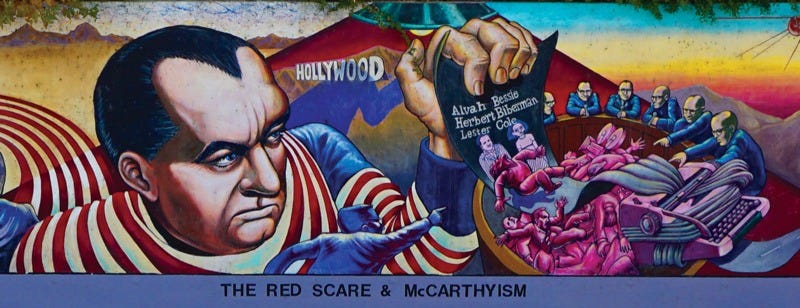
We are experiencing the most sustained and broad attacks on democracy since the McCarthy period. MAGA has put together a fascist coalition of white supremacist, reactionary nationalists, Christian fundamentalists, libertarians, and techno authoritarians, and they are on an offensive against the 20th century. All the gains of labor, civil rights, women, and the LGBTQ community are under assault in a blitzkrieg of attacks. The fascists intend to fundamentally restructure institutional democracy and to impose a straitjacket on civil society. This closely parallels the McCarthy period, and there are important similarities and differences between now and then, and lessons we can draw.
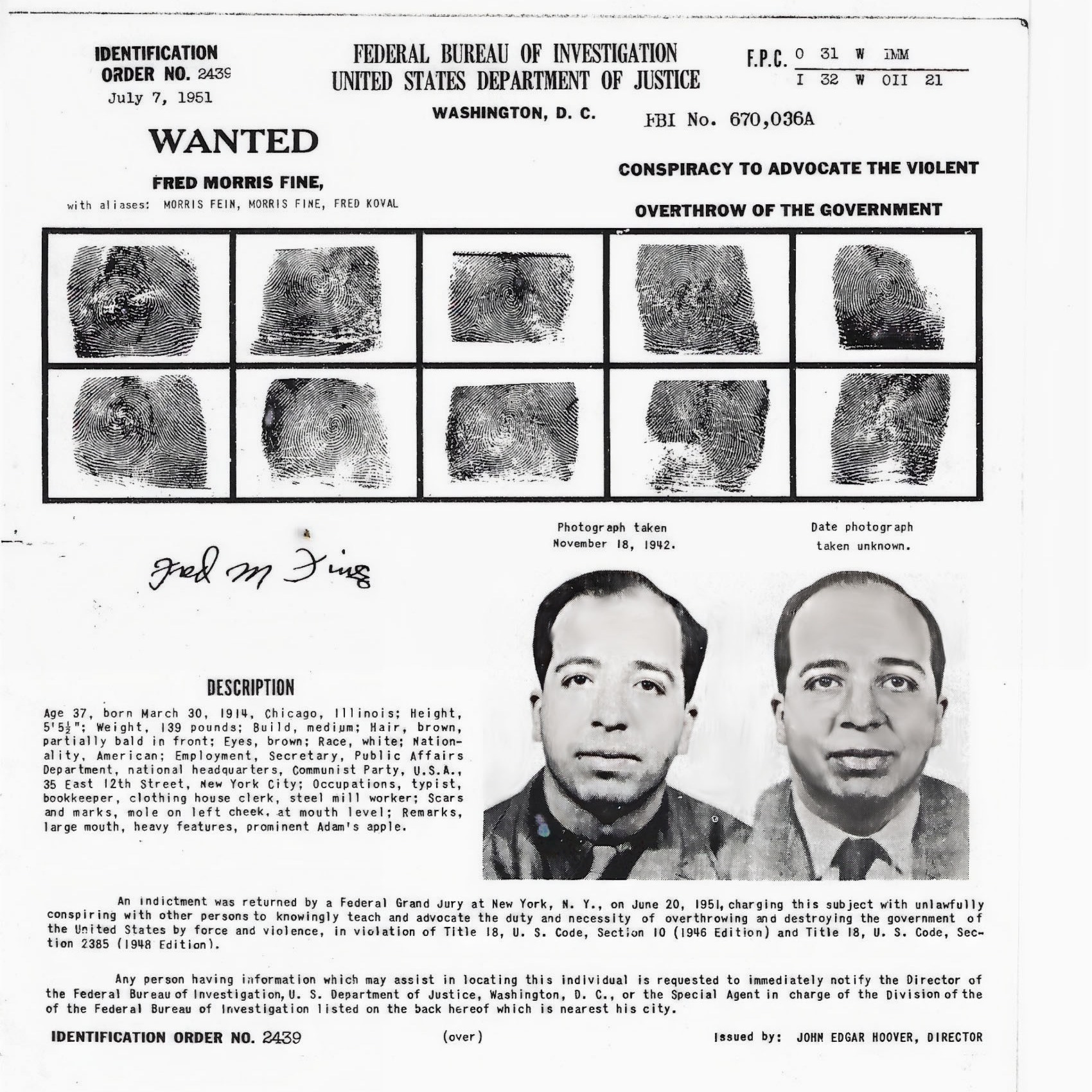
My uncle was on the leading committee of the Communist Party (CP) and closely involved in discussions about the underground, setting it up, and going into it for four years. During that time, he was on the FBI’s Ten Most Wanted List, and never once spoke with his wife or young son. My father, who had fought in the Spanish Civil War, was threatened with deportation. And the FBI threatened to declare my mother “unfit” and told her they would have her children (ages 6 and 11) put into foster homes without visitation rights. Thousands suffered similar threats and intimidation, key leaders were jailed, some cadre turned informants, and Ethel and Julius Rosenberg were executed.
When the Party leadership discussed how to respond to McCarthy, there were two key assumptions: fascism was imminent and war with the Soviet Union inevitable. The similarities to today are striking. Many people feel fascism is imminent and war with China inevitable. The CP drew a number of conclusions from these assumptions that had drastic consequences for its members and mass organizing.
First, they purged members they considered untrustworthy or politically weak. And perhaps more damagingly, the Party concluded repression would be worst in the South, and so shut down all its southern districts and withdrew its organizers after 25 years of outstanding work organizing the South. When my parents divorced, my mother left Chicago and went to Florida with my brother and me to join a close friend—a woman who had been a nurse in the Spanish Civil War, working with Norman Bethune. My mother was kicked out of the Party for moving to the South, and was only let back in when we moved to California. That didn’t stop the FBI from following her to Florida and getting her fired from several jobs.
My mother kept a journal of her time in Florida. Here is one short excerpt of her experience:
TODAY IS MY BIRTHDAY…35 years. Nobody knows except the FBI. My gift from them was once again being fired. This time from a job short lasted. But I truly enjoyed working as proof-reader on The St. Petersburg Times. Well, at least I was let go early in the day. So now I’m home with enough time to change into my waitress uniform. And time enough left to wait for Paulie to come home from school. Young Jerry is only 4 and Paulie 9. The best Birthday. We’ll be playing a few games of baseball before I take off for my night shift. There sits the limousine of the FBI. Another obstacle of fears, confusion of what the future holds. This is the time for courage and bold adventures. For it is now, I have come to understand, and someday so will my sons. Of that I’m confident. For my mother’s heart tells me so.
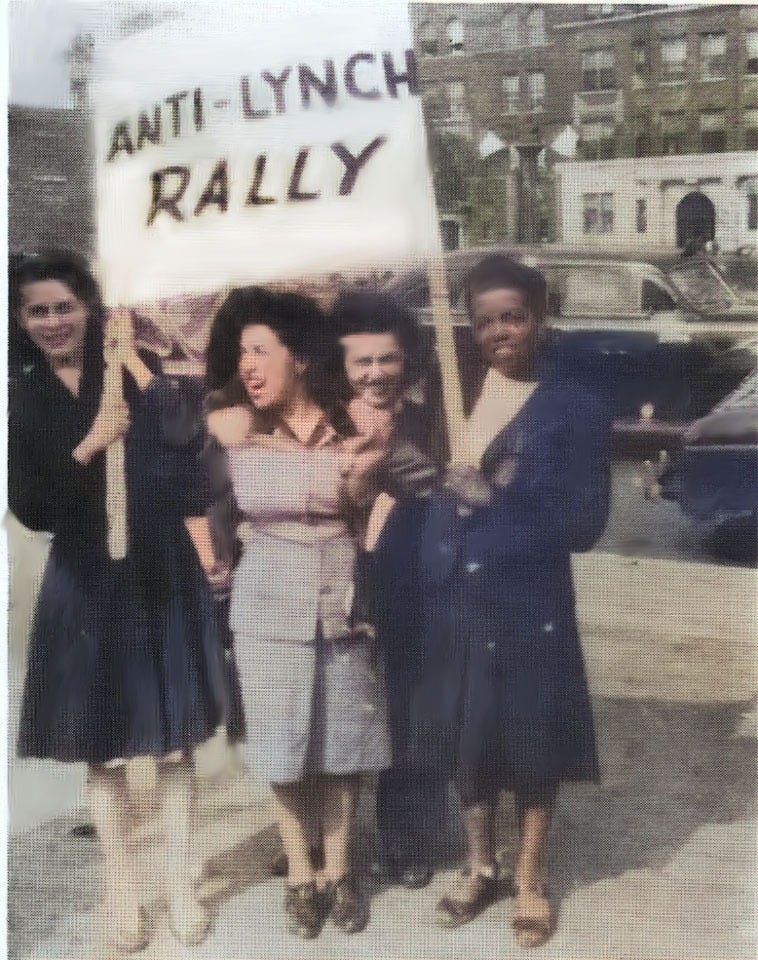
The Party went to great lengths to set up an underground apparatus. This had at least two levels: the most secure in which eight national leaders were sent into hiding, and a less secure state and city underground into which hundreds of local leaders were assigned. This eliminated many of the best organizers from doing mass work. Moreover, local underground networks were largely penetrated by the FBI. Even at my uncle’s level, four of the eight leaders were captured by the FBI. Although he had a number of close calls at different safe houses, he held out until the Party decided to come out of hiding and he eventually stood trial with several other leaders in New York.
When the Party’s first line of leadership (William Foster, Eugene Dennis, and others) went on trial, they tried to defend themselves by educating the jury about the true meaning of Marxism-Leninism. The result was prison time for all. On my uncle’s wanted poster (up in post offices throughout the country) was the following charge: “unlawfully conspiring with other persons to knowingly teach and advocate the duty and necessity of overthrowing and destroying the government of the United States by force and violence.” Of course, the Party never told members to arm themselves, they never organized armed cells, nor did they have plans for an armed insurrection. They did teach about the armed revolution in Russia, the history of capitalist violence, and the ultimate need to defend any socialist electoral victory from a reactionary counterrevolution.
By the time my uncle stood trial, the Party had switched its defense strategy to asserting the freedoms of speech, association, and assembly. There is a difference between speech and advocacy, and actively organizing acts of violence. This focus on civil liberties proved more successful with the courts. In 1957 the Supreme Court ruled that the First Amendment protected radical speech, overturning the conviction of 14 Communist Party officials and effectively ending the use of the Smith Act to target leftists for their political beliefs. A series of subsequent rulings forbade the use of blacklists and other methods of political persecution, which helped bring about the end of the Second Red Scare. However, the proceeding period of internal debates and bitter feelings resulted in about half the remaining members leaving the Party by 1957.
Lessons for Today
During the McCarthy period the ruling class was united in its efforts to destroy the left. From conservatives to liberals, Republican to Democrats, a united front was not possible. Even the ACLU purged Elizabeth Gurly Flynn from its board for being in the CP. Furthermore, social democratic union leaders like Walter Reuther were more than happy to rid labor of Communists. Loyalty oaths were demanded at universities, public schools, unions, Hollywood, and various industries. Public show trials were held by the House Un-American Activities Committee in cities across the country. Many former friends of the Party were running scared.
But while the persecution the Party faced was real, “the almost fatal blow,” as Party leader Peggy Dennis later wrote in her Autobiography of an American Communist, “was self-inflicted.” The decision to shutter its Southern districts and take the Party leadership underground anticipated a level of repression far greater than that which materialized. Designed to protect the Party from the advent of fascism and world war, it instead deprived mass struggles of thousands of their most militant organizers and activists, weakened the labor movement, cut off key linkages with the Black freedom struggle, and contributed to a decline of CPUSA membership from 80,000 in 1945 to less than 15,000 by 1957.
Today, conditions are in some important ways more favorable for us than during the McCarthy era. The ruling class is split. Already we see mass rallies and protests. AOC and Sanders, Hands Off, 50501, and May Day marches have already gathered millions in opposition to fascism. Courts have consistently ruled against Trump. A united front is not only possible, but is in early formation.
In this moment, many leftists are concerned about safety and security. Understandably. The harms caused by Trump’s repressive regime are real. But a key lesson from the McCarthy Era is that we must not let our fear of persecution isolate us from the masses and from mass movements. We can and must continue to organize, even as we take measures to help keep ourselves and each-other safe. The following are some suggestions for this period:
Stay rooted to mass work, defend our friends and allies, and ask them to defend us.
Defend the Bill of Rights, civil society, civil liberties, and civil rights for all.
Stay calm but be aware of security.
Make sure your financial records—particularly organizational finances—are in order.
Organizations should have a house counsel, and individuals should always keep the number of a lawyer with you.
Never write on social media or in email what you don’t want read back to you in court.
Vocally reject any illegal rhetoric at public meetings.
NEVER TALK TO THE FBI. Legally you don’t have to, but if you lie, you’re committing a federal crime. So, NEVER TALK TO THE FBI.
This is the time for courage and bold adventures. Collectively, our actions now will help determine what the future holds.
Jerry Harris is the national secretary of the Global Studies Association of North America, and on the international board of the Network for Critical Studies of Global Capitalism. His articles have often appeared in Race & Class (London), Science & Society (New York) and International Critical Thought (Beijing). His last book was Global Capitalism and the Crisis of Democracy. His work has been translated to Chinese, Spanish, Portuguese, German, Czech, and Slovak.
This is an extraordinary recounting of history and most importantly it is instructive to those of us who face is somewhat similar grow of vicious authoritarianism. I have said that the present attack on our already weakened democracy and the rule of MAGA / TRUMP is the worst threat to the constitution faced by this country in a century. Jerry Harris‘ telling of the history of McCarthyism would say that analysis is incorrect.
At this moment, none of us are on the 10 most wanted list . The number of firings are restricted mainly to universities, and the level of persecution is still mild by comparison. What is clear is that any and all of this can happen again and be much worse than it is now. This well crafted article gives us an idea what it would look like and feel like has the basis for fascism is strengthened.
Jerry’s article makes me wonder if the use of the word fascism at this moment is counterproductive to keeping together a united front for the preservation of bourgeois democracy.
The term may over, emphasize the existing political reality leading us to make mistakes as Jerry has pointed out.
The most wonderful, insightful part of the article that can be applied, comes at the end with the recommendations of how to protect the movement and its organizations. The destruction of the 80,000 strong Communist Party and the loss of almost 5/6 of its membership was a devastating loss to the labor movement , the black liberation movement and a cadre of community organizers who were both disciplined and educated in collective struggle. As part of the New Left, I criticized the CP for its tailing of the Democratic party, but failed to appreciate the extraordinary deep roots in the class struggle and trauma of sacrifice in confronting McCarthyism.
It behoove us to read Jerry‘s recommendations and a train each other, to neither overemphasizing nor diminishing the threat that we face at this moment. We are well served to encourage each other to draw lessons from our historic involvement and a popularized our messaging and tactics connected to a collective strategy.
We cannot afford to let the authoritarians dismantle the voting rights of millions of voters, especially communities of color who are suffering the worst disenfranchisement (Follow Greg Palast’s exposes about the depth of voter corruption that continues to hand the minority party false victories).
Bravo Jerry Harris!
This was great reading, Jerry! Thank you. The story of your family’s history is fascinating, and I’m trying to imagine what it was like for you. You tell some history of the CP’s line and practice that I wasn’t aware of. In the CP’s defense, it’s really hard to analyze and make predictions about history when you’re right in the middle of it. Can we do better? It’s sobering.
Your lessons for today make sense, though I need to think about them a bunch more.
My uncle John had to testify at HUAC. He had traveled in China in the 1930s, and in the 1950s was teaching Chinese at Johns Hopkins University. He defended his boss, Owen Lattimore, and refused to rat on any friends. In 1954 he was fired and blacklisted, and couldn’t get another teaching job until 1966.
Was Uncle John in the CP? I’ll never know. My mother told me – disapprovingly – that in the 1940s he would buy a Daily Worker from a news stand and fold it inside a New York Times. Then when he was done reading it, he would throw it out in a public trashcan, not his own.
The McCarthy era had a desired effect on Uncle John. It silenced him. As far as I know, he was never active politically again. This meant that those of us who came of age politically in the 1960s were deprived of the mentorship and comradeship of a lot of people like him, and it impeded our political development. And there was that whole “don’t trust anybody over 30” nonsense, which was so destructive and stunting.
Around the year 2000 my husband Howard and I went to visit Uncle John, who by that time was a respected professor emeritus and had already outlived most of his persecutors. We told him how much we would like to learn more about his history and what had happened to him. But even though he knew what our politics were, he refused. It was very frustrating and it saddened me.