

by Michelle Foy
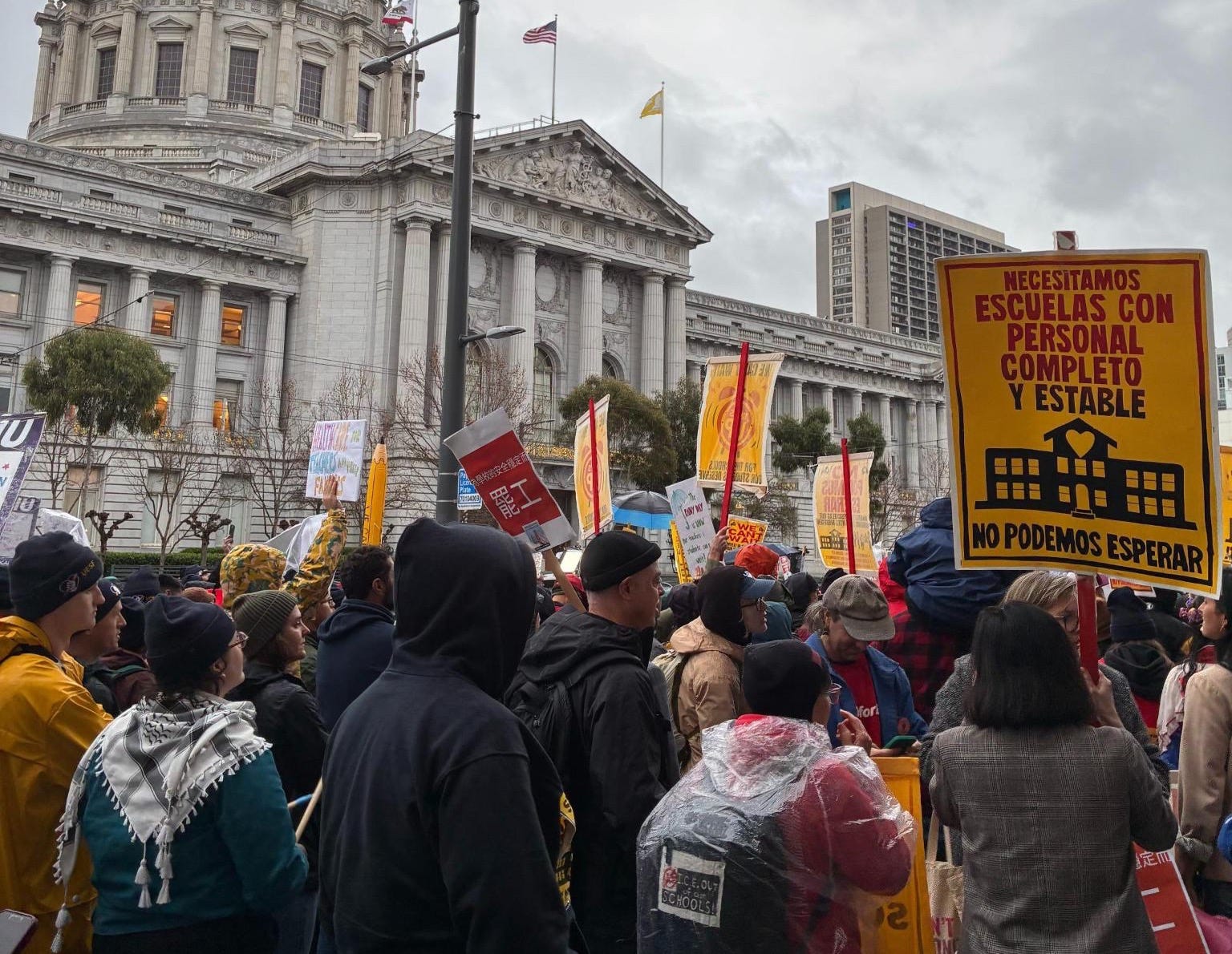
On Thursday, February 12, the United Educators of San Francisco (UESF), representing 6,500 teachers, paraeducators, counselors, nurses, and school psychologists, declared victory after a four-day strike, the first one in 47 years.
After 11 months of bargaining, the union not only won important economic demands, including wage increases and fully funded health care. It also won demands for “the common good,” which helped to mobilize parents, students, city officials, small businesses, and community members across the city and beyond. The new contract includes sanctuary protections for students and educators, by :
Formally designating school campuses as sanctuary spaces.
Prohibiting cooperation with ICE without a criminal judicial warrant.
Requiring sanctuary policy training for all staff.
Guaranteeing newcomer students and families access to legal, housing, health, employment, and food security resources.
Limiting immigration status inquiries to what is strictly required by law.
UESF also won an extension of the “Stay Over Program” which allows unhoused families to stay overnight at school campuses throughout the city.
In addition, the union negotiated protections from the effects of artificial intelligence. The district is prohibited from using AI to replace union members or their work or to increase educator workloads; nor can it use AI for staff evaluations.
Solidarity made visible
The energy over the course of the four days the union was on strike was contagious and affected everyone. You couldn’t go anywhere in the city without hearing the singing, music, drumming, and noise on the picket lines—including from all the commuters, bus drivers, commercial truckers and others, continuously honking in support of the striking workers.
As a parent of a public school student, I saw and felt the solidarity—kids baking to feed and support their teachers and administrators on the picket lines; community groups organizing alternative childcare programs for the younger kids at urban farms and gardens; artists screenprinting signs and t-shirts at community print shops, and all the usual support for people on strike coming from members of other unions, as well as nonunion staff at schools, parents, and workers throughout the city.
The union’s organizing power inspired political activism by many students in the city. Just a few weeks earlier, students had organized a joyful school walkout, in defense of immigrants and in solidarity with the people of Minneapolis and all those impacted by ICE terror across the country. Now, students showed solidarity with the striking educators. My 17-year-old son’s school, the only public arts high school in the city, was particularly ebullient, with the school’s drummers and dancers taking over the street, sidewalks, and medians. Children and their parents brought their own handmade signs and banners to picket lines at over 100 schools, adding to the joyful feel.
Collective power forces the district to prioritize students and educators
From what I could see, the union leadership and members were unified (97.6% had voted yes to authorizing a strike) and incredibly resilient through what was clearly a very frustrating process with the Superintendent and Board of Education. Adding to the frustration was a millionaire mayor (not just one or two but hundreds of millions of dollars from the Levi fortune) who has little understanding and even less interest in how the issues leading to the strike impact governance in a state where public education has been eviscerated by austerity, privatization, and disinvestment, as well as ongoing attacks on the Ethnic Studies curriculum.
In a historic act of solidarity, the city’s two other school unions joined the picket lines in sympathy strikes: SEIU 1021, representing some of the district’s lowest-paid workers, including 1,000 custodians, food service workers, and clerks, as well as the union representing 250 principals and supervisors. The solidarity strike ensured a total work stoppage, forcing the closure of all San Francisco public schools. Meanwhile, the school district unnecessarily spent funds to get part-time contractors, including some paraeducators and noon-monitors, to cross the picket line into empty schools—and face the shouts of “scab” from the strike supporters.
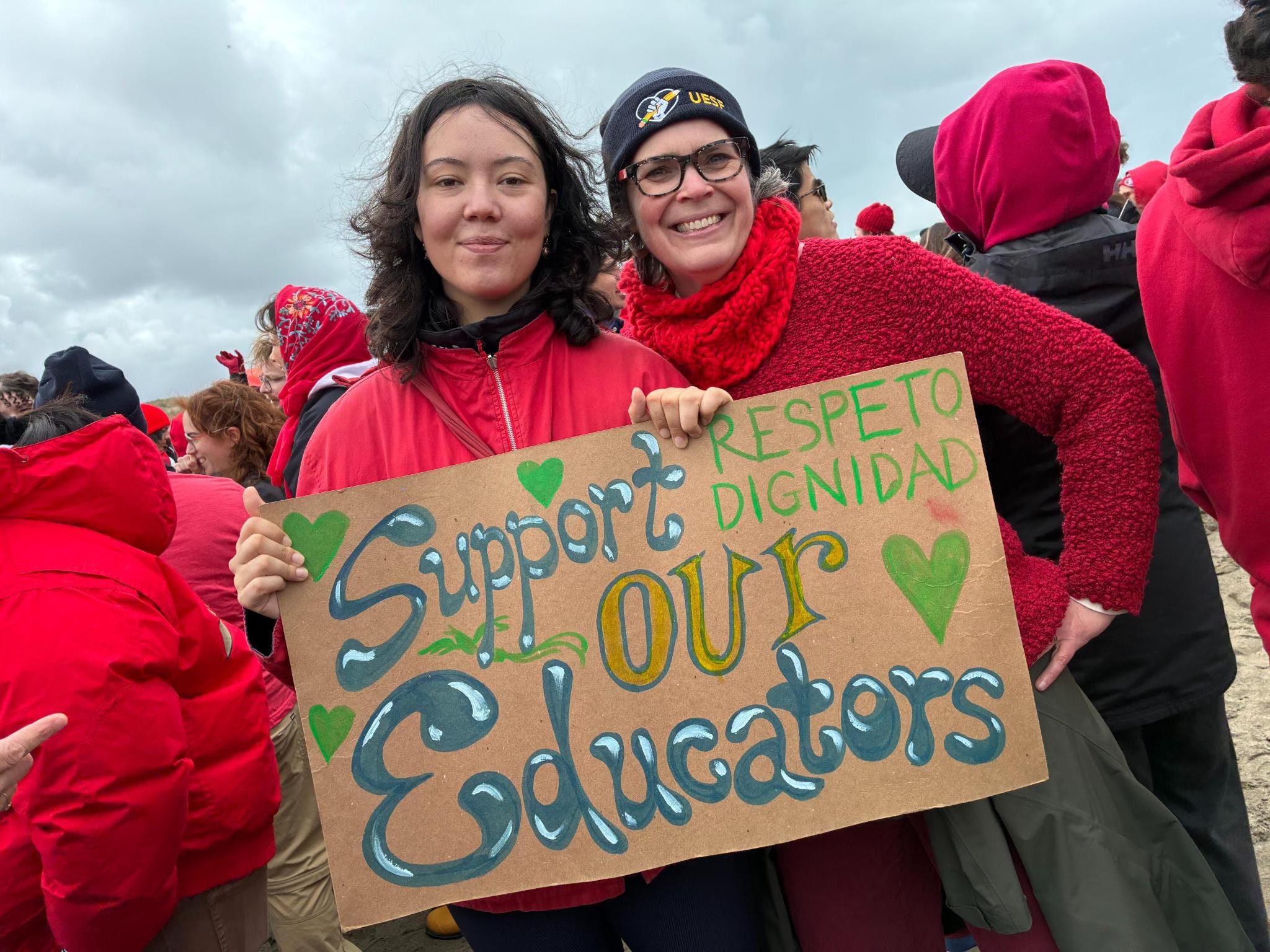
After joining a few morning pickets throughout the week, I took a mid-day work break on Wednesday, day three of the strike. I rode my bike to join the human banner at Ocean Beach, standing with striking educators from my kid’s old middle school. (These human banners are becoming more and more common here in SF—recent ones include “NO KINGS, YES ON PROP 50,” “ABOLISH ICE,” and “IT WAS MURDER: ICE OUT.”)
The next day, Thursday, February 12, UESF announced a tentative two-year agreement covering 100% employer paid family health care benefits, special education workloads, improved wages, and sanctuary and housing protections for families in the district’s schools.
It was inspiring as a parent to see how the union’s broad and deep organizing, for public education and for the common good, led to victories for educators, students, immigrant families, and community members–the city as a whole. In UESF's words:
This historic strike built an unbreakable solidarity across our city, among families, students, educators and community…At a time when there are ongoing attacks on our profession and our communities, we stood strong in the face of adversity because our students deserve sanctuary schools, shelter in times of crisis, and classrooms staffed with trusted and committed educators who can stay.
Here’s to worker power and organizing for the common good that gets the goods!
Michelle Foy is a parent, member of Liberation Road, and through her day job and other organizational hats, is deeply involved in movement operations work to support power building for working class communities of color in California and beyond.
Educators have real power and leverage in our hollowed out neoliberal societies. This is great!
As a former member of one of the predecessor unions of UESF (AFT #61) I want to thanks you for this very good and timely article. Two additions: 1. By signing a 2 year contract, UESF has effectively lined up their contract to expire in 2028 as requested by UAW Pres. Sean Fain and Mayday Strong coalition. This is a big deal and if the rest of the alliance of teacher unions in CA (LA, Oakland, Richmond and others) do the same it could have a real impact on building working class power. 2. The article does not mention that the SFUSD Trustees immediately responded to the settlement by announcing layoffs (well before the legal deadline) so as to make it look like it was the teachers' fault with the strike. How the union is dealing with this should have been part of the article.
In solidarity,
Joe Berry