


Our history is many-sided. From North America’s earliest days–from the 1619 selling of slaves in Virginia, or the 1620 landing of Europeans at Plymouth Bay occupying Native homes vacated earlier by European disease, or the 1570s French fur trade setting tribe against tribe in Quebec, or the slave revolts of the late 1700s in Haiti, the purging of the Tuscarora from the Carolinas, or the 1680 Pueblo revolt in New Mexico—all of these had an impact in shaping what would become ‘USAmerica.’ The oppressed and the exploited rose in rebellion against the ruling blocs of their oppressors and exploiters. Sometimes they fought alone; other times, they formed blocs with others. Most of the time, they lost; but in a few cases, they won. Sometimes their victories lasted only for a short time, but in a few others, they lasted longer. But there was never a time when Turtle Island wasn’t contested terrain.
Why do we need a new national narrative? First, we need the tools to fight the GOP’s current efforts to rewrite history once again. Much anti-white supremacist history in our schools is under attack today in over 20 state governments, largely in the Old Confederacy but reaching outward as well. Second, we need to make a new and more accurate consciousness of ourselves, our past, and our future. The ‘1619 Project,’ organized and primarily written by Nikole Hannah-Jones for the New York Times, redated our beginnings as an American people from that year. She was widely scolded for not using 1776. But her date is as good as any and better than most. (One wonders if she would have met with the same resistance had she picked one year later, 1620).
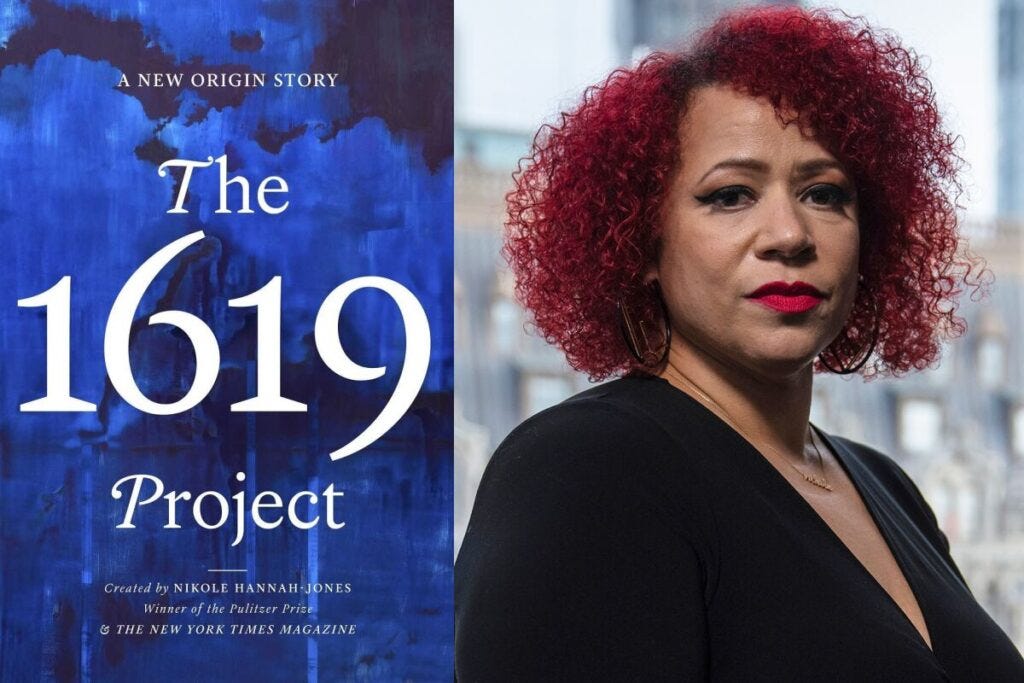
But the main point many of her critics opposed was her bringing to the surface a little-known fact. For some Anglo-Americans fighting for Independence, mainly Southern ‘planters,’ their main concern was defending slavery. (I put ‘planters’ in scare quotes because the enslaved did nearly all the planting). Since slavery had been outlawed in Great Britain proper (but not yet in its colonies), a victory for the British, they feared, might mean the spread of abolition to its American colonies, as it had in Canada. We can argue over the degree to which various actors had these mixed motives, but not that they were nonexistent.
What can’t be disputed is that tens of thousands of enslaved Africans joined the contending blocs of both sides in this conflict. Those are matters of fact. Nor can it be disputed that of the Loyalist Bloc (about 20 percent of the English colonists), some 60,000 headed for Canada when they saw British defeat coming, if not before–and that many Africans, enslaved and free, escaped with them.
Likewise, among the Native peoples, the Haudenosaunee (or ‘Iroquois,’ a derogatory French term) sided with the Americans. But many others, such as the Shawnee, sided with the British. In both cases, the Africans and the Native peoples were gambling on how best to defend their interests against the new and expanding settler-colonial slave republic. In the case of the bloc of the Shawnee and their allies under Tecumseh, they waged battles for a common Red homeland in the early Northwest Territory. These efforts continued beyond the 1789 Constitutional Founding until the War of 1812 when Tecumseh was finally defeated and killed in 1814 in Canada.
The ‘settler-colonial slave republic’ of the USA, with this linked chain of descriptors, is obviously conflicted as a political entity. Early in 1780, Thomas Jefferson named it an ‘Empire of Liberty,’ envisioning its expansion to the Mississippi River and even absorbing Canada. However, he was taken aback and fearful of the 1803 Haitian Revolution. He worried that it might spread, via New Orleans, then owned by France, to the slaves of the South. After the ‘Whiskey Rebellion’ in Western PA, he worried about efforts to form a breakaway ‘Western Mississippi Republic’ (Aaron Burr was involved in such a plot). It’s why Jefferson sought and obtained the Louisiana Purchase from Napoleon in 1803, who desperately needed cash for other projects, especially fighting Spain.
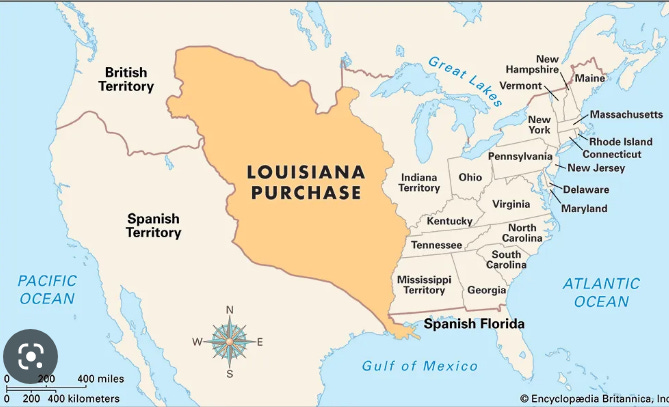
At one master stroke, Jefferson had doubled the territorial claims of the new nation to all lands drained by the Mississippi and Missouri Rivers, reaching to the ‘Stoney Mountains,’ as he called them. The 1804-1806 Lewis and Clark Expedition–part scientific, part military—surveyed the various peoples who lived in the vast region, taking stock of their military abilities and other resources. Jefferson was rather explicit that the Natives must be displaced or confined. Given their hegemony in various homelands, the only question was how it might be done.
Despite their grandiose claims to vast swaths of territory, Europeans controlled only a few dozen port cities or river villages with a few hundred troops. Faced with Tecumseh’s rising in 1812, Jefferson arrogantly told John Adams, “These will relapse into barbarism and misery, lose numbers by war and want, and we shall be obliged to drive them, with the beasts of the forest into the Stony mountains.”
The Empire of Liberty Expands
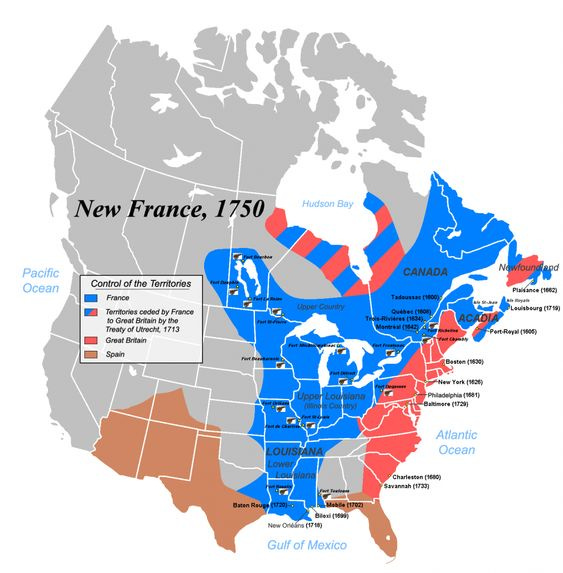
The expanse of the ‘Empire of Liberty’ was loosely defined by Jefferson. He never quite grasped what was on the other side of the Rockies and had relatively flexible ideas about this side. In 1804, he said: “I confess I look to this duplication of area for the extending of a government so free and economical as ours, as a great achievement to the mass of happiness which is to ensue…. Whether we remain in one confederacy, or form Atlantic and Mississippi confederacies, I believe not very important to the happiness of either part.” In 1809, he sent a note to James Madison: “…We should then have only to include the North [Canada] in our confederacy…and we should have such an empire for liberty as she has never surveyed since the creation: & I am persuaded no constitution was ever before so well calculated as ours for extensive empire & self government.”
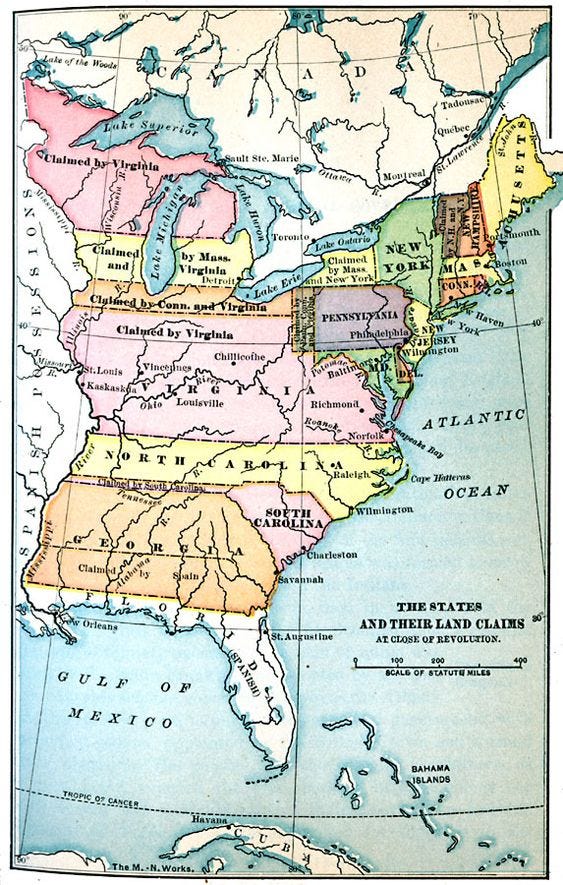
Jefferson’s close assistant in arranging the Louisiana Purchase was James Monroe, who later, in 1816, became the 5th President of the U.S. Monroe first served as a diplomat in Europe, and initially supported the French Revolution. He was also a slaveholder known for treating his slaves harshly and often selling them to clear his debts. He directly felt the impact of ‘Gabriel’s Rebellion’ in 1800 in and around Richmond, VA. When it was suppressed, he saw to it that Gabriel and 25 other rebel enslaved people were hanged. Despite this, he often claimed to oppose slavery as an economic trap imposed on the country by Great Britain in the colonial period. Near his death, he wished he and other enslavers could send the enslaved back to Africa after being compensated for their loss by the federal treasury. But he never did anything to oppose slavery’s persistence, save for helping to initially draft the Northwest Ordinance, which excluded slavery in the Northwest Territory, and reluctantly signing the Missouri Compromise, which, except for Missouri, banned slavery above 36′ 30″ latitude.
Monroe was said to have had two great political fears. One was a class insurrection of the poor laborers, which he witnessed in the ‘excesses’ of the French Revolution. The other was a racial and servile insurrection, which he saw in Richmond and through his knowledge of the Haitian revolution. At the same time, in a conflicted consciousness, he held the wars for independence (and slave abolition) across Spanish America, primarily led by Simon Bolivar, in a favorable light.
Monroe Expands the ‘Empire of Liberty‘
Monroe was most interested in opportunistically taking advantage of Spain’s difficulties to seize Spanish Florida. He sent Andrew Jackson to take most of it militarily, waging war with the Seminoles, who were joined by the escaped slaves who lived with them, and with Spanish troops. Spain finally gave up all of Florida in a treaty, which they hoped giving up the East would better define and secure the western border of New Spain in Mexico and the Southwest.
Carl Davidson is a former student leader of the New Left of the 1960s, serving as a Vice President and National Secretary of Students for a Democratic Society. From 1968 to 1976, he worked on the Guardian newsweekly as a writer and news editor. He continues to write prolifically.